Speaking Our Truth: A Tapestry of Faith
Opening Words

Faith of the larger liberty –
Faith for the people everywhere, whatever their oppression –

This majestic old hymn tune, #287 in our hymnal, has had many lyrics set to it over the years, and these words were written by Vincent Silliman, a UU minister, in 1944.

One way to think of the larger liberty is to look at the foundations of our own country. Our constitution begins: “We the people.” Our bill of rights states that we, the people, have freedom of religion, freedom of speech and the press, and freedom to assemble and to ask for redress of grievances.

Faith of the free! Whate’er our plight,
thy law, thy liberty, thy light
Shall be our blest possession

In so many ways, our country was founded on the principle of the people speaking out. This song, “The Great Correction” speaks about the foundering of some of America’s cherished dreams.

The Great Correction by Eliza Gilkyson

Whole lotta people tryin’ to turn it around
Gonna shout ‘til the walls come tumblin’ down
And the great correction comes

Our UU tradition calls us to promote justice, to search for truth and meaning, and to use our conscience and the democratic process.

In this month of focusing together on Prophecy, we’ve heard the questions: Which truths are you willing to speak? Which truths are you willing to hear? But as many of us have experienced, truth is often unpopular.

Pete Santucci says, “The Prophetic role is such a tough one…It’s annoying and unsettling. It points out hypocrisy and the intentional self-deception we engage in. Who wants that?”

Cornel West puts it more bluntly. “A leader is somebody who has to jump in the middle of the fray and be prudential, we hope, rather than opportunistic. But a prophetic person tells the truth, exposes lies, bears witness and then, usually, is pushed to the margins or shot dead.”

Societal sanctions, and peer pressure, have taught many of us to keep our mouths shut rather than voice the truths of our conscience.

Last week, Rev Kevin invited us to build our truth telling and truth hearing capacity by first speaking truth about ourselves, then listening to truths we don’t see, when they are told to us.

Today, in this Tapestry of Faith service, three of our members share their stories of listening to their own truth, and the truths of others, and then speaking out to those who were willing to receive.

Gail Johnson Vaughan will talk first about finding and speaking her truth as an advocate. Then Frank Lawrence will talk about confronting management about wages. Finally, Karyn Packard will talk about speaking up to administration about budget cuts.

Gail Johnson Vaughan

I have a clear memory, now 47 years old, of telling my cousin that I believed that if anyone, anywhere, whether I knew them or not, did not like me, I would cease to exist and diffuse into the universe.

20 years later I found myself showing up, and speaking up, on behalf of children languishing in foster care. Lots of people, right in front of me, did not like me because of what I believed and said. I threatened the status quo, what I suggested seemed impossible to them; it couldn’t be possible, because if it were they would have already been doing it.

12-year old Libby had a lot to do with this change in me. Libby was in my son’s 6th grade class where I volunteered each week. When she found out I worked in adoption she cornered me at recess, told me she’d been in foster care for six years, been in four families, and left behind when her two brothers and sister were adopted by a family that did not take her. She wanted a family, she told me – would I help her?

I explained that most people thought that kids her age were too old to find adoptive families, but I would try. She told me the name of her county and of her worker and left with a wisp of hope on her face.

It took me three weeks to get through to her worker. “I met Libby,” I told her. “If I found her a family could she be placed for adoption?”  The answer came quickly, “No, she’s unadoptable.” I sucked in my breath of disbelief and tried again. “I mean, if I found a family that wanted her and had the skills to meet her special needs, is there any reason why she couldn’t be adopted?”  “You don’t understand,” she replied, “she’s unadoptable.”

It took me no time to identify the right family for Libby, but it took me five months to get permission from the county to place her. When the big day arrived, she and her new family stopped by my office. Libby brought me flowers and a balloon that said “Thank You.”  She said, “If it hadn’t been for you this wouldn’t have happened.”

“If it hadn’t been for me…” That struck a deep chord in me, and my career as an advocate began. As I pushed forward with as much grace as I could muster, many of the county’s child welfare staff pushed back. When ultimately we had to play hardball and go to the board of supervisors, the adoptions unit showed me who had the power – they boycotted our agency. For three years we got not one referral.

I could go on and on about how that formerly skittish, needing-to-be-liked young woman worked for decades confronting the powers that be, and amazingly influencing sweeping policy and practice changes that have resulted in permanent families for thousands of children in California and beyond, but the power of bureaucracy, and the political system are wimpy compared to the Goliath that still shows up in my life today. That Goliath lives inside of me, masquerades as me, threatens to annihilate me if I question its authority.

Goliath – or actually, a long time ago I named her Maud – served as the internal guardian of my little girl survival strategies. She’s the one that taught me that I’d better hide my true self so everyone would like me, especially mommy and daddy, or the kids in the new schools when we moved every 2 years, or the teachers, or anyone, anywhere.

I got pretty good at following Maud’s advice, guessing who people in my life wanted me to be and being it. But the mask got heavy and it didn’t work so well as a young woman moving into marriage. I did a great job convincing the 1st husband, and the 2nd, that I was exactly the woman they wanted… but after a couple of years the real me got tired of hiding behind Maud, contorting myself to fit into the required disguise.

It took a lot of work, a lot of tears, a lot of courage to begin to speak my truth louder than Maud. I was often terrified. I remember having my first truly genuine conversation with my 2nd husband. The only way I could do it was to sit back-to-back 4 feet apart, so I could say what I really thought without seeing the reaction on his face. It was a long journey, but over time I could stand up to Maud and tell her that she had no power. I thanked her for helping me when I was little, but I didn’t need her anymore.

When I met John, my real husband, he was recently widowed, and perhaps even worse, had survived the death of his 19-year old daughter, killed in an accident involving a drunk driver. I was drawn to him, but knew I couldn’t do the old unconscious bait and switch – being who I knew he wanted and then revealing, later, the true and unacceptable me. I had to be kind to his heart. I took the risk and showed him who I really was. He loved me, not Maud. And if he hadn’t, that would have been okay because at last, I loved me too.

Pema Chodron says: the point is not to change ourselves, the point is to make friends with who we already are. I recommend it.

Frank Lawrence

When Annie and Gail asked me to speak today, I first thought about a college experience. I was an Editor at City on a Hill, the U.C. Santa Cruz newspaper. A Women’s Studies professor was up for tenure.  She was an outspoken progressive and an out lesbian. Both the internal and external review committees unanimously recommended tenure. The Chancellor denied tenure. The campus erupted, and we wrote a series of scathing articles and editorials. One night at the paper’s office, I got a call – “Frank, the Chancellor’s wife is on the phone for you!” Every phone extension in the office was muted and lifted, and I picked up. She cussed me out at full volume. I managed to stay calm enough to ask if we were on the record…  We were not…  The newspaper staff dinner at the Chancellor’s house was pretty interesting later that year.

Reflecting on that incident, it seems to me that I was not really speaking truth to power. She did not have power in that situation. We ran the newspaper with no financial support from the University. More to the point, she had done nothing substantively unjust – it was her husband who had denied tenure.

Then I remembered a time when I worked as a reporter for the People’s World, the Communist Party’s weekly newspaper. Conn Hallinan, of the famous SF progressive Hallinan family, hired me. The staff included Pele De Lappe, an artist and writer who had befriended Frieda Kahlo and Diego Rivera during their time in the Bay Area. Billy Allen had spent half a century reporting on the labor movement. In 1936 he covered the Flint, Michigan sit-down strike from the inside, sneaking past GM’s armed goons in the middle of the night, manual typewriter under his arm – the same typewriter he was still using in 1985 – again and again. He’d walk to a pay phone, read his story to his editor, then turn around and do it all over again for the duration of the month-and-a-half occupation of Fisher Body Plant #1. So the People’s World was staffed with wonderful folks whom I respected greatly.

I covered major strikes by the California Nurses Association and SEIU. Billy took me to interview Harry Bridges, the key organizer of the Longshoremen’s’ Union in SF (as I mentioned last week, a Bridges’ speaking tour in the early 1940s brought my father into a Unitarian Church for the first time). The People’s World was a pretty good gig.

There was only one problem: they paid me about half of the minimum wage. The hypocrisy of the situation gnawed at me. I turned it over in my mind for a long time. I knew I was a 25-year-old, privileged, white, college graduate, with no family to support. I knew the paper didn’t have much money. I had a lot of respect for the staff and their many decades of struggle. More selfishly, I was afraid that if I raised the issue I’d be shown the door.

But I could not shake my disquiet. Finally I found the courage to speak up at a staff meeting: an organization that advocated so passionately for workers’ rights should pay its own workers minimum wage. A few folks let me know that if I truly believed in “the cause” I would gladly accept the hardship of low pay. But I also earned respect from others for speaking up. I was not fired. Of course, I did not get a raise.

That experience has stayed with me. I still feel good about having spoken up. It reminds me again and again that we need to treat others fairly and with respect, not regardless of the “cause” but because of it. It reminds me that I’m good at imagining bad consequences, and that they almost never come to pass. It reminds me that I have the strength to speak up even when I’m afraid. And it reminds me that, even if I can’t remedy an injustice, when I do speak up, I change myself a little, by gaining courage and confidence to do the right thing.

Karyn Packard

I was born in 1945 just as the second World War was over. When my father came home, ‘tis said that he ran a “tight ship;” he had definite rules and regs. These are ideas that I internalized: Girls were to be “seen and not heard.”  They were to “do as they were told.”  Orders were to be obeyed! Girls were never to speak back to authority. I learned “to please” and “to comply.” I learned not to speak unless spoken to. In many ways, it actually served me well. As we moved from place to place (15 schools before finishing high school), there was an ever-changing array of “authority figures.” I pleased, complied, kept my mouth shut and worked hard. To the degree a child can succeed, in the eyes of my parents and my other authority figures, I was not a problem. I was predictably acquiescent. I learned to avoid conflict at all costs, to always take the subservient position, to always be willing to compromise. Those behaviors didn’t threaten anyone or upset anyone; people could count on me! I really did not see myself becoming anything other than a secretary, or a store clerk, a job that matched my perceived skills of service.

In the 80’s I cared for my mother, father and husband through their long illnesses and eventual deaths. During that time, I had to take over all of the decision-making. It was heady stuff for me to be in that position. I learned about medicine and how to navigate the system for their care. I was forced to take personal responsibility. I had to be their advocates when they couldn’t speak for themselves. After they all died, I was encouraged by my minister to train to be a hospital chaplain…to be ordained to the ministry. It was rigorous training and I was a good student. In that training, I began to be confronted on my acquiescence. I remember in my ordination service being told that I was now called to be “a prophet.” I knew in my heart that it would be my biggest challenge.

In 1992, I was hired to be the Director of Pastoral Care at Long Beach Memorial Medical Center and Miller Children’s Hospital. Once again, I was new, and didn’t have directorial experience. I went back to my tried and true role. I learned to please, to comply, to care for others and put my own needs and ideas on the shelf. I carried three pagers, 24 hours a day. I didn’t want any needs to go unaddressed. You guessed it, I was very popular, albeit very tired. But I didn’t threaten anyone, didn’t upset anyone. I took care of others and they appreciated it. It was a meaningful work, and my job was secure. I was now a single mother and that was imperative for my son’s and my well-being.

But things began to change in the health care environment. Administration had supported my creating relaxation rooms for the staff, and we had taken them on retreats to teach them about self-care. They knew they were appreciated. However, I began to see things change. What had been a strong focus on patient care became more of a focus on the bottom line. Staffing was reduced to a place where I felt it was unsafe; I saw staff working through incredibly difficult situations with no time for self-care. I was having to scan every little box of tissues that I handed to family members at the bedside when we were discontinuing life support. It wasn’t right! We all knew it. What could I do to support them? I felt called to “speak up.” How would I do it? Where would I do it?

Speaking truth to power is not the same challenge for everyone. Each of us has to use our own unique gifts. What were mine? I looked inside to see just what came to me when I thought about these financial changes. It was the patient-care stories that had moved my heart. Perhaps they would move others. I used them in my sermons and in my pastoral care teaching. Maybe I could share them more broadly. Where was there a place that these stories could be shared with the fiscal decision-makers? Did I have the courage to ask for a voice at the table? The Chaplain’s role was carefully defined. But there was one place where our spheres overlapped…the monthly Operations Steering Committee. As a Director, I had a recently been given a place at the table. It was a dubious distinction. We met in a room for 1 hour a month to discuss “the budget.” I was at the table and heard the discussions. I seldom said anything, unless directly asked. I was not regularly presenting. Pastoral Care’s budget was hardly worth their attention.

I began to wonder if this executive grouping might possibly be the place for inspirational stories.  I believe that change comes when both hearts and minds can be impacted. Maybe I could bring out the “heart” in this “mind” environment. I knew we all were best when we integrated the two.

I had given invocations at various hospital occasions that were well received, so I asked if I might offer one at the beginning of the Operations Meeting. I knew most of them as we had interfaced after a recent shooting at the hospital. Everyone had been impacted in a different way to this incredible tragedy. I was given permission to try. I began gathering stories about our wonderful hospital staff and their work with patients and families, focusing on stories of unselfishness, kindness and commitment to the institution. I wanted these folks who were focused on finance to remember why we were all there. Everyone from the cooks to the CFO wanted to help people. From my perspective, this was about discovering shared values. It worked in patient rooms and so I hoped it would have an impact in this setting.

At the next Operations Meeting, I was hopeful when I noticed that no one arrived late for the meeting. They didn’t want to miss it. After the invocation, there were tears and a natural silence in the room. They told me that it reminded them of why they had gone into healthcare in the first place. They asked me to bring copies and they took them home and shared them with their families and friends. They never ran out of financial crisis, and I never ran out of stories. We were all in agreement that it was a wonderful hospital system with outstanding employees. We did good work. Yes, they still chiseled away at the budget. I can’t tell you that we saved a lot of money or a lot of minds. But I was heartened that they were consistently reminded that excellent care takes time, talent, and resources, and that real care is not always “cost effective.”
Oh, We Give Thanks!

Note: Rather than a traditional sermon, this service offered a feast of pieces calling us to awareness and gratitude. Here are links to most of those pieces.

Gathering Song #21 For the Beauty of the Earth

Opening Words    What Song? by Victoria Safford

http://archive.uuworld.org/2003/03/calltoworship.html

Opening Hymn    #1010 Oh, We Give Thanks

Story     Thankful Dogs by Naomi King

http://www.uua.org/worship/words/story/151529.shtml

A Thanksgiving Feast (An Introduction by Rev. Kevin Tarsa)

Rather than a sermon, this morning we’ll continue to set a table of readings, music, reflection, images, movement, and sharing, and invite you to partake of this meal family style, which is to say take and taste what you will, what you need, what will nourish you, and simply pass on the rest.

I will name for us all that we already know that gratitude is good for us, and that expressing gratitude is good for us and for the recipients of that gratitude. Gratitude strengthens our spiritual health, our emotional health, and our physical health. It is a virtue prized in our tradition.

In fact, Rev. Galen Gingrich claims that gratitude ought to be our defining religious discipline, as Unitarian Universalists, rooted in a transcendent experience of awe and an awareness of “how utterly dependent we are on the people and world around us for everything that matters. From this flows an ethic of gratitude, …an obligation to nurture the world that nurtures us in return.”

It’s difficult to force a feeling of genuine gratitude, however we can cultivate a sense of gratitude. We can take on spiritual practices that bring our attention to what we have in life, and we can cultivate practices that help us move from feeling to acting, so that gratitude becomes a life-giving virtue, not simply an internal state.

Robert Emmons, who studies gratitude right nearby in Davis, CA, echoes Guengrich, saying there are two key aspects to cultivating and experiencing gratitude. One: Recognizing all that we have, even when we don’t have everything we want. And two: recognizing all the things that benefit us that come from outside of ourselves, all that arrives by what some call grace.

So let’s begin with grace, cultivate our gratitude, partake of the feast, and so find ways to feed not only ourselves, but others and the well-being of the world in the process.

Reading    Meditation (#479) by Denise Levertov

http://www.goodreads.com/quotes/3222273-an-awe-so-quiet-i-don-t-know-when-it-began

Music      Thanksgiving Song by Mary Chapin Carpenter

https://www.youtube.com/watch?v=5mEHOWsTaas

Reading     Let Us Give Thanks by Max Coots

http://emilierichards.com/2013/11/sunday-inspiration-let-us-give-thanks-for-a-bounty-of-people/

Reading      There Once Was a Woman…

There once was a woman who woke up one morning, looked in the mirror, and noticed she had only three hairs on her head.

‘Well’, she said, ‘I think I’ll braid my hair today?’

So she did and she had a wonderful day.

The next day she woke up, looked in the mirror and saw that she had only two hairs on her head.

‘H-M-M,’ she said, ‘I think I’ll part my hair down the middle today?’

So she did and she had a grand day.

The next day she woke up, looked in the mirror and noticed that she had only one hair on her head.

‘Well,’ she said, ‘today I’m going to wear my hair in a pony tail.’

So she did and she had a fun, fun day.

The next day she woke up, looked in the mirror and noticed that there wasn’t a single hair on her head.

‘YEA!’ she exclaimed, ‘I don’t have to fix my hair today!’

Universal Body Prayer by Rev. Beth Johnson, within a sermon by Rev. Denis Paul

http://uufkc.org/2013/03/exercising-gratitude-rev-denis-paul/

Reading    Gratitude by Max Kapp

http://www.uua.org/worship/words/meditation/58050.shtml

Meditation     Gratitude by Brother David Steindl-Rast with photography by Louie Schwartzberg (video)

https://www.youtube.com/watch?v=2egMSliB8DE

Gratitude Sharing (conversation with one another)

Gratitude Journals (copies are still available in the entryway at UUCM)

Offering

Offertory   Thanksgiving Eve by Bob Franke

https://www.youtube.com/watch?v=1dADZFqO62A

Closing Words  by W. E. B. DuBois

Give us thankful hearts . . . in [this] season of Thanksgiving.

May we be thankful for health and strength, for sun and rain and peace. Let us seize the day and the opportunity and strive for that greatness of spirit that measures life not by its disappointments but by its possibilities, and let us ever remember that true gratitude and appreciation shows itself neither in independence nor satisfaction but passes the gift joyfully on in larger and better form.

Closing Hymn #1064 Blue Boat Home

Community Benediction

Let us…carry the flame of peace and love until we meet again.

Music for Going Forth

What’s Y/Our Story

“What’s Y/Our Story” by Rev. Kevin Tarsa

Delivered November 6, 2016

Unitarian Universalist Community of the Mountains

Grass Valley, CA

Message

That hymn (#297 The Star of Truth) is one of my favorites. I appreciate its celebration of uncertainty, of a story continually being written. I appreciate also its naming that each of us sees only a partial glimmer of truth. No one of us sees it all, and so we benefit when we share with one another the pieces of light that we do see. And though at times it seems utterly unfathomable, people in political parties other than our own hold pieces of truth that we need.

I’ll come back to that.

In a seminary class once, a teacher asked us to introduce ourselves with the usual name and where we were from, but then the teacher added “…and tell us one story that’s told about you in your family.”

With that kind of question, I try go with the first thing that pops into to my mind, in this case, a story my mom loved to tell:

I was a junior in high school, helping my sister drive home from college in our family’s tiny electric blue Datsun B210. On the way home, we remembered that our parents had warned us to check the oil frequently. So, my sister and I pulled over at a gas station, popped the hood, used the oil dipstick to check, and sure, enough the oil was low. But we were prepared. We got the oil from the back of the car, returned to the front, looked under the hood………and we could not tell where to put the oil.

Now, in our defense, there were plenty of caps with that international symbol indicating “fluid goes in here,” but not one was labeled “oil” in English.

We knew enough to know that we should not put oil where it didn’t belong. So I, very cleverly, I thought, figured…“Well, we know that the dipstick reaches the oil, so if we pour the oil down the dipstick tube, at least we’ll know the oil is going where rest of the oil is.” And so we tried to pour the oil into this very, very skinny dipstick tube. It was a messy business and took forever, but eventually we got enough oil in to continue on our way.

Now, mind you, we had stopped at a gas station.

We had been too embarrassed to ask for help.

My mom loved to tell that story, and she’d laugh and laugh…until I told her how embarrassed I felt and I asked her please not to tell it anymore.

The message of my mom’s story was that Kevin had many wonderful gifts, but that mechanical ability was not one of them. For years, I let that story – as it was repeated and as it replayed in me – discourage me from working on cars. I had mechanically inclined uncles and brothers and cousins, but that was their story, not mine, I thought.

So for a time, I lived the story of the un-mechanical me pouring oil down the dipstick tube, until later, of financial necessity and with instruction from a woman I worked with at the Food Coop, I worked on my old cars quite a bit. I changed water pumps and starter motors, gaskets, brakes even, and … several times a year changed the oil, knowing by then exactly where to put it, and how to drain it and to change the filter.

In all that doing, all that working on cars with the help of a friend, the story that had been told in my family, the story I had internalized, gradually changed in me, and over time so did I.

That’s a simple story, but that pattern played out for me around much more profound identities –  regarding what it means to be a man, for example, or what it means to be a gay person, or a religious person, or an atheist.  There were many stories about myself or people like me, some of which I internalized, stories that shaped my life unless and until my life and experience started to reshape those stories, until I learned that I could remake those stories.

Three Early Memories

As part of a career assessment for seminary, I met with a psychologist who said, “Please tell me three of your earliest memories.”

Again, I tried not to censor, and took the first three memories that came to mind, all from when I was 2 or 3 years old –

The first was a memory of being out in the yard, a leather harness strapped around my torso, attached to 6 or 8 feet of clothesline behind me, tied to a cement block.

I remember reaching my arms forward, crying and screaming as I watched our babysitter hold the front door open to let my older sister into the house.

(I joke with friends that that memory probably explains everything you need to know about me.)

I named two other memories – in one I was reprimanded by my grandmother for licking my finger, sticking it in the sugar bowl, and licking the sugar off my finger, over and over. The same babysitter who had tied me to the cement block …came to my defense.

In the third memory, at my request someone lifted me up so that I could see into the top shelf of a kitchen cabinet in an abandoned house where I was sure there must be something wonderful.

When I had finished my three stories, the psychologist asked, “Do your three memories have anything in common? Do you see any themes in your three stories?”

I thought for a moment:

in each case, I really wanted something;
in each case my quest was thwarted,
in each case, I needed someone else’s help to get what I wanted.

Memory and Stories

Both of those experiences of being asked to tell my stories brought to mind something I had read years ago in the book At the Edge of History by philosopher William Irwin Thompson. He pointed out that given the extraordinary number of events that have taken place in all of human history, what we choose to remember and pass on and label “history” tells us very little of what actually happened, but tells us a great deal about how we see and understand ourselves now.

I read once something very similar about personal memory: Out of all that’s happened to each of us in our lives, the memories that stay with us, are memories of those experiences that we believe help explain who we are, and why we are the way we are.

More recent research has suggested that our memories change in the very act of our remembering! They are not so much indelible truths, as evolving stories about ourselves that we re-create every time we tell them.

We shape our stories even as our stories are shaping us.

I invite you to notice this week and all month –  in the midst of the election and its aftermath, and in the midst of family Thanksgiving gatherings, which are so story laden, even when no words are spoken –  to take stock of some of the stories you’ve internalized, and to do so in ways that are helpful to you. Notice the stories you tell yourself about yourself and the stories you tell about others, and consider how those stories might be perpetuating, or creating, or recreating a reality and quietly shaping the way you move through the world.

Psychologist Dan McAdams claims that our minds are story processors, not logic processors, and that stories about ourselves – though not necessarily true – are among the most important stories we know (Haidt 281) because they shape so powerfully our behavior, our relationships, our lives…. (281-282).

A Christmas Carol

As part of a storytelling class, four of us were each asked to tell the story of Charles Dickens’ “A Christmas Carol” …in five minutes. I expect you know the story: Ebinezer Scrooge, Bob Crachit, Bah humbug!, Ghosts of Christmas Past, Present Future, Tiny Tim… The first person in our group didn’t even get to the first ghost by the time the bell rang for “times up.” Surprised, she ended then suddenly, right in the middle of the story with, “God bless us, every one!” – Tiny Tim’s closing line. It became our running joke: no matter where we were in the story when the time ran out we ended with “God bless us, every one!”

After we’d each had a turn trying to tell the story in five minutes, the instructor asked us each to tell the story again – in three minutes. And then, to do one more round, to tell the story in one minute.

Now, squeezing Charles Dickens’ “A Christmas Carol” into 60 seconds requires that you distill the story to its absolutely essential elements: In some way to name Scrooge’s miserliness and greed, his chance to see both the roots and the consequences of his feelings and his actions, the opportunity to change the ending of his story – redemption.

I took the concept one step further and invited people from this congregation to tell the story of the Unitarian Universalist Community of the Mountains in six words…. i.e. to distill the story of this congregation – or at least their experience of it – to its essential elements.

Many stories came in, so many that we’re reading half of them at each service. We’ll post them all with this week’s eChalice and with the sermon on the website.

Thank you to everyone who wrote and sent in one of these stories. I hope it helped you consider the essence of UUCM for you. The authors will remain anonymous. As you hear them, listen for the recurring themes, listen for what a story says about the congregation, and listen for what a story says about it’s author and it’s author’s experience, in life in general and in this community.

Notice also what your reaction to each story tells you about YOU.

My friends, we give you The story of the Unitarian Universalist Community of the Mountains:

UUCM 6-word stories 9:45 Service – November 2016

It’s okay if I’m an atheist.

Critical thinking seekers building spiritual community.

Open-minded community learning about sharing love.

UUCM Celebrates diversity, love and justice.

Teaching my kids values in community.

Attended, listened, got involved, attended again.

UUCM invites me home to myself.

Moving forward with Concern, Laughter, Love

Connected with warm acceptance and growing.

Support is always there if needed.

We got trashed – now disgusted, wary.

Finding community of loving, accepting people.

UU accepts me as I am.

Group of dedicated people ever growing

After years adrift, I found home.

Helping my child find meaning, context.

My community of advocates for justice.

Community, where I can be me!

Energizing liberal folk in Nevada County.

Devastating loss…then wrapped in gentle embrace.

They paved the road we walk.

Stop! Look, listen, evaluate, negotiate.  Reflect.

UUCM crawled, walked, and now runs.

UUCM 6-word stories 11:30 Service – November 2016

Open minds. Warm Hearts. Fellowship hands.

Family – messy, loving, trying, forgiving, searching.

I value Unitarian social action principles.

Seekers, joining forces to find love.

From living room to living body.

Community, where I can be me!

They married us, no questions asked.

Unfocused hope and without a mission.

A community that shares my values

Spiritual support without fundamentalist guilt trips.

Island finds connection to the universe.

A community my child finds nurturing.

Safe place for my whole self.

Connection with Mind, body and Spirit.

I feel cared for at church.

An assembly of diversity and acceptance.

Helping me to be my best.

UUCM: In sickness and in health!

Returned to hometown to join UUCM.

A meaningful interconnection between loving people.

It offers a family-like atmosphere.

People sharing life, community, love, ideas.

It’s a loving community of friends.

Thank you.

What themes stood out to you?

Listen for what your stories and memories of this congregation are telling you about how you see and understand yourselves now. Listen for how your future is being shaped by the story you tell of this congregation’s past and present and future. Imagine the story you would like to be telling several years from now…

UUism….the Election

In this sermon on story I usually conclude by naming a couple stories told about UUism, I list a few of UUisms earliest memories, looking for common themes, and finally I try to distill UUism to its absolute essence – in six words or less.

But there is this presidential election looming, in which the story being told by many is that people on the other side of the political spectrum, whichever that may be, are misguided or cognitively impaired at best, and more likely morally corrupt or evil, even. An election in which the story is told that the process is rigged and you won’t be able to trust the outcome, and that people who support the other candidate are inherently deplorable.

No matter who “wins” next Tuesday it feels like we’ve all already lost a great deal of communal integrity and social connection in what was already a very polarized atmosphere before the campaigning began. In theory, next Wednesday morning we’ll at least have an answer to the immediate national question, powerful feelings of relief or terror, and either way, tremendous questions as to what will happen moving forward.

So there we will be.

How are you feeling about the election at this point?

[people are invited to name feelings]


My question to you is, what will your story be next Wednesday morning…or whenever the election results are finalized?

No matter who wins or what happens or which of the 837 state propositions passes or fails (I’m new to California), I invite you to pick up a thread from the recent service focused on forgiveness and to tie it to our Unitarian Universalist commitment to affirm and promote the inherent worth and dignity of every person, including yourself. Tie it to our commitment to compassion in human relations, acceptance of one another, the right of conscience and the goal of a world community with peace, liberty and justice for all. 

If you are tempted to tell a story that demonizes, dismisses, minimizes or rails against “those” people, as if they are inherently flawed, unintelligent and unworthy…

if someone who bothers you, or whom you don’t like, or of whom you are afraid, is the main character in the stories you are telling and retelling next week, see if you can (after some cathartic venting, probably), change the character of your story.

Change the main character, so it becomes a story about you and your effort to live your UU and personal values in the midst of potent and highly charged polarization. Draw on all your centering, grounding, spiritual resources to calm your fight or flight or freeze response, [3 deep breaths is a great start ] and then tell a story about your heroic effort to find genuine compassion and openness in your heart, a story about your desire to find some way to understand and connect to people who seem so different from yourself.

Change the character, the tenor, of the story so it is a story about what it might take to move forward from that moment toward the world you long to see, the best world you can imagine. Attend to the story you tell.

I’ll finish by offering two very brief bits of insight that help me, a liberal humanistic naturalist, to keep my heart open and to get off my high horse when I want to demonize or dismiss people.

These are from moral psychologist Jonathan Haidt who came to some understandings about why good people can be divided by religion and politics.

He writes that researchers have found genetic differences between liberals and conservatives, differences in neurotransmitter functioning in particular; seratonin and glutamate in conservative people, who react more strongly, physiologically, than liberals to signs of danger. And dopamine in liberal people, who are physiologically more sensation-seeking and more open to new experiences. Change as threat or change as “Oh, goody!” No wonder we are polarized!

Remembering to consider the physical roots of our emotional states, perspectives and behaviors almost always helps me surface more of my compassion. When I don’t think that people are being willfully antagonistic to may ways of seeing and being.

And…

Haidt identifies 6 moral foundations to which humans have access, though we may understand and draw on them in very different ways. Liberals draw primarily on two or at most three of those six moral foundations – care, liberty in terms of human rights, and fairness. While Conservatives tend to draw on all six.

So when asked to describe how the other side thinks, conservatives are able to do a pretty good job of describing how liberals think. Liberals, however, typically do a very poor job of describing what and how conservatives think, because liberals attach so little importance to half of those moral foundations – foundations rooted in a valuing of authority, loyalty, sanctity. Lliberals have more a more difficult time communicating to and with conservatives, because they are not accessing, resonating with or even recognizing half of the moral foundations that are important to conservatives.

So if you identify as liberal, and find yourself flabbergasted at other people’s stances, not understanding how some people could possibly think and decide the way they do…there are reasons for that. Reasons we can learn from.

When I can remember that some people will define and seek the common good differently than I do, and that I may have something to learn from them, I am better able to keep my heart open. Which has not been easy this year.

As for distilling UU-ism to it’s essence…

At one time Unitarianism was summed up in just three words: Freedom. Reason. Tolerance.

Universalism also was summed up in three words:

God is Love. (or as I reframe it for myself, Love is God)

Not a bad 6-word story when combined. We are at our best when we understand that freedom, reason, and tolerance or openness are not final ends, but means to higher a higher end: living more loving lives for the sake of the well being of all.

That’s one way to tell the UU story, anyway.

My invitation to you is to pay attention. really pay attention to the stories you tell and re-tell about yourself, about others, about this congregation, about our religious tradition, about the election and about democracy. Those stories shape who you are and who you will become. Who we will become.

The good news is that, like Ebinezer Scrooge, it’s not too late, you have a chance to shape your stories, and thus your future, in the telling.

So may it be.


Oh,… and God bless us, everyone!”

Forgive for Good

“Forgive for Good” by Rev. Kevin Tarsa

Delivered October 23, 2016

Unitarian Universalist Community of the Mountains

Grass Valley, CA

Opening Words   Let Go, by Lois Van Leer

http://www.uua.org/worship/words/opening/let-go

Readings

“The Skeleton at the Feast” by Frederick Buechner

http://www.goodreads.com/quotes/279489-of-the-seven-deadly-sins-anger-is-possibly-the-most

“You Might Not Get the Apology You Deserve” (excerpt) by Shannon L. Alder

http://www.goodreads.com/quotes/7571152-you-might-not-get-the-apology-you-deserve-you-might

Message         “Forgive for Good”          Rev. Kevin Tarsa

Ray Stedman claims that “Forgiveness… is the virtue we most enjoy, and least employ… . We all love to be forgiven — we expect it, and want it. But we find it a struggle to forgive; we resist it, and refuse oftentimes to do it.”[1]

I know that I have often struggled to forgive. Anyone else?

One Halloween, when I was about eight or nine years old I decided I would save my Halloween candy in a jar and eat only or two pieces each day, spreading out the enjoyment over a couple weeks. There were probably five of us kids at that time. The next day I got my jar out of hiding only to discover that almost all the candy was gone, eaten, presumably, by one or more of my siblings. I was furious. I’m still working on that one!

In the Catholic tradition in which I was raised, asking for and offering forgiveness were held up as central to our spiritual wellbeing. Catholicism keeps repentance front and center every week, inviting silent confession in the service itself, and in the Sacrament of Penance and Reconciliation beforehand. It was so important to this young Catholic and my fellow competitively Catholic school classmates, that it was tempting to make things up in the confessional, which would have the added benefit of giving something genuine to confess next time, but of course there was plenty about which to repent.

I remember my mother once insisting that I apologize to one of my brothers– I don’t remember for what – I only remember the feeling of my anger and my snapping back that I wouldn’t mean it.

And meaning it matters. I read recently of some legal scholars’ argument that “sincere penitence is superior to punishment as a way of resolving mutual grievances, and . . .[that] many legal disputes arise in the first place only because there had not been an apology.”[2] All kinds of disputes arise, or continue, because there has not been an apology. I bet you know some of those.

The High Holy Days

The Jewish tradition offers an annual invitation to reflect deeply on the relationships we’ve harmed or severed, and encourages people to seek reconciliation. Teshuva (repentance), is the focus, Teshuva, from a Hebrew root meaning “to return.” (“return to who we are, to what we are, to where we are born and reborn again”….to relationships that are renewed, if not ever quite the same as before.)

According to Jewish law a person is required to apologize sincerely three times, and if the apology is not accepted by then, it becomes the other person’s problem. If you happen to be the “other person” in a harmed relationship, “You might not get the apology you deserve …” let alone three apologies (for any number of reasons), but that doesn’t mean that you cannot forgive, that you cannot let go in ways that strengthen your wholeness and integrity, and maybe even, eventually, return you to a repaired and strong, if knotty, relationship.

The sincere penitence and apology parts of the reconciliation process are so important and worthy of a service and more.  I certainly want and need to work on those in myself. This morning, however, I will focus on the forgiveness side of the process, as we continue our month-long exploration of what it means to be a community of healing. Because if we require someone’s apology in order to forgive them, we are unnecessarily limiting our ability to forgive, and placing our capacity to forgive in other people’s hands, rather than in our own heart.

Forgiveness

A story from the Gospel of Matthew rings in my memory, perhaps in your memory too: The apostle Peter came to Jesus and asked: “If a member of this community sins against me, how many times should I forgive? As many as 7 times?” Jesus answers, “No, not 7 times, but …77 times or 70×7 times, depending upon the translation (Matthew 18: 21-22)

People who study such things say that both the number and the equation, represented infinity in that time and culture, meaning that the invitation was to forgive an infinite number of times. But those numbers can also be interpreted as “completeness.” That’s the way I think of it. We’re called to forgive others and ourselves enough to support our own wholeness, the integrity of our relationships, and the completeness of our community. “Return again…return to the home of your soul…”

To link back to a recent Sunday service and to be clear, this doesn’t mean that we allow people to keep hurting us or the community. We may need to say No! to someone’s behavior for the sake of our wholeness AND learn to forgive that person even as we set those integrity-sustaining boundaries.

The bottom line is that forgiving others is good for you.  We know this, but as

C.S. Lewis points out, “forgiveness is a lovely idea …until we have something to forgive.”

In the hope of offering insight that helps us move from “lovely idea” to effective forgiveness, I’ll share with you some of the teachings of Frederic Luskin.

Fred Luskin’s Work

For almost twenty years now Frederic Luskin has been the director of the Stanford Forgiveness Projects. He studies forgiveness, figures out what works, and teaches classes in how to forgive.

He points out that religions have been developing tools and urging people to forgiveness in passionate ways for thousands of years, and all he had to do was publish a paper showing that forgiving others lowers your blood pressure and he gets in the New York Times and the Wall Street Journal. If lower blood pressure is a compelling motivation, “great,” I say, especially when the end results offer so many other benefits.

According to Luskin’s research, when people learn to forgive, their cardiovascular, muscle and neural health improves, they have less stress, report fewer health problems, their relationships improve, AND learning to forgive, says Luskin, can also help limit the degree to which you get hurt in the future.

He’s particularly attentive to the emotional and physical stress that not forgiving causes people, and the toll that it takes on our bodies and our happiness.

Learn how to Forgive for Good, he advises, for the good of your health, for the good of your relationships, for the good of the world.

Forgive for Good

Luskin says that the problem begins when we form a grievance:

When something happens in our lives that we didn’t want to happen, or when something we really hoped would happen didn’t, if we deal with the hurt, pain and disappointment by thinking about it too much and too long, what he refers to as “renting too much space in our minds to it,” a grievance develops.  By carefully nurturing and feeding a grievance we can keep a hurt alive forever, feeling the anger long past when the anger might actually help us change the situation. But hanging on to a grievance after the event keeps us locked in the past, keeps us prisoner to the experience that hurt, and prisoner to the person that hurt us.

“[Though] to lick your wounds, to smack your lips over grievances long past, . . . to savor to the last toothsome morsel in many ways . . . is a feast fit for a king [or a queen]…. [however] what you are wolfing down is yourself.   – Frederick Buechner

After a painful hurt, we tend to think: “What someone did was wrong! End of the story,” and we get stuck there, telling that story in a way that hurts us. Luskin says instead, “What someone did was wrong, and that was the beginning of the forgiveness story.”

Here is how Luskin defines “forgiveness:”

“Forgiveness: is the experience of peace and understanding that can be felt in the present moment, if we let go of the grievance.” It sounds Buddhist, to me. Luskin says that without forgiving, part of our energy to love others is tied up in feeling and holding onto the grievance, and then a portion of our love is unavailable to give to others.

He names that “forgiveness is not condoning unkindness. Forgiveness is not forgetting that something painful happened. Forgiveness is not excusing poor behavior. … Forgiveness is not denying or minimizing your hurt. Forgiveness does not mean reconciling with the offender. Forgiveness does not mean that you don’t press charges [or work for change]. Forgiveness does not mean you give up having feelings.”

Forgiveness is a way of giving you back to yourself, of experiencing peace in the present moment, of freeing up the energy that’s tied up in holding the grievance, so you can channel it toward positive changes in your life, and toward loving others.

Forgiveness doesn’t excuse their actions. Forgiveness stops their actions from destroying your heart.              – Karen Salmansohn

Luskin offers many helpful insights. If you are wanting to strengthen your capacity to fogive, I commend his work to you. Here are a few of his ideas that I find particularly helpful. Draw upon any of these that might serve you:

In Order To Forgive…

Know exactly how you feel about what happened and be able to articulate what about the situation is not okay. (These are more challenging that they might appear.)Then, tell a trusted couple of people about your experience.

Now, given that I’ve recently asked you to practice direct communication with one another and to avoid pass-through communication, let me clarify the details.

The reason you tell a couple trusted others is important. Tell in order to receive support, and guidance for what to do about it, not to reinforce or get cosponsors for your grievance story.

And tell a couple trusted others. If you tell more than a couple others, you are starting to stoke a grievance story.

If you tell your story more than twice to the same person, it’s a grievance story.

If you replay your story in your mind throughout the day, it’s a grievance story.

Don’t confuse an unforgivable offense with an unwillingness or inability to forgive. No matter what we’ve experienced, someone in the world has forgiven such a thing.

When the 10 young Amish women were killed in Lancaster Co. PA, a grandfather of one of the women expressed forgiveness for the shooter the same day. That same same afternoon neighbors visited and consoled the shooter’s family. That same week the families of the young women invited shooter’s family to their funerals. At the shooters funeral, there were more Amish than anyone else.

I think of the Tibettan Buddhist nuns captured and tortured. Their greatest fear, they said, was not the pain they would experience, but that they would come to hate their captors.

I think of the Mother Emanuel AME church in Charleston, South Carolina. Families members of some of the nine people who were killed expressed very public forgiveness for the shooter.

Recognize that both a grievance and forgiveness are experiences in the moment. Recognize that your primary distress is coming from the hurt feelings, thoughts and physical upset you are suffering now, not what offended you or hurt you last year or four or ten years ago. Suffering is coming from the feelings we have now around the hurt, not from the original active hurting behavior itself, unless that behavior is continuing.

Make a commitment to yourself to do what you have to do to feel better.

Start with the realization that forgiveness is for you. What you are after is to find peace, the “peace and understanding that come from blaming that which has hurt you less.” Otherwise we are giving what or who hurt us power over how we feel.

Instead of focusing on your wounded feelings, and thereby giving the person who caused you pain power over you, learn to look for the love, beauty and kindness around you. Luskin advises, “Don’t tune into the grievance channel.” The grievance channel runs 24/7 and is enticing, but there are other channels. Find other channels.

At the moment you feel upset practice a simple stress management technique to soothe your body’s flight or fight [or freeze] response. We can’t think clearly when we are in survival mode. Luskin suggests taking deep breaths and imagining a person you love or a beautiful place.

Put your energy into looking for another way to get your positive goals met than through the experience that has hurt you. Instead of mentally replaying your hurt, figure out what unmet need is underneath the hurt and seek out new ways to get what you want.

Notice who is the main character in the story you are telling. It the person who hurt you is the main character in the story, it’s a grievance story. Can you it a story about you, change your grievance story to remind you of your heroic choice to forgive?

We can’t control what happened, but can control how we tell the story about what happened.

In the context of this congregation, perhaps you are feeling hurt. Perhaps you need, for your own peace of heart and mind, to apologize to someone. That may go a long way toward reconciliation since so many disputes happen or continue because there was never an apology.

You may need, for your own peace of heart and mind to forgive, with or without apology or reconciliation. “You may [never] get the apology you deserve.”

Either way, choose to forgive.

A Ritual

I imagine that various personal stories have been surfacing in you throughout the service today. I invite you to reflect for a moment, and to surface a grievance or grudge that you wish had less of a hold on you than it does. Something that needs forgiving (or apologizing for) for your own wellbeing.

Write some word or symbol or shape on the special paper you received on the way into the service this morning.  I invite you, as you are ready and if you wish, to bring your piece of paper forward and to place it in the bowl of water

On your way back, I invite you to take a piece of knotted rope as a tangible reminder of a re-connection you desire, or a knot that needs untying within you, or between you and another person – some forgiveness that you seek in your life.

Song:  “There is a Healing” by K. Tarsa

There is a healing…in this room; …in these eyes; …in these hands; …in this heart; etc.

That was dissolving paper. The message is not that forgiveness happens easily or quickly, that it disappears like magic. Sometimes forgiveness is like that, but often not. It takes practice and courage, takes changing your story, without waiting for an apology.

May that embodied ritual Ritual and the small piece of knotted rope anchor your memory, remind you of the invitation to forgive.

Choose forgiveness.

Corrie Ten Boom, a Christian woman who survived a Nazi concentration camp during the Holocaust, said,

“Forgiveness is to set a prisoner free, and to realize the prisoner was you.”

May this be the beginning of your forgiveness story.

May we learn, over time, to set ourselves free, each and together……

So may it be.

[1] Forgive for Good by Fred Luskin, HarperOne, 2002.

[2] http://www.aish.com/sp/pg/Im_Sorry.html

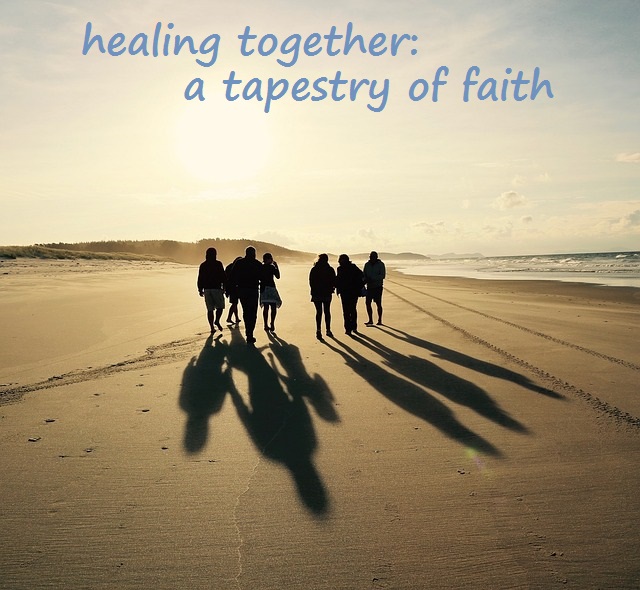
Healing Together: A Tapestry of Faith

Opening Words

We all belong to groups in our lives: a family or families, school classrooms, scouting or 4H groups, churches, sports teams, bands, choirs, and community organizations. And sometimes there’s an event or situation that affects the group, such as a disappointment, failure, tragedy, betrayal, injury, or internal disagreement.

Today, in this Tapestry of Faith service, three of our members will share their stories of what happened when their group went through a painful time together, and survived it, and healed or began a healing process.

Scottie Hart will talk first about a rift in her extended family. Then Walt O’Maley will talk about a toxic workplace situation that changed for the better. Finally, Lindsay Dunckel will talk about building collaboration between community agencies.

Scottie Hart – A Family Rift

In December 2015, a deep, painful rift occurred in my family that has yet to mend. I do not have words to express the anguish I felt then and now about the rupture.

How do we understand healing in a situation like this?

Sometimes healing is about a broken bone that heals stronger than it was before the break. So far, that’s not what’s happening here.

Sometimes healing is about working to create an atmosphere that welcomes dialog. Or maybe healing has occurred when I am no longer buried in sadness, or anger, or fear… Maybe healing means I am at peace with an unwelcome change in a relationship.

I really, really want things to be again the way they were last November, before the rift. My deep, deep preference would be to put that toothpaste back in that tube.

And I am willing to look at more probable possibilities. Given the current realities, what can I do to heal my heart? What strategies for healing do I already know about? In no particular order…

Acknowledge the reality of my pain. Recognize and make space for my tremendous grief. Be willing to do this again and again.
Ask for help. Talk to a neutral third party who’s balance I trust. Although my participation in essential, healing is rarely a do-it-yourself project. I have talked this situation over thoroughly with several wise and compassionate people, and will continue to do so.
Whenever possible, tell the deep truth. Not so much the truth that “That so-and-so is a jerk,” but the truth that I am in pain.
Look at my own contribution to the situation. In what ways did I help set this off? In what ways am I perpetuating my pain? Where have I been unskillful?
Get myself back into balance before I settle on a “plan.” When I am upset, my pre-frontal cortex is not very available; I am physiologically incapable of recognizing a good path toward solution. So it’s important to come to terms with my pain before making a pre-mature attempt to “solve” the situation.
Remember it’s never, ever personal. No one is doing this to me, they’re just doing it.
When I can, remember this is probably not about pointless pain. Chances are good that I will emerge from this furnace more the person I truly want to be than I was when it all started.
Connect in whatever way I can with the foundational reality that I am safe. No matter what it feels like in the moment, the deep truth is that I am safe and I am loved.

These strategies are a well-worn path that will lead me through to healing, to growth and to comfort. And I am deeply grateful for your company on the path.

Musical Interlude: “Rain, Rain,” by Tom Wernigg

Walt O’Maley – A Toxic Workplace

I’m a product manager down in Silicon Valley. Back in 2003 I was over a product for four years that had two different organizations

The first one was one of my worst jobs. The second one of my best. Both sentiments are because of the respective organizations.

First Organization

In first one, the company I was at acquired a small start up that sold software used by mobile carriers.

The general manager and about 25 developers and staff came over. I was their product manager and only one from the larger company.

It soon turned out to be a tough job. The general manager though smart had a large ego.  He is type of guy that it is his way or the highway. Also he was quite combative. If he was not happy with someone he would yell at them in meetings with often 20 coworkers in the room. He put people on the defensive and managed from fear.

The environment was quite toxic. Since he confronted people they would be defensive and often finger point to other coworkers as to why things weren’t completed. I believe a good measure of the state of an organization’s culture is how much joy is there. Is there laughter in meetings at all. In this group there certainly was not.

Given how harsh it was to work there the results were not surprising.

Many people left.  Something like 1/2 in two years
Given the turnover and lack of developers we missed significant customer commitments
Missing commitments resulted in lower sales
We had lost credibility with the sales force and most they did not want to try to sell the product anymore

After two years general manager was moved on, but the damage was done.

Second Organization

A new general manager took over who was more a coach than a tyrant. He deferred much of the leadership to myself and development manager.

I knew we needed to go a different way. The product was behind and we lost the sales force for main markets like US and Europe.

So lead engineers and myself brainstormed on possible new uses for the product. After couple days of brainstorm we came to a new vision.

We immediately evangelized the vision to the broader team. We wanted to say that we have a future and hopefully discourage further departures.

The team was jazzed. Plans were formed to start building this new vision.

Then the focus was on getting some customer wins. This was my main focus. It is complex product and requires in-depth technical sale. I acted as product consultant to help the field answer questions. I worked on large proposals and initial pilots. Often sales cycles would be 4 to 6 months.

After several months of work we won the largest carrier in Argentina.

That was a big win for the team. The team felt that not only are we working on a cool new thing, but we now have a real customer. I could talk to management that indeed we are starting to win.

Subsequently we won more deals and sales improved.

Looking at the work environment it was a lot more collaborative as people were not put on the defensive. There was also a lot more joy in the new organization.

Healing

After the general manager left the first organization, there was a lot of angst. Workers had bad feelings about him. They had bad feelings about some coworkers as it had been a finger pointing environment.

Though one might think having active discussions, possibly doing meditation might be a good course for healing, it was not taken. Corporations in my view really do not encourage such discussions even if they say they do.

Rather what I saw and experienced myself was “embracing the future”. Basically, people were assigned to work on the new product vision. They found it compelling and the work environment much more collaborative. So for the average engineer it was positive step. What I observed was no one told anybody “just get over the past”. Rather the negative energy people had about the first organization just “dissipated”. Basically it was not serving anyone anymore.

From this experience, though I do think people need to process things, that a heavy dose of embracing the future should be a good part of healing medicine.

Thanks for opportunity to share.

Musical Interlude: “Do It with Love,” by Tom Wernigg

Lindsay Dunckel – Agency Collaboration

I have a story for you about two groups of people who were working on behalf of children in this county, yet were oddly split from one another – and how we found our way forward, together.

Each county in California has a CAPC – a Child Abuse Prevention Council, charged with investing birth certificate revenues to help prevent child abuse. And each county in California has a First 5 Commission, charged with investing tobacco tax dollars from Prop 10 locally to enhance child development in the first 5 years. Many years ago, the CAPC oversaw some funds from the California Office of Child Abuse Prevention, funds that went to mostly non-profit services in the county; agencies receiving these grants were required to attend a monthly meeting of the CAPC. The meetings involved checking in about any news among the agencies with one agency highlighted at each meeting. As is often the case with meetings that have required attendance, the meetings were dreaded affairs for most participants, and often terribly dull, with no buy-in of the importance of being there and the strong arm of the CAPC board keenly felt. Because the agencies competed each year for the funds available, there was no true collaboration going on nor really any potential for true collaboration.

The executive director of First 5 heard the community’s frustration with these meetings and was also aware of the potential importance and impact of a family service collaborative – and so she got her Commission to agree to fund one that, in her words, ‘worked’. A funding process was undertaken and then the Family Connections Collaborative was begun. Agencies came to the table of their own free will, the collaborative grew as people formed relationships with one another, found common ground and support from the other attendees, and were free to focus on issues of importance to the community and not their own bottom line.

Of course there were hard feelings on the part of the CAPC Board who rightly saw this as a duplication of what they were trying to do, and therefore a challenge to them and their authority. It was at this point that I started working for First 5; I had had a brief stint on the CAPC board when I first came to town, but had had to step down when the meetings conflicted with the classes I was teaching at Sierra College. I suddenly found I was persona non grata with my former colleagues since I now worked for First 5. It was troubling to me, but I saw the work of the Family Connections Collaborative as more vital so gravitated that way anyway.

Long story short, a third collaborative was formed focused on direct service and crossing the county to include colleagues in the Truckee region. That one was called FAST – Family Advocacy and Support Team. And suddenly many people were attending three meetings a month focused on the needs of and services for children and families in Nevada County. I became the Executive Director of First 5 shortly after FAST started up. One day early in my tenure, I attended a child development conference and ran into the new chair of the CAPC board in the hallway – I introduced myself. She noted that there was bad blood between First 5 and CAPC but that with the new leadership, hers and mine, we had a chance to start over. She was a straight-shooter and what she actually said to me was “I think it’s time we all put on our big girl panties and get past that.”

At the same time, those of us on the steering committee of Family Connections, most of whom were intimately involved with FAST as well, were putting together a symposium on inter-agency collaboration – so we reached out to the CAPC Board who agreed to partner with us on it. We put together a panel representing some other communities who were moving mountains with their family service collaborative efforts. It was an inspiring day and proved that we could rise above past hard feelings and work on something for the greater good. We wanted to keep the good work going, so representatives of the three local collaboratives met in my office to discuss how we might move forward. At that first meeting, we all agreed that we should explore how we might work more closely together. Jokingly, we dubbed the group Collab-Collab – the collaboration of collaboratives.

Believe it or not, the Collab Collab met for about a year; we identified that we wanted to create a single collaborative that could embrace the goals and mandates of each group. We trod delicately at first, mindful of egos and politics; but as we worked together monthly, we formed relationships with one another; we laughed often; we loosened up. We refocused on the larger picture: we were all working on behalf of the kids, and that was a touchstone for us – what do the children need? We spent many meetings coming up with a name and then a logo for the new group: the Community Support Network of Nevada County. Throughout this work, we each checked back in with our three collaboratives, tweaking the work in response to their various inputs.

Finally, we felt ready to merge the three collaboratives: we had worked through the mandate issues and realized there were no outside forces keeping us apart. We hired a neutral party to facilitate our merger talks – and I think that was crucial to our success. Susan Sanford, a member of UUCM, actually, handily lead us through a several-meeting process in which all the potential pitfalls and issues were laid on the table and worked through. With her help as an outside observer and expert facilitator, who beautifully modeled positive language and clear and open communication, we were able to create a governance structure that we all felt would work and would meet all the critical needs that the three collaboratives had been, or had been dreaming of, meeting. We were able to work out a structure that was free of top-down or even of majority-rules decision-making, built on consensus that we felt was a better fit for a true collaborative. We articulated a mission statement that made our hearts swell and called to members of all 3 original collaboratives. Here it is: The Community Support Network of Nevada County is an inclusive, voluntary association of agencies and individuals from the Nevada County community who share a common mission:  That all families in Nevada County have ready access to a well-integrated and coordinated support network that is easily available and well funded.

The CSN is still going strong; it has over 400 individuals on its mailing list now, over 60 member agencies. But best of all, CSN has realized the advocacy potential it has to work for a better system for families and children. Last year, the group finalized a Children’s Bill of Rights for Nevada County which was then endorsed by the Board of Supervisors. We proudly wear our bright green t-shirts that say “And how are the children?” And remind those around us that this should be the first question we ask as we are making any decision that affects the community. The question that drew us together, that served as our touchstone, as we navigated our way to working together despite our fractious past.

Tikkun Olam: All Lives Mattering in a Wounded World

Tikkun Olam: All Lives Mattering in a Wounded World

            What does it mean to be a community of healing?

Rev. Kevin Tarsa

UU Community of the Mountains

Delivered October 9, 2016

(during the Jewish High Holy Days, between Rosh Hashanah and Yom Kippur)


Time for All Ages

In the Jewish tradition, there is a famous story of Tikkun Olam, which means “the repair of the world.” Rabbi Isaac Luria of Safed wrote this story almost 500 years ago, and he told the story this way:

At the beginning of time, God’s holy presence filled the universe. When God decided to bring this world into being, to make room for creation God first drew in a breath, and in so doing, became smaller.  In that new space made by God getting smaller, darkness was created. And when God said, “Let there be light,” the light that came into being filled the darkness, and ten holy vessels came forth, each filled with that bright first light.

God sent those ten vessels out into the universe, like a fleet of ships, each carrying its cargo of light. If all those containers had arrived unbroken, the world would have been perfect. But the containers weren’t strong enough to hold such a powerful, holy light. They all exploded, and holy sparks were scattered like sand, like seeds, like stars. Those sparks fell everywhere! (But more fell on the Holy Land than anywhere else, said Rabbi Issac.)

Our job, he said, is to gather the sparks from all over the world, no matter where they are hidden, and to keep putting the light back together. When all the sparks are back together, the world will be repaired, and perfect.

Rachael Naomi Remen tells the story a little bit differently, based on how her father told her the story. She says:

… that the holy light came out of a holy darkness, the source of all life, and that when the containers broke, and sparks of light scattered everywhere, the sparks fell into all events and all people, where they remain hidden to this day.

Each one of us as some of the light in us, she says, and each one of us has the ability to find the hidden light in all things and in all people, even in the person right next to us. We can help those sparks shine and so restore the world. She says this will take all of us, every person who ever lived, every person who lives now, and every person who ever will live. We are ALL healers of the world.

Tikkun Olam is not about making a huge difference, Rachael Naomi Remen says, it’s about healing the world right around you, the world that touches you.

It’s up to you to figure out how.

A True Story       

[A congregation member told a story about a young male family member who is black, who while walking down Mill Street twenty years ago was picked up by police as a possible suspect in a crime in Grass Valley. The perpetrator had been described as a white man in his 50s. When the person who had given the original description pointed out that this person they had brought in was not a white man in his 50s, the officer said, “I just thought we should check.”]

Instrumental Music    

Sometimes I Feel Like a Motherless Child – African American Spiritual

Sermon

Tikkun Olam: All Lives Mattering in a Wounded World        

Rev. Kevin Tarsa

The Black Lives Matter banner that this congregation had hung on its outside wall has been vandalized and/or stolen three times now. This congregation is still deciding what step to take next. This service/sermon is meant to set a context for that decision making.

My goal today is not to make the case for getting behind the Black Lives Matter movement, though I would, and I may, another Sunday. Meanwhile, my column to the Union names some of the reasons why I believe that’s important.

The story we just heard about a young black man in Grass Valley speaks powerfully to its importance. What does it say and what consequences does it have that right here in Grass Valley, one is forever treated as suspect for no reason other than the color of one’s skin? Except for being male, this man did not match the given description at all. What he matched – and only because of his skin color – is our US culture’s description of a criminal, of a person to be feared.

Addressing that often unconscious reality will require deep and sustained emotional, spiritual and political work. So today my goal is not to name a singular answer, but to help prepare us for both individual growth, and for this congregation’s effective, courageous and compassionate engagement with the wider community, knowing that intelligent, thoughtful, kind people can hold views that are very different from mine or yours.

Let’s begin by taking as a given, that yes, of course, we believe that all lives matter. And then to get us out of some either/or expectations, I want to share with you the basics of something I’ve found helpful, the Intercultural Development Continuum adapted from Dr. Milton Bennett’s Developmental Model of Intercultural Sensitivity. The question it addresses is, “what is [our] capability to accurately understand and adapt behavior to cultural difference and commonality.” What is our capability to accurately understand cultural difference and commonality, and what is our capability to adapt our own behavior to cultural difference and commonality?

As long as two or more are gathered we’ll have chances to work on those questions, for as one of my teachers, Mark Hicks, points out, every two-person conversation is at some level a multicultural conversation, especially if the two people are not from the same family. Couples know this. Its evidence can be as simple as differences in expectation regarding how one celebrates a holiday appropriately: Is the “right” way to open Christmas presents on Christmas Eve or on Christmas morning? Is 4:00 the correct time for a Thanksgiving meal, or is it noon? Is it okay to watch football that day? Is it okay to bring up touchy subjects, to raise your voice, to have a messy house when company arrives?

Bennet said that as we learn to understand and navigate cultural difference and commonality, we typically go through a set of developmental stages – “developmental” indicating that people tend to move through these stages in a predictable direction and order. Like any model, it’s a framework for our understanding, not a cage for who we are.

Developmental Stages In Our Intercultural Capabilities

Our early orientation, the model says, is DENIAL. After we are born, for a time all we know is our own culture, the world right around us. As time goes on we might notice obvious and observable cultural differences, like differences in food, clothing, language or religious rituals, but we might not notice deeper, less immediately visible cultural differences, like conflict resolution styles, notions of leadership or expectations around privacy or gift giving or spirituality.  In this stage, we are aware of the tip of the iceberg, but unaware of the significant cultural differences beneath the surface.

Two stories – The Eyes Have It

In college I was in Munich Germany, walking down a street, when I realized that I was looking primarily at the ground as I walked. This is not very friendly, I thought. I don’t want to appear to be a disengaged American, I should look people in the eye more often. And so I did. The very next people I encountered were a group of young men about my age. I held the gaze of the first person as we approached one another, radiating my gentle friendliness all the while. Except that when that person reached me, he started screaming at me and beating on me. A leader of a gang (a white gang, in case you pictured otherwise), he had taken my unfaltering gaze as a challenge to his authority. For him, lowering my eyes submissively would have been the appropriate stance.

More recently, a young African American man arrived at the congregation very distraught and seeking assistance. Not wanting to appear uninterested, wanting to convey, “I see you. I see your pain. I’m not treating you as invisible,” I pulled up a chair and looked him in the eye, a gaze he did not hold in return. I watched him as we spoke. After a while he communicated to me that this felt disrespectfully intrusive. As if I had the right to stare at him (from on high) in his pain.

In each case I acted from my own assumptions and expectations, wanting to do something kind and good, but in each case my behavior registered as hostile. I expect that you may have your own stories of differences in cultural expectations.

When we move forward from denial, we tend to move to an orientation of POLARIZATION, where we recognize cultural differences, and we judge them. We think in terms of ‘us’ and ‘them.’ One is right or better than the other.

Now the interesting thing is that this takes two forms:

In one form, our own cultural way is right, and others’ cultural ways are not: “If they would only get their act together and do it our way, things would be better.” “Why can’t they arrive at meetings on time?” OR “Why are they so uptight about starting a meeting at a certain time?” “Why do black people have to choose names like Shaniqua. Can’t they choose normal names (ie. names from white culture)?” “Why do the Italians need to talk so loudly and forcefully, can’t they be quieter and not get in people’s faces?”

In polarization, we critique other cultures’ practices and values, but not our own.

But for some people there comes a reversal of the us/them poles: to “Another culture has it right. Mine does not.” “Oh, Native Americans have it right, always so peaceful and spiritually enlightened and in tune with the earth. White culture is all screwed up.” Stereotyping, we put an entire culture on a pedestal and critique our own, wanting to distance ourselves and become ex-patriots from our own cultural landscape (culturally disengaged) and become a part of the culture that has it right. It’s still an us/them stance, but in favor of the “them.”

When we move forward from Polarization of either kind, we move toward MINIMIZATION, in which we focus intently on cultural commonality and universal values. “Really, we’re all the same. We all have the same needs underneath. We all bleed red. We’re color blind, we don’t see color.” It’s a very Universalist notion and moves helpfully toward great inclusion, but thinking that we’re all the same means thinking that we’re all the same like me! I universalize my perspective and believe it applies to everyone.

This is where most progressive people, where most Unitarian Universalists are, in minimization.

I want to celebrate that getting to minimization is wonderful progress, important and necessary movement forward from denial and polarization, from us/them, to it’s all us.  This is just what some people need to move toward. But those of us in minimization tend to think that we’ve arrived at the final answer. “What could be better for the world than focusing on what we have in common? We’re all one.” It sounds beautiful. “All lives matter. Isn’t saying that Black Lives Matter a racist message, I thought we were beyond race?” But minimization is not the end of the journey. We are not all the same, not even underneath.

Dancer Story

A few years ago I read a story that challenged my notion of human commonalities in a very simple but memorable way. A child somewhere in the vicinity of Papua New Guinea was recognized as a very talented young dancer and someone offered to pay the child’s way to a dance school somewhere else. The child had a very difficult time for the first year or so, unable at first to follow the teachers instructions. The teacher would say something like, “Please take two steps to the right.” But in the child’s culture, a person orients oneself to the cardinal directions – north, south, east, west – not to oneself.

In that culture one might say “Please take two steps to the east, or one step north.” To move right or left relative to oneself had no meaning. Even when they figured this out, the child had to learn to orient north, south, east, west in a new physical location. In that child’s culture, the self is not the center of the universe, not the point of reference. How different from our culture, and what a profoundly different way to see oneself in relation to the world.

You would think that we could safely assume that all humans share an understanding of moving right or left, by whatever name. But NO! Not even that can be assumed!

Next?

The next step in the journey, if one is in minimization, is to recognize and appreciate patterns of cultural difference AND commonality, to reach an ACCEPTANCE of both/and. We are alike in some ways, and not in others. Important others.

If we don’t see a person’s color, we are not really seeing the person. If those of us who are white we don’t understand that a black person will have a very different experience walking down Mill Street than we will, we are not seeing what we need to see.

In acceptance, we learn look at our own culture and how it is different from and similar to other cultures, without assuming that ours is the universal norm. In terms of race, it means that no, we are not color blind, and for those of us who are white, it means that we learn to see and better understand our own whiteness. The term “people of color” is used in our culture to refer to everyone who is not white, as if white is not a color. If those of us who are white don’t see our whiteness, if it is the invisible standard by which we gauge life, we are not seeing all that we need to see and accept.

Sometimes I Feel Like a Motherless Child

Though I’ve long loved the African American spiritual, “Sometimes I Feel Like a Motherless Child,” for a time I did not sing or play it, though it had been a powerful song for me. In UU music circles, a now decades long conversation has been underway among musicians regarding cultural misappropriation, and in this case, whether it is okay for white (dominant culture) musicians to sing or play music from other cultures. Is it okay for a white choir to sing an African American spiritual, for example?

In the midst of that conversation (a conversation that has followed the developmental stages I’m outlining), not wanting to do something harmful, I stopped singing and playing “Sometimes I Feel Like a Motherless Child” …until I read the book, Learning to Be White by Thandeka. In it she looks at the ways we in America, all of us, of any skin color, learn to devalue everything and everyone associated with darkness of skin. We are taught in myriad and mostly unconscious ways to be white. She helps white people look at the costs of learning to be white, and the ways our culture betrays us through the people closest to us, parents and family and community who often unknowingly perpetuate the culture’s norms and so lead us away from our original authentic, true, loving and open selves. We have to deny aspects of our true self in order to learn to be white. Becoming aware of this is a powerfully painful experience, she says.

The moment I finished reading the book, having taken it deeply to heart, I had no words. All I could do was sit down and start improvising on the piano to try to express and process what I was feeling. In the hour of playing, what gradually surfaced was “Sometimes I Feel Like a Motherless Child.” For the first time I felt that I could sing that spiritual for myself from inside of the song. Not from the same place someone whose ancestors had been enslaved might sing it, but from a place that recognized our common source of harm.

As part of Minimization earlier, people are likely to say that there are many paths to the mountaintop. It’s a wonderful and important way to move from us/them to inclusion of difference. However, that still assumes that we’re all going to the same mountaintop. In Acceptance, we start to come to terms with the fact that there may be more than one mountaintop.

In the final but never ending stage of ADAPTATION we take what we have learned about our own and other cultures, and learn to become flexible, able to shift our cultural perspective and change our behavior in culturally appropriate and authentic ways. When in Rome, do as the Romans do, not in superficial imitation, but in ways that recognize, respect and honor the ways of Romans while remaining authentic to who we are. It’s a move from the Golden Rule of “Do unto others as you would have them do unto you.” to the Platinum Rule of “Do unto others as they would have you do unto them.”

 “I do not want my house to be walled in on all sides and my windows to be stuffed. I want the culture of all lands to be blown about my house as freely as possible. But I refuse to be blown off my feet by any.”

– Mahatma Gandhi

In Adaptation, we learn to adapt our eye contact behavior to match the people we are interacting with, to let a meeting’s start time or length be flexible if need be, to adjust the tone of our voice or our expectations about who and how someone should be in charge when there is a task to do. We adjust our language, and still stay true to who we are.

This is not a smooth road. Despite our best intentions we will commit faux pas, and put our foot in our mouths, and look in someone’s eyes in a way we think is kind but that feels disrespectful to them.

The path is to learn whatever we can, to expand our understanding and awareness, and then, in good faith, to interact in genuine, authentic ways with people who are different from us, with hearts open to learning what we need to learn.

Why am I telling you this, as we ask together, “What does it mean to be a community of healing in the wider world?” and when this congregation has on the table an unanswered question about what to do regarding it’s third Black Lives Matter Banner being stolen?

In part, I hope this is an invitation to some personal awareness and curiosity and growth.

In part I hope it is an invitation to understand that all our congregational conversations are intercultural conversations, even when everyone in the room is of white, European descent, and that knowing this will help members learn to navigate difference.

And I believe that this congregation’s ability to be an effective facilitator of healing and its ability to make wise decisions about what to do about the Banner, depend on members’ ability to understand that people inside and outside this congregation are in different places in this developmental journey. There are layers of right answers about what to do.

If we go into our congregational meetings or meetings which engage the wider community thinking we have THE answer and everyone else just has to get up to our speed, we will miss the mark.

The goal – if we want to build the world we so deeply desire – is to help as many people as possible to move forward from wherever they are. And what people need in order to move forward, depends on where they are in the journey:

If in Denial – what one needs in order to move forward is to be exposed to and to learn to notice cultural differences.

If in Polarization, recognizing differences but:

…demonizing other cultures – one needs to discover and focus on commonalities with “them” and to engage in cooperative activities that help make connections.

…idolizing other cultures – one needs to discover what’s valuable in one’s own culture and to notice when we are stereotyping.

If in Minimization – in order to move forward one needs to look more closely, and to learn and discern what really is the same between cultures, and what is not. At first, reading books about black experience by black authors, for example, or watching movies from and for other cultures, or listening to speakers name the cultural differences for you. Then, personal experience with people who are different is key.

If in Acceptance – deep learning and direct practice navigating difference is what’s needed. Experiences in communities not our own, finding pressure points and discomfort zones. Learning to navigate other cultures authentically and respectfully.

If in Adaptation – which never ends, because there is always more to learn and new differences to encounter, the need is to keep learning, and, having made the journey,  to become a guide for others, perhaps teaching others how to travel their road forward.

The people who work with this model say that it takes 40 hours of focused work/experience/learning to move one developmental stage forward. The good news is that moving forward is possible. The sobering news is that our work is cut out for us. It will take much more than a single meeting or speaker or book or event.

Our next congregational conversation about the BLM banner, to make recommendations about specific, concrete steps to take, will be held in two weeks, on Oct 23, after the second service. [noting the list of stages] To whom are you intending to speak when you decide what to do about the missing Black Lives Matter Banner, and to what end?

As you are preparing for that gathering, I invite you to think about where you might be in this developmental journey yourself. I’ll also note that very consistently people identify themselves as one stage farther in the journey than they actually are.  (Note for this written sermon edition: There are good reasons for this. Ask me.)

I remind you that Rachael Naomi Remen says to start tikkun olam, the repair/healing of the world, not with something huge, but by healing the world right around you, the world that touches you.

What’s the world that touches this congregation?

What are the (cultural) differences and commonalities here in Grass Valley and Nevada City and Nevada County that people are not seeing, or are denying, or polarizing, or minimizing, and what can this congregation do to help as many people as possible, including us, move forward in this developmental journey, toward ever greater understanding, acceptance, compassion, kindness, justice and love, as our faith tradition asks of us. 

My hope is that we can learn to practice tikkun olam, the repair/healing of the world, with courage, strength and conviction, yes… AND humility at the same time, in order that we can make a meaningful difference, and gather more pieces of the light.

I’m not expecting that we will ever reach a perfect world, but together we can take some powerful progress toward that ideal.

So may it be.

Resources:

The Intercultural Development Research Institute

http://www.idrinstitute.org/

Intercultural Development Inventory

https://idiinventory.com/products/the-intercultural-development-continuum-idc/

Bennett, M. J. (2013). Basic concepts of intercultural communication: Paradigms, principles, & practice: selected readings.


When the Vow Breaks

When the Vow Breaks

            What does it mean to be a community of covenant?

Rev. Kevin Tarsa

UU Community of the Mountains

Delivered September 25, 2016


100 years ago this week in The Union, the local Grass Valley newspaper, there was a notice that Josiah Royce had died September 14. Philosopher/theologian Josiah Royce was born here in Grass Valley. Long time professor at Harvard, he developed the idea of the Beloved Community, an idea that Dr. Martin Luther King Jr. later adopted and adapted in light of the civil rights movement and a commitment to non-violence.

Royce wrote, “A crowd, whether it be a dangerous mob, or an amiably joyous gathering at a picnic is not a community. It has a mind, but no institutions, no organizations, no coherent unity, no history, no traditions…”

In that spirit, last week I offered a little of our Unitarian Universalist history, our backstory. I spoke of our tradition’s rootedness in covenants – the mutual, voluntary promises members make to one another – rather than a creed that spells out what a person is required to believe.

I spoke primarily of a central covenant for a congregation, the covenant that names the largest and most compelling reasons for being a community in the first place, the deep goals members promise to pursue together, and that names the inspiring, demanding commitments such goals ought to ask of us. As I see it, everything else grows from that central covenant, which the congregation has to identify, articulate and sign on to. This congregation doesn’t have that kind of covenant (yet!) That’s work for the road ahead.

But there is another kind of covenant we make in our tradition, a set of promises that names how members will be with one another as they move toward those larger goals. These are behavioral covenants whose purpose is to protect and strengthen relationships, and this congregation does have a behavioral covenant, a Covenant of Right Relations.

Why have such a covenant?

For all the importance placed on relationship in religious communities of all kinds, we don’t always know how to do relationships well. People may commit to loving their neighbor, they’re just not always sure how to do it in the middle of a contentious committee meeting when people are upset and the emotional heat is high!

I learned this early in my life since my father was a teacher in a small Catholic school and since I was a church musician at a young age. I saw the inside of church life. I saw church life bring out the extraordinary best in people – amazingly generous and beautiful, loving behavior, AND I saw it bring out the worst in people – cruel, destructive behavior.

As someone put it:

To dwell above
with saints we love,
Oh, that will be the glory                               

But to dwell below
with saints we know,
Well, that’s another story.

Religious communities are human endeavors, and the stakes are high and personal since ideally we are working with values and ideas and feelings that really matter to us. So the quality of the relationships across the congregation is central to the community’s well-being and effectiveness.

20 years ago, Mary Sellon and Daniel Smith started studying why some communities that looked vital and dynamic from the outside failed or continually lost members, and why some communities that looked like duds from the outside, thrived or survived against all odds. They discovered that it wasn’t the building or budget or staff size or the programs or the years of academic training the minister had that mattered most, it was the quality of the relationships.

“Relationships embodying qualities like caring, playfulness, collaboration, authenticity and deep trust engendered commitment…and personal fulfillment. They … fostered creativity and drew others in. These groups’ paths were not always smooth; group members did not always agree. But, there was an energy, commitment, and audacity that other groups strove for, yet never attained (Practicing Right Relationship, xii).”

This is my experience too, in a lifetime working in religious communities, and as a long-term investment, I’m inclined to invest first in the health and quality of the ways people here relate to one another. That’s what behavioral covenants are meant to assist, to protect and strengthen the health of the relationships, so that the congregation can do what it’s here to accomplish.

As is often true, this congregation’s behavioral covenant – or Covenant of Right Relations – was birthed in response to a particular time of conflict. The people who helped craft it for the members to vote on, have said that they didn’t think it was perfect at the time, but they felt it was important to create a covenant then, to get one in place. We’ll read through it in a few moments, knowing that a there is already a group exploring ways for this congregation to look at it again, to review and revise and renew it for the future.

But first I want to address or at least acknowledge the concern some people have that behavioral covenants that set standards and expectations for members’ behavior are unnecessarily restrictive at best, and maybe even dangerous.

This is a relatively common attitude in our tradition, since for so much of our history we have been a haven for refugees from other religious traditions, people who left traditions that felt too restrictive and demanding to them. When they arrive in our communities, wounded, they arrive wary and cautious around any strong expectations, and I can understand why. I have been that refugee in my lifetime. I have had that same wariness. Maybe you have too.

However, while we do insist on absolute freedom of thought and belief in our tradition, we do not enshrine absolute freedom of behavior, freedom to do whatever one wants however one wants without regard for others. Instead our religious community calls us to our most courageously loving and compassionate behavior. It matters what we do, not just what we think.

What many wary members have said to me over this years is, “We are all adults here. We don’t need a set of rules.” And in response, I simply ask people, I’ll ask you, to think about some of the adults that YOU know – those adults who do not play well with others.

One of the challenges is that we have learned different patterns in our families.

A colleague told the story of a congregant who often yelled when he spoke to her. In response, my colleague would lower her voice and act more and more calm, at which the gentleman would get even louder. Until someone helped her understand that she might need to raise her voice, maybe even yell back at this man. Once she did, he was fine.  If the norm in a family is to yell at one another, than that’s how you “know” others are engaged with you. When someone gets more and more silent more and more quiet, it feels like they aren’t caring, aren’t engaged. Conversely, when your formative environment was one in which surface calm was the priority, a raised voice or any tension is perceived as a sign of danger.

In part because of the different ways we learn to relate, Sellon and Smith say that life giving healthy relationships don’t just happen automatically or magically. They are created by people who make the choice to be “open, authentic, caring and curious” with each other (11).

Creating and entering a behavioral covenant is part of naming and committing to that choice, to nurturing and preserving relationships through our behaviors. And we make this choice, voluntarily, not only because of the good it will do us, but also because there is a larger shared goal we want to reach together.

Let’s try UUCM’s covenant on for size:

UUCM Covenant of Right Relations

Recognizing that conflict is normal in human relations and wishing to relate to others as harmoniously as possible, I sincerely intend to:

Before we read the rest of the covenant, I want to not that I think in terms of conflict being natural rather than normal, not wanting to imply that conflict is the norm. You don’t HAVE to have conflict all the time. Really.

Also, I’ve noticed that UUCM has a tendency to use soft language when it comes to expectations and commitments, as if you don’t want to ask too much of people.

My first title for this sermon was “Great Expectations? or Anything Goes? Usually covenants are more like a wedding vow. “Do you promise…? I DO!  I will!” Rather than, “Do you promise to love and cherish…? I’ll Try. Or, I sincerely intend to.”

I can imagine that some people, taking a literal interpretation, might say, “I can’t in good faith promise that I won’t EVER speak unkindly, so the best I can do is sincerely intend to.

I served a family that took a trip to Canada, only to realize at the border that they had not brought birth certificates or passports for the children. At one point while they were detained, a border guard asked the young son, “Are you absolutely certain that these are your parents?” Responding perfectly logically, the boy said, “No.” As far as he knew, they were, but he couldn’t be absolutely certain.

Covenants are by nature aspirational. They imply “I sincerely intend to.” If these were commitments of which we could be absolutely certain, we wouldn’t need covenants around them. The value of the stronger language is the stronger hold it has on those of us who enter a covenant. “I will” is a different level of commitment than “I sincerely intend to.”

Okay, here is UUCM’s current Covenant of Right Relations what members have promised one another, or sincerely intended to one another.

Treat others with kindness, empathy and respect.
Communicate with patience, flexibility, and a willingness to negotiate in the spirit of meeting as many needs as possible.
Be aware of my own thoughts, feelings, and needs, and share them directly and honestly with others, without judgment or blame.
Invite and listen to all points of view, respecting others’ feelings and needs and encouraging minority opinions.
Take responsibility for my own mental, emotional, and spiritual balance, asking for support when I need it.
Be mindful of the needs of the group as a whole, mourning together when individual needs cannot be met.

Notice how those felt to you as commitments that might help build healthy, strong, dependable trust-filled relationships. You’ll have a chance sometime in the future to re-envision those commitments.

So what do you do when you or someone else doesn’t hold to the covenant, when these vows are broken? (Which they will be, since none of us is perfect.)

When we break our vows in a community the covenant is there to remind us of our own commitments, the choice we made to be part of a community, not just part of a crowd, even when we disagree, even when the vote doesn’t go our way, even when the sermons are “insufferable.”

“Covenant offers us an invitation to be curious and humble, to make room for mistakes by pre-promising that–when we fail–we are willing to forgive and try again.” – Rev. Renee Ruchotzke.

A covenant is not a set of laws used by other people to put us in some kind of prison or to punish us. It is there to help us call each other back to behavior that strengthens trust and well-being, rather than behavior that harms trust and well-being. Members have a responsibility – not just the capability – to call each other back to, and help each other to live the covenant, to live those more loving and life-giving behaviors, to help each other “come ‘round right,”  in the words of the song.

We can’t know what is in someone’s mind and heart for certain. It’s not about motivation, and it is not about whether someone is a good or bad person. It’s about observable behavior and the effects that behavior is having on the health and wellbeing of the community and its members.

A community like this often creates a team of people to help members find their way back into covenantal behavior when it’s difficult. It is sometimes called a right relations team.  That’s an option for this congregation to consider, though it’s important to remember that every member has a responsibility to help each other do this.

I would name today that the starting place is honesty, with ourselves, first of all and with others. I its important to name our hurt, and to learn to do it in ways that do not shame and that call people back to relationship-sustaining behavior. Ultimately the work then is to help people rebuild trust by helping them to be trustworthy – again and again, nurturing health and wellbeing, by living those covenanted behaviors.

The Rumi poem we sang at the beginning of the service includes the line, “Though you’ve broken your vows a thousand times, come, yet, again, come.” Or as Jesus said, forgive seventy times seven times, or an infinite number of times. But I need to say, while we’re on this subject, that there are limits to the amount of harmful behavior a community can sustain and survive with integrity.

On those rare occasions when a member cannot, even with help, manage their own behavior and bring it round, when that person’s behavior is continually hurtful, and undermining and destroying trust and goodwill, I believe that at some point a community has to be willing to say to that person, “We have made promises to each other for the good of all. If you cannot behave differently here than you are now, you cannot be a part of this community.”

[shield self with raised arms]

BLASPHEMY! I know. How could you ever exclude anyone?! In our liberal, universalist tradition, this is the thing many people have the hardest time imagining. They cannot imagine saying no to someone in this way. But that reluctance comes at the expense of the health and strength of the community.

The good news is, that that is a rare last resort, though it needs to be a conceivable possibility. Happily, it’s usually much less dire than that, and we’ll have many chances to practice and learn together around more mundane, everyday experiences.

To that end, I close with an invitation – a request really.

I ask you to take on a simple relationship-strengthening practice rooted in the part of the congregation’s covenant about sharing thoughts, feelings and needs directly and honestly with others. Direct communication is one the strongest and fastest ways to nurture health in relationships, in your family, where you work and in the congregation.

Here’s the practice: Avoid pass-through communication, communication in which “to get a message to someone, you tell someone else.” (Healthy Disclosure, 188-190)

The beauty of this is that it shows up often and in very ordinary ways, and you’ll get many chances to practice. A common scenario is something like, “Bob, would you please tell Carol that I’ll be late for the meeting tomorrow?” The message is for Carol but we tell Bob instead. Indirect communication.

Here’s your chance to practice while the stakes are low. Catch yourself, and say, “Wait, better yet, I’ll tell Carol myself.” And if someone asks YOU to tell Carol that they’ll be late for the meeting, or to pass on any other message, I encourage you to refuse, kindly. If it helps you, feel free to say, “Rev. Kevin asked us to practice direct communication and I’m trying it out. I’ll ask you please to tell Carol directly.”

It would seem that having Bob give a message to Carol is simply expedient and practical, but if our behavior pattern and habit is to communicate with someone indirectly through someone else, then that’s the same pattern we’ll likely rely on when the issues are much more important and the stakes higher. Remember the game of “telephone,” in which you pass a whispered sentence around a circle of people? By the time it reaches the end it is often completely different from the starting message. The same thing can and often does happen when we pass messages through someone else.

So here’s a low-threat way to strengthen everyone’s healthy communication muscles. Help each other avoid pass through communication and you’ll be making a wise investment.

The life a religious community is about many things – our spiritual, emotional, intellectual and social selves.  The foundations for our ability to grow in all those areas in a community are 1) a powerful shared focus and 2) the quality of our relationships. That’s why it’s important to covenant around each. That’s why I’m spending time in these first couple services laying groundwork for the road ahead.

People sometimes fear that covenants will hem us in, but in truth, covenants are meant to liberate us for the greatest possible personal growth, the deepest possible mutual love, the strongest chance to make a difference for those in the world who are suffering.

I trust that you as a community can eventually find yourselves in the place just right, and then it will indeed be in the valley of love and delight. Along the way the road may be “muddy and rough,” but “we’ll get there. Heaven knows how we will get there, but we know we will.”

So may it be.


Resources and Works Cited

Ruth, Kibbie S, and Karen A. McClintock. Healthy Disclosure: Solving Communication Quandaries in Congregations. Herndon, VA: Alban Institute, 2007. Print.

Sellon, Mary K, and Daniel P. Smith. Practicing Right Relationship: Skills for Deepening Purpose, Finding Fulfillment, and Increasing Effectiveness in Your Congregation. Herndon, VA: Alban Institute, 2005. Print.

Rev. Ruchotzke’s quote came from a UUA Growing Vital Leaders blog entry: http://vitalleaders.blogs.uua.org/leadership-skills/reflections-on-right-relationship/

The closing lines quote the songs “Tis a Gift to be Simple” and “Woyaya,” from the UUA hymnbooks Singing the Living Tradition and Singing the Journey.

We Would Be One

WE WOULD BE ONE

What does it mean to be a community of covenant?

Rev. Kevin Tarsa

UU Community of the Mountains

Delivered September 18, 2016


After Jesus died… (which is not how I begin most sermons, by the way, or have ever begun a sermon, until now)  the people who had known and loved and followed him had a lot of questions.

The reason I’m starting there, in a room full of us atheists and agnostics and humanists, as well as Buddhists and Christians and others, is because though you might not know it from looking around this room or the rest of the building, Unitarian Universalism has roots in the Christian tradition, in Calvinism, to be more specific.

Our ancestors – both Unitarians and Universalists – rejected certain teachings of Calvinism,

which was one of the protestant traditions that had rejected aspects of Catholicism,

which was one form of Christianity,

that had evolved out of some of the small communities of the early Jesus followers,

who were, for the most part, Jewish.

We retain pieces of all of those traditions and I think its important to know where you come from as you figure out where we’re going, even though much has changed over the centuries. So I want to offer you a little bit of the backstory.

After Jesus died, there were two fundamental questions for his followers, questions that people argued about for centuries and still do:

1) What was Jesus’ purpose? I.e. Why was he here and for whom?

2) Who or what was Jesus, exactly – God? A god? Partly god? Divine but not as high on the ladder as God, a special prophet, a wise guru, en exemplary human being? What was his nature?

The Judaism that gave birth to Christianity prioritized ortho-praxy – correct action, over ortho-doxy – correct belief/opinion. Both were important, but when push came to shove, what mattered most, is what you do. What you believe about a ritual, for example, is less important than that you do the ritual, and do it correctly. Think the 10 Commandments….primarily about what you do.

The earliest Christian communities also prioritized action over belief (even as they argued about their beliefs about Jesus), perhaps because they were made up primarily of Jewish people. At their best, loving action was at the center of these communities and I find the ancient accounts of them powerfully inspiring. Following Jesus’ teaching, these people cared for the least and the ostracized, the poor, the widowed, the orphaned, the lepers at great personal expense and risk. And they cared for each other in a way that elicited remarks from the Romans, according to Tertullian, “See how they love one another,” they would say.

Justin Martyr, born around 100 CE, portrayed Christian love this way, as he tried to convince the Roman emperor to stop persecuting Christians:

“We who used to value the acquisition of wealth and possessions more than anything else now bring what we have into a common fund and share it with anyone who needs it. We used to hate and destroy one another and refused to associate with people of another race or country. Now, . . . we live together with such people and pray for our enemies.”

One of my favorite songs as young catholic, as guitar masses were coming in, was “They’ll know we are Christians by our Love (sung).” That’s how I wanted to be known…by the visible evidence of my love.

After 300 years or so, when Christianity had spread and included people from many different cultures and traditions, there were many different ideas about Jesus’ purpose and nature and Christianity was fragmented. In hopes of unifying Christians in the known world, Emperor Constantine convened the Council of Nicea in 325, to decide once and for all, among other things, which ideas about Jesus’ nature were correct.

Their answers have important repercussions in our UU history, but today I want to name that what that Council of Nicea did, in our heritage, is shift the focus in Christianity from orthopraxy (correct action – doing the right thing) to orthodoxy (having the correct belief). It was a turn away from being the religion of Jesus, toward being a religion about Jesus. That’s oversimplifying it, but that turn was significant.

What thereafter defined a true Christian, was holding the approved/sanctioned beliefs – the beliefs spelled out in the Nicene Creed. For the next 1300 or 1400 years or so in much of Western Christianity, people were in or out, included or ostracized, burned at the stake or allowed to live, based on what they were willing to say they believed.

Fast forward to the 1600s and our direct religious forebears on this continent – the Pilgrims and the Puritans. They came for many reasons, among them the freedom to practice Christianity as they felt it ought to be practiced. The Pilgrims sought to build a community separate from the world. Puritans sought to build communities that would become a shining example to the world and the folks back home, and many expected to return to England at some point. You know how that goes. You plan to stay for a year and 20 years later you are still there.

They were here on their own all that time, without bishops or any hierarchy telling them what to do. And when Presbyterian ways of governing churches started to become a trend in England – where regional groups of elected elders had the power to make decisions for congregations – our ancestors here said wait a minute, we like making our own decisions.

They called a meeting at Harvard, the Cambridge Synod, and drafted and eventually adopted what we know as the Cambridge Platform, which is the basis for how we govern ourselves in UUism. It is the basis for our congregations making decisions for themselves, and the basis for our focus not on a creed or a specific set of beliefs, but on covenant.

The drafters of the Platform looked back to and referenced the early Jewish communities in the Hebrew Bible, and the early Christian communities in the Christian New Testament, and they said that THE reason to form religious communities, and the purpose of everything religious communities do is “mutual edification” – mutual teaching and learning –  that is based on the second of the Great Commandments, “Thou shalt love they neighbor as thyself.”

As Alice Blaire Wesley put it, our ancestors said that we gather “for mutual learning and teaching concerning the (many and complex) ways of Love.”

Wesley points out that there are an infinite number of subtopics in this category of Love, and that our Forebears believed that people have to gather with others in order to figure out the details, or as they put it, to discern God’s will.

Communities like ours must figure out continually what, specifically, love demands of us now, so that “neighborly love” is not just a “fuzzy, sentimental abstraction” …but rather a challenging call to be more and more our best and most courageously loving selves within our gathered community, with our sister congregations, and in the wider world.

Our job, according to our forebears, is to help each other figure out what loving your neighbor (as yourself) means and looks like today, and then to help each other do that, while caring for each other along the way.

That is Christianity at its best, I say, and I know people who live that faith beautifully and powerfully. I expect that you do too. The thing is, that is also Unitarian Universalism at its best, no matter whether we think of ourselves as Christian or not. I would go one step further to say that that is religion at its best: helping each other discern and practice loving action in our community and in our world.

For this to happen well and in ways that can keep evolving with our evolving understandings, our forebears said it’s not a creed that we need, its a covenant – not a static statement of beliefs, but a mutual, aspirational, voluntary promise of how we’ll go about being a community trying to discover the demands of love and how to live that love. A “declaration of interdependence.”

Though we let go of many aspects of the Cambridge Platform over time, our UU congregations today are still rooted in covenants, mutual promises developed and chosen and committed to within each congregation as well as between and among congregations.

I want to acknowledge that some people feel uncomfortable with the word or the idea of “covenant.” For some it feels too churchy, religious, old fashioned, or too legalistic. Some fear that covenants are used as punitive instruments to pummel people back in line.

I would offer:

The root – “co-venir” – means to agree (to) – to be not merely of like mind, but of like heart and like commitment. It’s about shared commitment

The word and concept are indeed churchy, religious, old fashioned, and legalistic. The drafters of the Cambridge Platform drew the concept from the Hebrew Bible (the covenant between God and the Israelites), and the Christian New Testament (meaning new covenant), It is a concept rooted in political agreements of biblical times.

Covenants are entered voluntarily.

However, to be a member (of a UU congregation) requires entering a covenant with the other members, making a set of mutual promises. Members do not always realize this. Since the tradition is not defined not by creed but rather by covenant, simply agreeing with other UUs or even with the Seven Principles is not enough. One must be in a covenant with other members. That is our religious practice. That is our spiritual discipline

Covenants are created by the members, not handed from on high or elsewhere, and they are not etched in stone forever. Each congregation, group, or committee decides what it will covenant in order to best achieve its goals and care for each other in the process. Dave has already asked a small group of people to explore ways for this congregation to review, revise and renew its behavioral covenant.

Covenants are upheld mutually. The people who have entered a covenant with each other are responsible to help each other live into it and live up to it. A covenant does not say you can do whatever you want, whenever you want, however you want. It holds out mutual expectations.

Covenants are aspirational. They are not a tool used to slap someone’s hand, but a tool to help us hold out a hand to invite members to live into community-building and love-enhancing behavior. More about this next week.

“A contract is a matter of law. A covenant is a matter of love.” 

~ Rev. Preston Moore

“A contract protects interests, but a covenant protects relationships.”

~ David Brooks

The theme this month is “What does it mean to be a community of covenant?”

SLIDE of word cloud from last week’s service: Answers to, “Why are you here?”

The words used most often were: Community, Love, Others, Friendship, Connection

All relational.

A few final thoughts:

Covenant is a way to become ONE out of many.

With all these different theological beliefs, and in a culture that prizes individualism, the question is: How do you hold together/cohere as a community?

When I work with choirs I try to help them understand the difference between singing at the same time and singing together. Singing at the same time can sound beautiful, but when truly singing together, something else happens, something powerfully transcendent and even transformational. Covenant binds us and, ideally, helps us “sing” not just at the same time and in the same direction, but together.

We claim to prize diversity – which is important – but diversity does not connect people. To be a community of cohesiveness and meaningful depth, people have to connect in common around something so important that they can draw on their differences to reach toward a common goal, rather than to have those differences interfere with that reaching.

I therefore believe that our foundational covenants in congregations must speak to the largest, most compelling goals we hold, and that mission statements are best framed as covenants or in covenantal language. Name your deepest shared aspirational mutual commitment up front, and covenant toward reaching it, so that members new and old know that that’s what they are signing up for and signing on to…

Your congregational covenant cannot be shallow. It must lay claim on your heart, must inspire you enough to want to be subject to its demands. Not because anyone said you have to, but because you want to, because you know, as frightening as it might be, that it will call you toward who you most want to be in the world. It ought not be easy. It ought to give you pause before you sign on to it. It ought to be worthy of your commitment.

Our ancestors said that we best covenant in order to figure together what loving our neighbor (as yourself) means and looks like and asks of us now, and then to help each other do that, caring for each other along the way.

My personal dream is to be able to sing with total honesty and conviction, “They will know we are UUs by our love” (sung)… whatever that love might need to look like in Grass Valley these days.

What great end does or would keep your critical thinking skills humming AND grab your heart at the same with such power, that you would risk a great deal to be here, to be part of it.

Figuring that out together – so that you can be ONE and a powerful force for good in this community – that’s the work ahead. The marvelous, hard, and joyful work ahead.

Yonder, come day!

May day be a’breakin,

and may the sun be arising,

In your collective soul.


So may it be.


Works cited:

Wesley, Alice B. Our Covenant: The Lay and Liberal Doctrine of the Church : the Spirit and the Promise of Our Covenant. Chicago: Meadville Lombard Theological School Press, 2002. Print.

This is a 2000 Minns Lecture Series by Alice Blair Wesley, available for free download at http://minnslectures.org/archive/wesley/wesley.php

The Cambridge Platform 1648

Available to read online at https://books.google.com/books?id=aSkPAAAAIAAJ&ots=rPIGSnDqRP&pg=PA43#v=onepage&q&f=false

Everybody Needs a Rock

by Kristin Famula

Religious Education – Everybody Needs a Rock– August 14, 2016

Everybody needs a rock.

I was introduced to this book early-on in my path as a religious educator – during a workshop on multigenerational worship at General Assembly. I immediately had a strong connection to the story – I loved the gentle symbolism and simple, yet deep message. And I knew I wanted to share it with you today, because it so perfectly explained my vision of RE: the metaphor of finding your ‘rock’ – which will serve as the solid UU foundation that grounds us in life and gets nurtured through religious education.

But, as I was looking up the book online to refresh my memory – I discovered ‘reviews’ of the story.

The first reviews I read were from rock-hounds and teachers: these reviews said things like, “this is a great story! It fit in perfectly with the lesson on geology and exploration of the natural world. We’re going to read the story in class and then go examine rocks and figure out if they’re metamorphic or igneous! ”

These reviews caused me to pause: “Obviously they’re missing the intent behind the book, right? It’s clearly not meant as a book about rock hunting!”

But then I kept reading – (you know how you get sucked in when you’re online?)

One review shared that it’s about paying attention to the small things (ok, I thought, that’s closer …)

Another explained that it’s about holding on to something solid during the tough times…

And yet another described the books ability to encourage you to listen to yourself and not what others tell you.

There were pages of these reviews – each with a completely different explanation of the meaning of the story. I got a bit worried. I didn’t want to use the book if there was no agreement about what it’s about… It wouldn’t fit with my theme of the importance of the ROCK – the solid UU foundation — that gets encouraged in our religious education programs.

One book review simply quoted a sentence in the book: ‘You have to make up your own mind. You’ll know.”

And it dawned on me that actually the story fit exactly what I know from religious education. Yes, RE gives us a solid foundation of ethics and principles to ground us in our faith; but more than that, it encourages us to commit to the ongoing process of rock-shaping.

And that’s the whole point of religious education – helping us stay open to each of our own life experiences that contribute to how we make-meaning and take-meaning from something as simple as a story about a rock.

***

Last year, members here were asked, “Which of UUCM’s programs and activities would you like to see growth in?” …and, well, the answer seemed pretty obvious.

This ‘word cloud’ was created to visually show our community’s priorities. Obviously Religious Education is something we are deeply committed to.

And that’s not necessarily surprising. In many churches, the answer to that question would be similar – we understand that religious education is an integral aspect of our faith; we know it’s essential to support our families in the hard work of educating their children; and we understand that a strong religious education program leads to committed families which leads to growth in our churches.

However finding a common understanding of what we should be teaching and what the end goal is has continued to evolve in Unitarian Universalism for decades. In part, because we are so committed to not just the content of the classes, but our own ongoing learning.

In earlier days we adults dropped off our children and youth at “Sunday School”, happy for an opportunity to sit by ourselves in the service in silence as we received the solitude, thoughtfulness and adult-time necessary to begin another week of work.

And as the adults sat in the service, UU “Sunday School” usually consisted of our children and youth engaging in a ‘comparative religions’ type curriculum that would introduce them to the world of beliefs that exist. We knew it was important that they form their own opinions about what they believe.

But then we began to realize that just teaching about other religions didn’t give our children and youth anything to stand on when their religious beliefs were being questioned at school or elsewhere.

I was one of those children, standing in a middle school classroom in bible-belt Oklahoma – where my friends, would cry and pray for me about my inevitable path to hell. And while I sincerely appreciated that they cared about me, I wasn’t prepared to advocate on my behalf about my own religious convictions. Simply saying that UUs believe in a free and responsible search for the truth didn’t give me enough leverage when their convictions about heaven and hell were so defined. “I can believe whatever I want about Hell” didn’t give them (or me) any confidence.

For years, our UU children had no language to explain what they believed, only that they were allowed to believe what they wanted. And so we learned that we needed to actually teach about our own faith, not just that of others, and we learned how to teach our children about our own UU theology and helped them develop their own answers to the big questions of the world: Who are We? Why do we exist? What is our purpose?

In our religious education classes we began shaping opportunities for this deeper questioning and wonder. We developed Coming of Age programs so that our youth could learn how to create their own credos – their own statements of belief – and we challenged our children and youth to come up with their own answers to these existential questions.

And then our learning progressed further and we discovered that not only is RE about religion and spirituality, but it’s about living our principles in the world. It’s about understanding what it means to be a Unitarian Universalist in real life. And so we incorporated service and social justice and action into our curricula.

And throughout this time Unitarian Universalism itself was changing – questioning our use of words like Religion, Faith, and God. Incorporating learnings from Humanist, Pagan, and Atheist UU’s…Discarding language that didn’t work, reclaiming language that could… gleaning new understandings of what it means to be a religious community.

Even the documents that are seemingly so fundamental to Unitarian Universalists were transformed. The most recent version of our 7 principles was only agreed upon in 1985 – revised from a version of “The Six Principles” passed in 1961 – with the merger of Unitarians and Universalists. The original principles referenced “God” and the “Dignity of Man” and was clearly not inclusive enough for our evolving understanding of the world. This new framing of our principles also finally included our commitment to the earth. In 1995, they were edited again – this time recognizing earth-centered traditions as part of our sources.

Throughout our existence as a religion (as Unitarians and Universalists and Unitarian Universalists) we have shifted and changed to meet the evolving needs of our congregants and our understanding of the world around us. And in parallel, our UU churches adapt new learning opportunities and expand and transform our philosophy of education in order to reach those new needs. It is a deliberate process. Grown from the UU foundations we set in place, and yet with an intentional commitment towards the progression of our learning – even if it means challenging our own foundations.

I share this history with you because it’s important to remember that the “who, what, why and how” of religious education is constantly transforming – even the name changes! And our growth as a faith is dependent on the purposeful dedication to the process itself.

In the past decade I noticed a shift in RE again as churches recognized a new philosophy of religious education being “all the time; for everyone; everywhere”. And that has once again modified the way we engage in RE practices. At first it was just a new emphasis on the importance of adult education offerings. Now we are beginning to see UU churches leaning in to an emphasis not just on the rock foundations of being UU, but on the importance of this life-long process of learning and changing and meaning-making. Our churches are finding a new appreciation that everything we live daily is religious education.

***

So if our rock of religious education actually reminds us to commit to our ongoing growth and learning – what does that mean here at UUCM?

What does an RE program look like that encourages us to keep searching for our own truth and also to understand someone else’s truth and be shaped by it as well?

This year, the staff team has committed to theme-based ministry and education. We’ve learned that if everyone is challenging themselves through the same theme (in age-appropriate ways of course) that we can go deeper in our learning. We open up new opportunities for finding our truth, because we’ve given ourselves additional openings for conversations with others in our community. If we’re all exploring the theme of ‘love’ – we can talk to each other about. Our children can ask you, during coffee hour, what you learned about love. Oftentimes we don’t make enough space for learning from each other – especially from our younger ones. Many of our young people have been raised in UU churches (while many of our adults are later-in-life UU converts), and so often-times our faith-elders ARE our young people – they’ve been steeped in our UU principles and have clear ideas about the world.

I have this distinct memory of sitting at the kitchen table with my mom when I was younger. She was encouraging me to write a thank-you note to a family friend. My parents are liberal UU’s who encouraged all of my foundations of ethics and values in the world. I remember after writing the letter that I was addressing the envelope and wrote “Lynn and John Smith” on the front. My mom scolded me and told me that the formal and appropriate way of addressing the letter was to write, “Mr. and Mrs. John Smith”. I was shocked that my mom, model of all things progressive and good, could possibly think that referring to a woman as “Mrs. John Smith” would be appropriate! I responded with self-righteous outrage while she sat in reflective silence.

This memory seems silly, but it was a key moment in our shared learning – that the values I had learned (that she had taught me, along with many UU’s) were now helping to shape new cultural norms; and my mom’s willingness to take in that new thinking, born of the same foundational principles she herself had taught me and allow the new thinking to sink in to her own truths – was part of the ongoing learning and shaping. We are invited to be willing to listen to one another and be open to our truths being shaped and transformed.

Sarah van Gelder, an editor of YES! Magazine, which offers stories about positive changes happening in the world, once wrote in her editor’s letter, “As a child, I remember thinking adults reached a magical age when they became “grown-ups” and were therefore done growing. Now that I have reached that age myself, I realize that we’re not done—we have the option of continuing to develop throughout life. We need people who choose to continue learning.”

I really resonate with her call for people who CHOOSE to continue learning. We get to be intentional about the fact that we’re always learning throughout our lives and we can be deliberate about putting ourselves in places where our growth is guaranteed and supported. UUCM is one of these places. Helping us grow in our understanding of the world; helping challenge us to be more creative, loving, and authentic.

It was the courageous UU’s throughout our history that continued to shape the very foundations of our faith because they were committed to ongoing learning and a dedication to incorporating that learning into our changing understanding of the world – and it will be us, helping shape our future.

***

None of this learning is confined to just one age group. No one needs it more than anyone else. Elders, seniors, children, teens, young adults, however you identify. Religious education is for all of us. It’s about learning how to live our lives as Unitarian Universalists. It’s about how we show up as authentically as possible and make meaning of the situations we find ourselves in. It’s how we stand grounded in our principles, and also allow ourselves to be shaped by the process – always willing to keep learning and growing – always willing to reshape our truth and be shaped by the truth of others.

We need people who choose to continue learning.

We need people who know that more than just searching for the perfect rock, it’s about committing to the journey, and allowing yourself to be shaped by the process and practice of the search.

May it be so.

Not Knowing

NOT KNOWING

Copyright © 2016 by Jeff Kane

They say that if you’re going to give a talk, you ought to address a subject you know something about. So I’d like to talk about something I feel pretty accomplished at: not-knowing.

I don’t know the answer. After decades of this, they’re finally saying, “Dad, what kind of a doctor are you, anyway? You never seem to know anything.”

I have to answer, “I’m one of the few honest doctors you know.”

After all, my profession is rich in ignorance, if we’d only admit it. The dean of a medical school was addressing his graduating class. He said, “I’m very sorry, but about a third of what we’ve taught you is incorrect. We just don’t know which third.”

What he meant was that the way we understand and practice medicine today is certain to be obsolete in fifty years. Our current style might even be laughable then, in the way we now think of leeches and cathartics. Medicine is a story of continual evolution of knowledge, and it’s the same in the world at large. We can’t get around that, which leaves both knowledge and ignorance troublesome.

As for knowledge, Will Rogers said, “It isn’t what we don’t know that gives us trouble, it’s what we know that ain’t so.”

And as for ignorance, world renowned expert Donald Rumsfeld said, “There are known knowns; there are things we know we know. We also know there are known unknowns; that is, there are some things we know we don’t know. But there are also unknown unknowns, the ones we don’t know we don’t know.”

At least we’ve been around long enough to recognize that we’ll never know everything. That doesn’t stop us from trying, though. In fact, seeking facts like flies seek honey describes the entire history of science. We love learning about the world so much that when we hit a cul-de-sac, a place that won’t reveal its pattern, we feel terrible. And we deal with that feeling by repressing it or denying it.

I had a boss once, the director of a hospital, who would say the most outrageous things. “You really don’t have to treat a lot of cancers,” he’d say. “They clear up by themselves.”

When we suggested diplomatically that maybe we hadn’t heard him right or that he was overgeneralizing to make a point, he’d double down. “I’m right,” he’d say. “Try not treating some patients and see what happens.”

“Are you sure?” “Are you absolutely sure?”

“Of course I’m sure. There is a tiny chance I’m wrong, but I’m sure.”

We see this posture’s full bloom in politics. Better to be sure of what’s not so than admit ignorance. Voters love that Strong Chin of Certainty. If you’re running for office you can say Mount Rushmore is actually a mound of blue cheese. When you’re challenged, all you need to do is repeat it confidently, and you’re still on solid ground. But if you’re asked about an issue and you respond that you don’t know, you’re a dead duck. You may as well pack up your bumper stickers and go home.

Ignorance is bliss? No it isn’t. In fact, not knowing constitutes much of human suffering, especially when we’re sick. I’ve worked with cancer patients and their families half a century now. I’ve seen a lot of suffering. Some is physical, but most is emotional. And most of that—the issue that drives people to tears and beyond—is their discomfort with not knowing. And when we don’t know, we employ our very human tendency to fill in the blank with negativity, fantasizing about all the things that can go wrong. In the cancer support business, we call that “awfulizing.”

Maybe you were told once that there was something amiss in your body, and it might be serious. No one takes that as small talk. I’ve been there. Many years ago an x-ray showed a sharp bony growth crimping my spinal cord at the second cervical level. I was looking at impending quadriplegia. The doctors advised me, “Whatever you do, don’t turn your head. Let’s get you into surgery right away.”

I didn’t turn my head, but I didn’t choose surgery then, either. I went home and performed emotional cartwheels around not knowing for weeks. “What does this mean?” I asked myself. Will I survive? If I do, how will it affect my life? We were building a home then, and we added a wheelchair ramp. What’ll it be like to be unable to move my limbs? Were the friends who didn’t contact me respecting my privacy or frightened by my situation?

In the cancer world especially, there’s far more unknown than known. Where did this illness come from? Did I do something to bring it on? What treatments should I choose, or decline? Which of the twenty diets my friends suggested should I go for? Might alternative therapies be effective or only make things worse? Should I look for clinical trials? Contact Hospice? If I feel better, does that mean my treatment is working, or would I have felt better anyway? If I feel worse, does that mean it’s not working, or that maybe I’d be dead without it?

Not knowing isn’t simply unnerving. It’s more like we’re fallen off the Good Ship Reality As Usual and we’re flailing around in the waves grabbing for any little piece of flotsam. Sooner or later, facts—or at least reputed facts—drift in, and whatever those facts are, they relieve us to some extent. Even bad news is often better than no news. We might say, “At least now we know what’s going on, so we have a course of action.”

That makes sense, yet at that point the next unknown pops into our normal human mind. Should I think about retiring? Who should I name as my healthcare agent in my advance directive? What’ll happen to my family if I die? Where do we go when we die?

These are worthwhile questions and deserve to be asked, but they don’t deserve to torture us. A man in our cancer group asked another, “So what are you doing about your cancer now?”

“Well, I’m worrying a lot.”

“Oh, good. Is it helping?”

Sooner or later, sick or not, we’ll do well to ask ourselves whether every unknown is bound to trouble us, or whether we can simply accept that not knowing is a natural, normal, predictable flavor of life.

The psychologist Abraham Maslow wrote about the qualities of what he called “self-actualized”, or optimally mentally healthy people. One of those was equanimity in the face of ambiguity, as he put it, or, more simply, comfort with not knowing. Since there’s so much not knowing in life, that would seem to be a handy skill. In fact, the Dalai Lama has said, “I sit in the field of not knowing, and invite you to join me there.” But Your Holiness, which way? How do we get to this palace of equanimity?

We can start with humility about what we think we know. Do we really know what we say we do? Listen to some of the things I’ve said to sick people in the past.

“I just know you’re going to come out of this even stronger than before.”

“I’m sure the surgery will be a huge success.”

“You’ll outlive me.”

Were those statements true? They were wishful thinking. I have no more idea than anyone else how things will turn out. I was hoping my confident positivity would alleviate the sick person’s discomfort with not knowing. Really, though, that never works; I was only comforting myself.

When I’m with someone who’s sick, I realize now there are only four things I can know. First, they’re sick—unless you want to argue about what “is” means. Second, they are mortal, and so will one day die. Third, they are unquestionably alive right now. And finally, I can know my own feelings in response to being with them. Virtually everything else is conjecture.

The more I hang around this planet, the less sure I am of just about everything. I’ve seen people with cancer choose a staggering variety of ways to address their illness, from prayer to chemo to Romanian clinics to incomprehensible diets to doing nothing. Should I tell them to get a grip and choose today’s cutting edge medical science? Well, I don’t do that because it turns out that the results are all over the landscape. In terms of both quantity and quality of life, those who do best are the ones who’ve chosen the route they most deeply believe in, whether it’s chemotherapy or visiting Our Lady Guadalupe.

When I had my spinal problem and got over the initial shock of diagnosis and could once again think somewhat, I figured I’d first try disciplines I’d been teaching, yoga and imagery. If they didn’t work, I’d consent to surgery. Gradually, as I practiced them, my symptoms diminished, and a year later another x-ray showed the bony growth had retreated. Does that mean yoga and imagery cured me?

I don’t know. Is it okay that I don’t know? It better be, since it’s logically impossible for me to know, anyway.

To sum up: not only don’t I know, but I can’t know. Further, obsessively craving to know distracts me from seeing more fully what’s going on now, which includes a greater range of possibilities than I’ve recognized so far. So please excuse me. I’m going to go sit with the Dalai Lama and see if I can get comfortable there. Where is he? I have no idea, so here will have to do.

*****

Note from Jeff: Folks who are interested in more material in this vein can browse my KVMR podcasts at http://HealingHealthcareBook.com/category/Healthcare-As-Though-People-Matter