What Does it Mean to Be Connected? – August 8, 2021 – Rev. Karyn Packard

What Does it Mean to Be Connected?
Unitarian Universalist Community of the Mountains
August 8, 2021
Rev. Karyn Packard

However, and whenever we look at moving ahead from our COVID isolation, what is required to effectively reconnect: spiritually, physically and as a dynamic community?

In our summer series of “Voices Near and Far,” Beth Karow fills in for Worship Associate Gail Johnson Vaughan as we receive the wonderfully “near” spirit and wisdom of Rev. Karyn. Her sermon begins at 32:50.

Greeting Beth Karow, Worship Associate (for Gail Johnson Vaughan)

Song for Gathering Peace Like a River #100, Jordan Thomas-Rose, Music Director

Welcome Gail Johnson Vaughan 

Lighting of the Chalice Adapted from The Holy Work of Showing Up by Ashley Horan, Theresa Houtman 

Land Acknowledgement Carmen Riley 

Opening Words We Need One Another #468 by George E. Odell, Corrie Silva and Cheryl Morris 

Wisdom for All Ages The Missing Piece, written and illustrated by Shel Silverstein, read by Beth Karow

Joys & Sorrows Beth Karow 

Prayer & Meditation Rev. Karyn Packard  

Song From You I Receive #402 by Joseph and Nathan Segal, Jordan Thomas-Rose

Sermon What Does it Mean to be Connected? Rev. Karyn Packard 

Offering Beth Karow

25% of our offering this month will support: Community Beyond Violence whose mission is to offer resources for building healthy relationships and to work with community partners to provide services for healing the effects of interpersonal violence. Their vision is a community unified in peace and justice for the safety and well-being of every individual. 

Since we are not passing a plate in person, giving in other ways is vital to our ability to sustain the work of our community. Thank you for your generosity. See the insert for ways to give by text, PayPal, UUCM’s website or by mail. 

Offertory Jordan Thomas-Rose

Dedication  

Thank you Beth Karow

Closing Song Weave by Rosemary Crow 

Closing Words Adapted from The Holy Work of Showing Up by Ashley Horan, read by Rev. Karyn Packard   

Community Benediction / Extinguishing of the Chalice  
                   Carry the flame of peace and love until we meet again.  

Music for Going Forth  

Right Speech – August 1, 2021 – Rev. Meg Barnhouse

Right Speech
Unitarian Universalist Community of the Mountains
August 1, 2021
Rev. Meg Barnhouse and Beth Karow, Worship Associate

Actions may speak louder than words, but if we don’t tend to the words we speak and how we speak, them we can do great harm. This Sunday Rev. Meg Barnhouse, the wise and musical senior minister of the First Unitarian Universalist Church of Austin, Texas, draws upon the Buddhist concept of “right speech” and how to adapt that in a practical way as we begin to return to face to face meetings between people, and from zoom meetings to larger groups. 

Greeting Beth Karow, Worship Associate  

Song for Gathering When Our Heart is in a Holy Place #1008 by Joyce Poley

Welcome Beth Karow 

Greeting Rev. Meg Barnhouse, Senior Minister, First Unitarian Universalist Church of Austin, Texas  

Lighting of the Chalice by Steve Dick, read by Carmen Riley  

Land Acknowledgement read by Jim Perkins 

Opening Words   

Wisdom for All Ages I Wish I Were a Butterfly by James Howe, Illustrated by Ed Young 

Joys & Sorrows 

Prayer & Meditation  

Song Filled with Loving Kindness #1031, based a traditional Buddhist meditation, music by Ian W. Riddell

Sermon Right Speech, Rev. Meg Barnhouse, Senior Minister, First Unitarian Universalist Church of Austin, Texas 

Music Gentle Words, Kindly Spoken, a Shaker Hymn by Polly M. Rupe, Jordan Thomas-Rose  

Offering Beth Karow 

25% of our offering this month will support Community Beyond Violence: whose mission is to offer resources for building healthy relationships and to work with community partners to provide services for healing the effects of interpersonal violence. 

Since we are not passing a plate in person, giving in other ways is vital to our ability to sustain the work of our community. Thank you for your generosity. See the insert for ways to give by text, PayPal, UUCM’s website or by mail. 

Offertory 

Dedication  

Thank you 

Closing Song There is More Love Somewhere #95 

Closing Words/Sung Benediction Rev. Meg Barnhouse 

Community Benediction / Extinguishing of the Chalice  

                   Carry the flame of peace and love until we meet again.  

Music for Going Forth  

Close To Home, Close To Heart: Learnings from these 16 Months – July 25, 2021 – A Tapestry Service

Close to Home, Close to Heart: Learning from these 16 Months
Unitarian Universalist Community of the Mountains
July 25, 2021
Reflections from Susan Merrill, Ruth Ghio, Jim Bair, and Julia Park Tracey, with Chuck Champlin

These sixteen months spent in our homes and navigating the pandemic have shed light into many corners, helped us look at ourselves in our mirrors, invited us to recognize long-time truths, and given us deep time with our own hearts. Here, some of our members and friends share what they’ve learned, what they see, what they now know, what they now wonder.

E Unum Pluribus – July 18, 2021 – Rev. Kimberly Quinn Johnson

E Unum Pluribus
Unitarian Universalist Community of the Mountains
July 18, 2021
Rev. Kimberly Quinn Johnson
Unitarian Universalist Congregation of the South Fork, Long Island, NY

The Rev. Kimberly Quinn Johnson speaks to UUCM as part of our “Voices Near and Far” summer series. We are grateful and fortunate to receive the gifts of her presence and wisdom.

Rev. Johnson serves on the Organizing Collective Board for Black Lives of Unitarian Universalism, is co-chair of the Unitarian Universalist Association Appointments Committee, and serves on the Board of Trustees of the UU Women’s Federation. Reverend Johnson has a passions is serving our UU youth and is a leader with the UU College of Social Justice. Rev. Johnson was selected to co-present at the prestigious Berry Street Essay, the longest running lecture series in the United States on its 200th anniversary in 2020.

Beloved Community in the Park: A Lamp in Every Corner – July 11, 2021 – Rev. Kevin Tarsa

Beloved Community in the Park: A Lamp in Every Corner
Unitarian Universalist Community of the Mountains
July 11, 2021
Rev. Kevin Tarsa and UUCM with Wendy Wernigg, Worship Associate


With musicians Kathyrn Young, Taylor Carey, Tom Wernigg, Frank Lawrence, and Steve Wiley

A Lamp in Every Corner
Rev. Kevin Tarsa

A reflection delivered July 11, 2021 to the
Unitarian Universalist Community of the Mountains
at Condon Park, Grass Valley, CA

My reflection this morning is brief. The sermon is in your bodies, in your faces, in your eyes, in your voices this morning . . . in your music. Ultimately, the sermon is in your hearts, not in my words.  

We have shared Janeen Grohsmeyer’s story “A Lamp in Every Corner” before. I’ve read it a number of times, but when I read it this time, in preparation for this service, seeing you in my mind’s eye, I was moved to tears.  

The image of that Transylvanian church, built lovingly and with care by people all ages with many kinds of skills and gifts and materials and contributions, painted in bright colors and marked with common yet personal designs . . . the image of those ready but empty lamp stands and the darkening church as night fell . . . the image of those dots of light arriving over the hills, gradually streaming toward the church, each individual lamp contributing in the end to the light of that community . . . that is you. That is YOU! 

Not me, not the tradition; that light is generated, carried in, brought in and shared by each of YOU. That is especially clear now, after our unexpected, life-preserving exile . . . and as we gather this morning.  

One of our chalice lightings names the chalice flame a light of truth, a light of love, a light of action, a light of harmony. That light is you – together. Our Unitarian Universalist tradition is a container for it; the congregation is a place to gather it, a chalice to hold and reflect it, but the source of the light is every member and everyone who contributes their light to it. It is the sum total of every generous light-bearer’s gift – pooled together – that illuminates that otherwise empty and dark building.   

I was in UUCM’s church building when the earth quaked last week for a good long while. Mere coincidence? Or holy metaphor?!  

I was in the sanctuary, preparing for this service, when the walls pulsed and creaked and rattled. The TV monitor that Bob Miller uses wobbled back and forth on its table; I steadied it, and though I wasn’t hearing anything crashing from walls or shelves, I decided I should probably not remain under the ceiling of that old building’s largest room. So, just in case, I moved to a doorway for the remainder of the shaking.  

Honestly, it’s a marvelously apt metaphor . . . me readying for our first service together after all this time, in the congregation’s older building which needs some work and about which this community will need to make some important decisions . . . as its walls shake. 

The congregation owns its building outright now, but in significant ways, after these 16 months searching our hearts and our lives, you are about to build your church for this new day . . . 

you stonemasons who chisel foundations,  you glaziers who ensure that light will enter from the outside,  

you foresters who know the demands of strong beams and trusses,  you carpenters who make sure the doors welcome and open wide and true,  you hoisters and ringers of the bell that calls people in and calls people to help others,  you weavers and embroiderers of beauty for the altars at which people lift up their deepest truths and to which they bring their wounds and their joy,  you smiths who craft the lamp stands for other people’s light and who shape compassion into shining oil lamps so that every person is invited to bring out their flame and to help illuminate the room for all, you who paint with bold, bright colors, with courage and trust, you who paint the softer subtleties, flowers, trees, the unique designs that your heart speaks. 

You . . . you . . . YOU! . . . are about to build your church – your community – for the new day. And no amount of minister or tradition or history will illuminate it without you. After 16 months outside the building and discovering ourselves from our own homes, this congregation is both alive and nascent . . . about to come into being. Its walls and our world have been shaken, which is a blessing, in the end. What it will be now, next and for whom, is in your eyes, in your newly informed hearts, in your hands.  

Help it to be a place about which you cannot help but sing a song of happiness and praise. A place to which you will feel the call to carry your light again and again and again, a place from which you know you will be able to take light when you need it, light that will be available to you every day, no matter how far away your body.  

What will make it all those things? Only the bringing of your light to help illuminate that question . . . 

What will make it all those things? A lamp in every corner of this shared, if sometimes shaking, sanctuary . . . whenever, wherever, and however this community gathers.  

So may you be! Anew and in your unique way.  

So may each of You be.  

Thank you for bringing your light. 

Two Wolves and a Lamb: Democracy this July 4 – July 4, 2021 – Rev. Kevin Tarsa

Two Wolves and a Lamb: Democracy this July 4
Unitarian Universalist Community of the Mountains
July 4, 2021
Rev. Kevin Tarsa

Benjamin Franklin wrote, “Democracy is two wolves and a lamb voting on what they are going to have for lunch. Liberty is a well-armed lamb contesting the vote.” The tensions in democracy are inherent and, ideally, managed, though never entirely resolved. Let us honor both our joy and our concern this July 4, celebrating our interdependence as well as our freedoms.  

Remembering Well – May 30, 2021 – Rev. Kevin Tarsa

Remembering Well  

Rev. Kevin Tarsa 

A sermon delivered May 30, 2021 via Zoom to the 

Unitarian Universalist Community of the Mountains 

(Preceded by Remembering Well by Paul S. Sawyer.) 


For those of us who remain, it’s about remembering well.  

Who are you remembering today? 

I’ve been thinking about someone I never met.  

I’ve shared that my grandfather was disowned by his family, and since my grandmother had only one sibling, my dad’s few cousins were, I think, very precious to him. All his life he remembered and named that his cousin Stevie had died in WWII. I thought he had said in the bombing of Pearl Harbor, but Stephen died in action in Germany in March 1945, his body not returned to Pennsylvania and his parents and family until nearly three years later, in December 1948.  

Whether it was Stevie, or perhaps a different relative of whom my father spoke, my father spoke not only with a sense of love and of painful loss, but also with a unique reverence for his cousin’s sacrifice. It was a reverence that caught my young attention. 

History and meaning of Memorial Day

As you likely know, Memorial Day remembers and honors those who died while serving in the U.S. military. 

It began as Decoration Day in the 1860s, in particular in the Union states, as an honoring of the quarter of a million lives lost in the Civil War. Not a war with another nation or in some other location on the planet, but a war within our nation and on this soil. Honoring the dead then was not salved by a unified “‘rah, rah”’ for the United States,; it was instead mired in the messy and continuing pain of the Divided States of America. I imagine that many cemeteries – Unitarian and Universalist cemeteries too – – were homes to both healing encounters of parallel grief, and  tense and unwelcome reminders of the reasons for it.  

It has always been difficult for me to imagine the painful emotional dynamics of such an intensely divided nation and intensely divided families as were present during the Civil War, or the Vietnam War, until recently – when more and more of us are experiencing glimpses of such passionately and maddeningly opposing perspectives. Now I see how it can happen; I feel how it can happen.  

For all the scores of years that have passed since the end of the US Civil War, it’s become clear that that war has never really ended. Much of the conflict and divide underneath the Civil War simply mutated, into forms which we’ve carried into today, often asymptomatically, at least on the surface, and with many kinds of casualties. 

But back to Memorial Day, for this morning… 

There had been numerous Decoration Days already around the nation when in 1868 the leader of an organization for Northern Civil War veterans called for a nationwide day of remembrance to be held on May 30, a date chosen because it was not the anniversary of any well-known battle. It was held “for the purpose of strewing with flowers, or otherwise decorating the graves of comrades who died in defense of their country during the late rebellion, and whose bodies now lie in almost every city, village and hamlet churchyard in the land.”  

It was a way of remembering well.  

Over time, as other wars arose, the celebration grew to commemorate American military personnel who had died in any of our wars, and it became the federal holiday of Memorial Day in 1971.  

But as is so often true, there are missing and invisible pieces to the story.  

More of the Story

I learned only recently, that the likely first memorializing event took place on May 1, 1865, less than a month after the Confederate Army surrendered. It happened in Charleston, South Carolina, at a race track that had been used to house Union prisoners, and where the hundreds of Union soldiers who had died there were buried in a mass grave.  

As Dave Roos writes, “When Charleston fell and Confederate troops evacuated the badly damaged city, those freed from enslavement remained. One of the first things those emancipated men and women did was to give the fallen Union prisoners a proper burial. They exhumed the mass grave and reinterred the bodies in a new cemetery with a tall whitewashed fence inscribed with the words: ‘“Martyrs of the Race Course.’” 

And then on May 1, he notes, a crowd of 10,000, mostly formerly enslaved people with some white missionaries, held a parade around the race track. “Three thousand Black schoolchildren carried bouquets of flowers and sang ‘John Brown’s Body.’ Members of the famed 54th Massachusetts and other Black Union regiments were in attendance and performed double-time marches. Black ministers recited verses from the Bible.”  

Imagine the moment.  

Long forgotten, buried, in fact, because it was not a story that served those who had the most power to share it.  

The poet Xochitl-Julisa Bermejo, a daughter of Mexican immigrants, went searching at Gettysburg National Military Park for the Civil War graves of Mexican soldiers. She was there, in 2017, as the official “Poet in the Park.” Not a Spanish name in sight, in the Gettysburg memorials, though later, from others sources, she began to unearth the stories. Instead, at Gettysburg, Bermejo found Klu Klux Klan books on display in the park’s gift shop.  

In her poem, “Battlegrounds,” written at that time, she writes: 

I invite the unseen to speak. . . .
In war, not all bodies are returned home
nor graves marked. 

This Year

I do not usually feel a strong personal pull to the celebration of Memorial Day, but this year – this year – I feel drawn to memorialize not only those who died in active military service, but also those who served and who died by delay, and those many, many others who lost or who gave their lives in service to the yet-to-be-fully-realized idea and ideals of this nation, especially those who died for an America that never was truly America to them, as Langston Hughes framed it.  

I’m remembering a friend and long-time neighbor, veteran of the Vietnam War, who took his own life years after his recognized service, the cost of his service that never really ended until he did. 

I’m remembering a congregant who suffered for many years the damaging effects in his body of agent orange, though convincing the powers-that-be of the connection to his suffering health took years, persistence, courage.  

I’m remembering the Ottowa people of Michigan who fought both against and for the United States over the centuries – the sharpshooters of Company K, a total Ottowa Indian company in the Civil War, whose ancient families had been forced out of so much beautiful and sustaining Michigan landscape, and who themselves had just recently been funneled into a small, impoverished reservation just outside the property my immigrating great grandparents would soon acquire and use to build a life and a legacy in a new country.  

I’m remembering the larger body of American Indians and Alaska Natives who, despite the centuries of attempts to eradicate them, are said to have the highest per capita involvement of any population to serve in the US military – remembering Lori Ann Piestewa (PEES-too-wah), a Hopi citizen who was ambushed and taken prisoner in Iraq in 2003 and who died in an Iraqi hospital – the first woman in the US military killed in the Iraq war.  

I’m remembering the unseen Nisenan who have fought here for their lives within the violent, roaring sweep of the Gold Rush that also has never really ended, merely changed shape, carried on now in some of our own pursuits of various kinds of riches.  

As we find our way through what the Rev. William Barber identifies as the third reconstruction, with its predictable and sobering backlash to perceived progress, even miniscule progress, in racial or caste equity, I’m remembering those seen and unseen, who, generation after generation moved to the front, willing to offer their lives in service of freedom and justice they had never received nor fully known…yes, members of Black regiments, but also those unnumbered at war fronts as simple and as dangerous as lunch counters and school sidewalks. Persons of Chinese, Japanese, Asian and Mexican descent, whose rights were denied or removed even after they had built so much wealth for others and defended the nation’s interests. 

I’m remembering those who continue to put their lives on the line for the America they believe is possible.  

I’m remembering, too, those like my father’s cousin, who fought, willingly or unwillingly, in the US armed services, to protect a world, a people, a nation, an ideal, a pride, a principle… 

Who are you remembering this Memorial Day weekend?  

Dear loved ones?  

Some of the unseen? In graves unmarked by memory? 

I don’t usually do much memorializing on Memorial Day, but I think I WILL go to a cemetery tomorrow…the large cemetery near my home, or the Jewish cemetery on the hill in Grass Valley, or one of the old quiet rural cemeteries under the beautiful pines. I’ll take some of the pink peonies in the yard, and look for a grave, feel for a grave that somehow speaks to me of sacrifice for something beyond oneself, and I will do my best to remember, so that the sacrifices of which I do know of will not be lost on me… 

Before I leave that cemetery, I think I will hum taps…to my dad’s cousin, to the seen and unseen, to the remembered and unremembered…in the hopes that they do sleep in peace, and that their legacies might encourage my own commitment to both justice and peace, that they might speak to me in my heart and soul about dying,  about what matters,  about remembering well,  that I might be heart-centered and ready for the journey to come.  

May your own Memorial Day rituals center your heart, and ready you for the journey.   

[Hum Taps] 

So may we be.  

Works Cited, Referenced, Consulted 

Remembering Well. A short article by Paul S. Sawyer about his time playing Taps for a local cemetery. 

Remembering Well | WorshipWeb | UUA.org 

One of the Earliest Memorial Day Ceremonies was Held by Freed African Americans. A brief history by Dave Roos on one of the first Memorial Day ceremonies, which was observed by African Americans honoring fallen Union soldiers. 

https://www.history.com/news/memorial-day-civil-war-slavery-charleston 

Battlegrounds. A poem about Xochitl-Julisa Bermejo’s wandering through the cemetery at the Gettysburg National Military Park. 

Xochitl-Julisa Bermejo — Battlegrounds | The On Being Project – The On Being Project 


A Community of Communities – April 25, 2021 – Rev. Kevin Tarsa

A Community of Communities


by Rev. Kevin Tarsa

A sermon delivered April 25, 2021 via Zoom to the

Unitarian Universalist Community of the Mountains

“There is no me without you. 
We shape one another. 
… we can only find ourselves through shared becoming.”  

~ enfleshed ~

Food Forests

Shared becoming. That’s the reality, if we allow it, of being community, our focus for this time together.  

I am going to invite us into this morning’s exploration of community and becoming by blaspheming. 

But first, an image that I had in mind last week when we were speaking of climate change and the earth. It’s the image of a food forest, or forest garden.  

The typical garden or orchard has areas of single kinds of plants – fruit trees here, vegetables there, each in their separate rows or areas, blackberries here, strawberries there…  

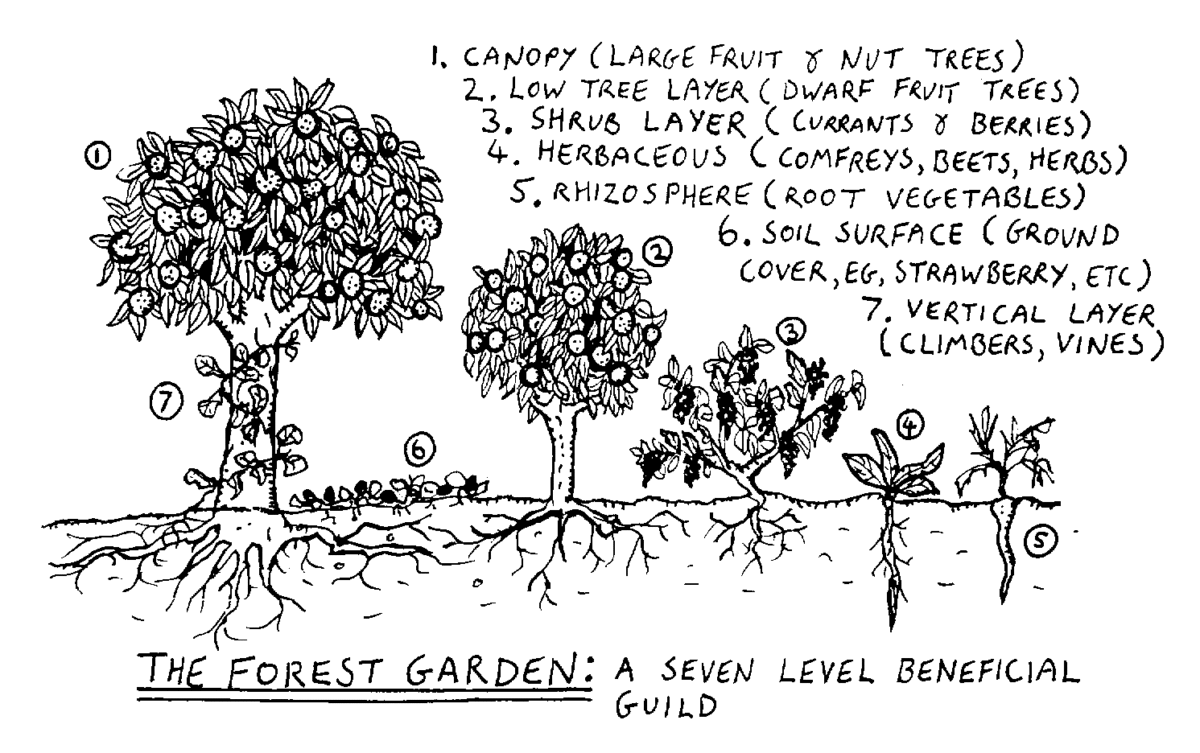
The idea in a Food Forest, on the other hand, is to cultivate an ecosystem of interconnected layers where a variety of plants live in relationship to one another.  

For example: 

Large fruit and nut trees toward the north or the back; 
Dwarf fruit trees around them, partly underneath; 
A shrub layer of currants and berries underneath the dwarf trees; 
Herbs and greens growing around the berries; 
Root vegetables underneath those; 
A ground cover at the bottom – like strawberries, or a woodchip mulch in which edible mushrooms grow; 
And, finally, some fruiting vines that climb up the larger trees, as vines do in the wild.  

A food forest is a set of interconnected layers rather than a monoculture of single kinds of plants. It is a metaphor for community: Not all the same. Not all needing the same things. Not all producing nourishment in the same ways or at the same time, but, all together, sustainable and sustaining with attention and intention in the design, with ongoing gentle support, watering, and continual adaptation as plants grow and change.  

So, that is one physical, earth-based, concrete metaphor for community and Beloved Community, in particular: interconnected layers of different kinds of plants in a mutually sustained ecosystem. It’s a far cry from the garden rows I weeded for hours and hours as a child in the hot sun.  

Beyond the “Family”

So now to blaspheme in another way…by sharing the blasphemy or the vision held and invited by Paula Cole Jones.  

Paula is a lifelong Unitarian Universalist, founder of ADORE, the acronym for A Dialogue on Race & Ethnicity, and a former president of DRUUMM (Diverse and Revolutionary Unitarian Universalist Multicultural Ministries), an organization of and for BIPOC (Black, Indigenous, and other People of Color) UUs. Paula, who lives in Washington, D.C., is a consultant specializing in multicultural competencies and institutional change. She brings all of those gifts to her insight.  

Paula suggests that we UUs let go of the metaphor of community as “family” – that we stop thinking of ourselves as a family.  

I know! Blasphemy, especially in this time after more than a year of being held away from each other physically by the virus, when the pull is so strong to connect and reconnect to one another and warmly so. But now’s probably the perfect time to consider her proposal – as we reconnect and reimagine our way forward. 

Paula Cole Jones has been sharing this vision for 11 years, most widely in a lecture she gave at UU General Assembly in 2019, our big annual gathering, our last onsite General Assembly before the pandemic. I’m going to ask Beth to please paste the link to Paula’s presentation in the chat right now, so you have it. I encourage you later to listen to Paula’s entire piece, the 1019 Sofia Fahs lecture, which is less than an hour.  

In it, she asks us to consider the dynamics that come with the metaphor of community as a family. It sounds so warm and wonderful, and in many ways it is. It served us well for a long while, but no longer, says Paula. Families, she points out, “have a structure, often a pecking order, there is a narrow lineage, and everyone knows, [or discovers,] where the authority is. Spoken or unspoken,” she says, “we all know who we can bring home and who we cannot.” At least comfortably. 

Family comes with a sense of everyone being similar in important ways, forming an inside, insular group, no matter how large and open and caring, who choose to let others in, or not, that defines the family, often without even realizing it, through its own set of rules, and traditions, and habits and expectations that new members have to learn and adapt to in order to be included.  

[The metaphor of community as family] is a beautiful sentiment,” says Paula, “but it doesn’t work as a vision.  It’s too narrow to describe who we are,” she adds.  She recommends to us that we claim a new identity. 

A Community of Communities

Paula says that the metaphor that matches who we truly are as a tradition at our best, that matches our theology, that matches this moment in time, that matches our congregations already, really, is the metaphor of being not a family, but a community of communities, just as the UUA is a community of congregations. 

People who study religious community dynamics have taught for a long time that as a community grows, it has to shift from thinking of itself as a single organism – as a family – – and has to understand that it becomes more like a cluster of cells, each cell distinct, but part of the whole. Paula Cole Jones goes further than that, to say that it’s not simply about organizational dynamics and the size of the community, although that has an influence, it is about our core sense of identity as UUs and what we are about – of being a food forest, in essence, no matter our congregation size.   

In Call of the Forest, the film I spoke of last Sunday, Diana Beresford-Kroeger speaks with Japanese botanist Akira Miyawaki, a man who promotes the building of forests in Tokyo, Japan, the most populous metropolitan area in the world, with about 38 million human residents.  He looks for even very small city spaces, working with local people to plant micro forests. In the film they show the smallest of them. It is this tiny narrow space at the very corner edge of a city block. It has all the layers: tall trees, understory trees, shrubs, lower plants, in soil rich with the life that such a forest requires and sustains. Professor Miyawaki says that to build a forest one needs a space only about 80 cm or 31.5 inches wide. 

When we think of the congregation as a family, Paula says we focus on the individual, rather than the more wholistic ecosystem, often to the detriment of community. We can allow any individuals in, even as exceptions to our norms, without ever changing anything about ourselves or how we do things. “We can like you,” she says, “and still distance ourselves from you and your community.” Cuz it’s OUR family.  

When we understand ourselves as a community of communities, we realize that we have to nurture relationships between the communities, not just between the individuals.   

So, when a person arrives, looking for, longing for a home, a person who does not feel or look or act or present exactly like the majority of others, we understand that we are called to nurture a relationship not only with that individual, but also with the community of which THEY are a part. That person is not an exception that made it through our barriers, but an invitation to reach out in relationship.   

Here?

I think about the challenge that we’ve felt, certainly that I’ve felt, to hold the community together as a singular thing, in essence as a family, where everyone has to belong to the whole. But in reality, that has never been completely true, even in the earlier days.  This congregation has always been a community of communities, even when small, and even though we often try to squeeze it into one big family shape.  

This shows up noticeably when we face our theological diversity. If we think of ourselves as a single family, with established rules and norms and expectations about what it means to belong, then talking about God on Sunday morning has some people wondering whether this is really their home. And NOT talking about God has other people wondering whether this is really their home. Or if someone is more politically conservative or on the outside edges of progressivism, and we are thinking of ourselves as a singular family, it will never feel completely like home to them, when the expectation and pressure is to be “family.”   

If, instead, we understand ourselves, from the start, as a community of communities, with a range of needs, and expressions, and we look for common ground without expecting everything to be held in common, then we can truly build Beloved Community, says Paula Cole Jones.  

Like I said, blasphemy! I come from a lifetime steeped, warmly, in the family metaphor. 

And many of the wonderful attributes of families that call to our hearts – intimacy, similarity, shared concerns, connection  –  are still available, once in a while even in the entire large group, but more consistently and deeply, within the smaller communities that make up our community: 

The Choir. The Finance Committee. The Board. The Walking Group. The Humanist Group. The Writers, Artm Men’s, and Women’s groups. Soul Matters Circles. The Buildings and Grounds Team. Art and Aesthetics. The Care Team. The Justice team and the Climate, Challenging White Privilege and Nisenan task forces, the Worship Team, Family Ministry, Stewardship, Nominating Committee, the Pandemic Health and Safety Committee, the Singing Meditation Circle, and all the groups, current and yet to be formed: all communities, if we expect and help them to be communities, that make up this community.  

We’ve misnamed committees, Paula, says. In truth they are communities – in which people express care, reveal themselves, share common interests, serve others, grow their spirits, and connect to the mission and vision of the whole congregation.  

For example, I’ve been hearing of and recognizing the need for a circle of people who can speak of and explore their relationship with God or spirit or the divine, without fearing that they’ll be attacked or ridiculed or dismissed, without feeling a need to apologize or to bring others along. Perhaps a caucus or circle of BIPOC or young adults ,is on the horizon, or….the community that YOU have in mind and heart.  

Like in the food forest, as the seasons turn and plants grow, and die, the communities will keep arising, changing, falling way, shifting adaptively, always maintaining the mutual ecosystem that supports them all.  

We know that unless people get connected to others in smaller groups, they tend not to find a home in a congregation like this one. Members of mega churches with 5000 or 10,000 members or more say that what they love most about their church is the intimacy. Because in order to be that big, churches have to do “small” really, really, well.  

As we emerge from the initial heart of the pandemic, our work is to be conscious about building a community of communities, I think, rather than a community of individuals – and to nurture the small groups in which people can be known, find real connection, and have their spirits deeply fed.   

The Opportunity Fair this afternoon, highlighting some of the teams, and committees and task forces of the congregation may sound like business, but is an invitation to find your community for this next piece of the journey. Not for forever, but for now. Working together in a small group to serve the whole, is what nurtures the larger community, and, at its best, is a powerful relationship builder as well as a deep opportunity for spiritual, emotional and intellectual growth, if we intend for and help it to be that.  

I strongly encourage you to join in the Opportunity Fair this afternoon at 1:00 not because it will give you all your answers, but because you’ll have a chance to talk, connect, imagine, laugh, explore, try on possibilities in your own heart and mind. If nothing else, come to support the people in those groups by listening to them and asking questions, learn more about what they are doing, even if you are not feeling like you have the time and energy to join them in the work.  

“we can only find ourselves through shared becoming.  This is loving and being loved.” 

~ enfleshed ~

In many ways, we need to build and rebuild this particular community of communities for the new day. Today, and in the weeks and months ahead, come, see where you might best find your sustaining community now within this community, and consider how you might help others find theirs.  

If we all do that, and become a community of healthy, thriving, communities, we’ll not only transform this congregation, we’ll be building skills to help the community outside our walls to do the same. And we’ll even find some of what we thought we needed in a family.  

So may we be.  


Works Cited, Referenced, Consulted 

Building a Community of Communities. 2019 Sophia Fahs Lecture by Paula Cole Jones. 56 minutes. https://www.uua.org/ga/past/2019/workshops/sophia-fahs-lecture 

Creating a Community of Communities. A 2020, online follow-up workshop to Paula’s original address. With Paula Cole Jones and Renee Ruchotzke. 1 hour and 29 minutes.  https://www.uua.org/leadership/library/communities 

Call of the Forest: The Forgotten Wisdom of Trees. –A video available on Vimeo and Amazon. 1 hour. http://calloftheforest.ca/ 

Take a walk in the woods with acclaimed Irish-Canadian scientist and author, Diana Beresford-Kroeger, as she reveals our profound human connection to the ancient & sacred northern forests and the essential role that they play in sustaining the health of our planet. 

Coming Together to Restore our Earth – April 18, 2021 – Rev. Kevin Tarsa

Coming Together to Restore our Earth  

Rev. Kevin Tarsa 

A sermon delivered April 18, 2021 via Zoom to the 

Unitarian Universalist Community of the Mountains

Out of Thin Air

From our Earthbound vantage point, the enveloping sky and atmosphere above us seem endless, or at least immensely vast.  

 From the space station that circles the Earth, having gained some distance, we can see our Earth’s atmosphere as the thin protective skin that it is.  

 In a recent local League of Women Voters’ presentation organized by our very own Carol Kucsora, I learned from Gary White that if you were to drive a car at highway speed directly upward into the sky, it would take 10 minutes to get to the end of the breathable atmosphere. That might seem like a good distance, a 10-minute drive, but at the scale of the entire Earth, that 10-minute drive wouldn’t take us very far from the Earth’s surface. It is indeed a beautiful, protective, and thin skin. 

Whether or not you know the latest data, I am going to assume that you know that the Earth’s climate is changing, with a rise in the Earth’s temperature that could have dire consequences for many lifeforms on the planet. I expect that most of us here accept scientists’ research indicating that our human behavior and activity are contributing to the rise in temperature through our short-sighted use and abuse of land and its resources, and through our significant contributions of carbon dioxide to Earth’s atmosphere.  You may know that it’s happening even faster than predicted. As Jeff pointed out, the hopeful among us say there is still time to make a meaningful difference, if we act with courage and solidarity and soon, meaning now. We’ve got 9 years, according to Gary White, who gives a helpful presentation of the current data, and his reasons for hope. in the local League of Women Voters video that you can watch online.   

UUCM’s climate change task force has encouraged the legislative approach.  

Here’s Bob Miller with an update. [click for video]

 I like to point out that for many people, pursuing legislation is not a sexy approach, and that often the effective actions are not the sexiest ones. 

I felt a dilemma when preparing for this Earth Day service – wondering how to approach the sobering realities of climate change and its effects without adding to people’s existing sense of overwhelm after several years of unrelenting uncertainty and fear. Rather than crying out that the sky is falling, which it is, and telling exactly how it’s falling, which others do so well, I want to take a different approach, which is to invite us to notice not whether we should care, but how we each care.  

Help From Adam Robersmith and Our UU History: For the Love of God 

I received some help from a piece in the book Justice on Earth, written by UU Minister Adam Robersmith, who offered me a doorway to speak to this moment through the lens of our tradition’s history and our tradition’s particular take on what matters.   

So, to look back for a moment, to a time when the predominant religious leaders in this nation were preaching hellfire and brimstone in the 17 and 1800s, preaching that you better shape up or you’re going to burn in hell, our Universalist Christian forebears offered an alternative message – that God loves you and everyone, completely and unconditionally, and you are going to be okay, in the end, no matter what.  

Hosea Ballou, our nation’s most powerful exponent of Universalism, listened to the common religious messages of the day, and said, now wait a minute. You’re telling people that the reason they should love God and the reason they should be good and do good, is because if they don’t, they are going to be in big trouble, or you are telling them that the reason they should love God and good is because if they do, they will get a big reward. Well, what does that say about God and about the value being and doing good?, he asked.  

Now, to those of us for whom the concept of God is not helpful, I offer a humanist slogan as a bridge. The saying is: “I spell my God with two O’s, and the devil without a D.” It names a focus on doing good and challenging evil behaviors in this world.  

In the cadence of his day, Hosea Ballou wrote: 

“The preaching of future rewards and punishments, for the purpose of inducing people to love God and moral virtue, is not only useless, but pernicious. All such preaching, be it ever so well intended, not only amounts to a declaration, that God and moral virtue are, in themselves unlovely and unworthy of being loved, but, as far as it is believed, serves to alienate the affections from those most precious objects.” 

If the only reason people would love God or good, is so they won’t be punished or so that they’ll get a reward, that not only says that good and God aren’t worthy of our devotion all by themselves, it pushes us away from them so that we are less likely to love them.  

The alternative, he said, is to believe that God and good are worthy of our love because they are precious and inherently valuable in their own right. Worthy of our devotion because of who and what they are, independent of rewards or punishments. 

Rev. Adam Robersmith draws a parallel between that Universalist thinking and our approach to climate change and our relationship to the Earth. 

He asks, “Are the nourishments, life-sustaining cycles, and blessings of this world only worth saving because we should be afraid of some hellish future?” 

In other words, are climate crisis warnings the modern-day equivalent of fire and brimstone sermons, preaching that if we don’t stop sinning, we’re going to bring on the apocalypse and burn for all eternity. And is that the most helpful motivation? Does the threat of fire and brimstone actually inspire people to change their behavior?  

Adam writes, “Let us not [work for] change out [of fear] of some future hell, lest we link acting faithfully to fear, rather than love; lest we link action to disaster, rather than reverence.”  

It’s one of those internal shifts that can make a significant difference.  

As Jeff Stone pointed out, sometimes and for some of us fear does help get us past our inertia.  Fear may indeed be helpful and even necessary for some of us. And there will be no shortage of it available. There is plenty of information and fabulous presentations that will scare the pants off of you.  

And it is important to know that there is another way available:  it is to protect the Earth, to protect our grandchildren’s grandchildren, to protect those who will suffer first and most from climate changes – not first out of our fear of impending disaster, but first out of our love, and to recognize it as such, including our love of the Earth because it is inherently worthy of our love and affection – not for its economic value or even the safety and sustenance it provides us, but because of the extraordinary reality it is, with our without us.  

Adam Robersmith writes, “If we, as a nation, a people, or a species, loved this planet as our Universalist ancestors understood loving God, we would have already made so many different choices about how we live on this Earth and with each other.” 

If a Tree Falls 

Jeff told me about Diane Beresford-Kroeger, an Irish-Canadian scientist who speaks “of our profound human connection to the ancient and sacred northern forests and the essential role they play in sustaining the health of our planet.” In a beautiful, moving, and inspiring film – Call of the Forest: The Forgotten Wisdom of Trees – she takes us around the globe, sharing not only the extraordinary revelations of science, but also her tremendous and contagious love for the trees and forests of which she and others speak. It is a heartening film, spiritually and intellectually heartening.  

She speaks, for example, of the 1000-year-old tradition in Japan of “forest bathing” – which is to walk through a forest bathing in what the forest offers. And this isn’t simply about liking forests and so enjoying the experience because of that. Diane lists a litany of medicinal aerosols that trees produce and that we breathe in when we walk through a forest, chemicals that directly benefit our immune systems and trigger our nervous systems to relax. Walking in the woods feels good not only because we like forests, but also because the gifts we are breathing in are doing us neurochemical good.  

Diane invites our personal, deep, everyday, at-home grounding in the Earth and its spectacular and sustaining marvels right in our yards. After watching the film, I could not help but go out and observe more closely the world in my backyard and to work in my garden immediately. And while she names with clarity the current dangers to those forests and trees that she so loves, she also lifts up reasons for hope – reasons grounded in those very trees. She says, for example, that if every person planted one tree a year for 6 years – one native species tree to an area – we could reverse climate change. Like Robin Wall Kimmerer, Diane Beresford-Kroeger embodies that love of which Adam Robersmith writes- It’s a beautiful and profound love. Maybe it’s a kind of love that motivates, or could motivate, you. I commend the film and Diane’s work to you. Thank you, Jeff! 

Environmental Justice 

Or… your strongest motivation around climate change may be rooted in your loving compassion that calls you to care about the well-being of those who will suffer first and most from climate changes…those with the least voice and power. As Jennifer Nordstrom put it, “While the entire world may be threatened by climate change, the individual threats we face are particular to where we live, and our access to power and resources (Justice on Earth 6).” Here too, a glance into our tradition’s history sheds some light. Back to the 1800s again, transcendentalists Ralph Waldo Emerson and Henry David Thoreau set the tone and articulated a perspective not only for their fellow Unitarians, but also for the nation to this day.  

Sofia Betancourt, Associate Professor of Unitarian Universalist Theologies and Ethics at Starr King School for the Ministry in Berkley, reminds us “that not only are we profoundly shaped by their idealized vision of one white man communing with the wilderness [think of Thoreau in his Walden Pond cabin] we are also responsible,” Sofia says, “for reimagining the transcendence they offered us.”  

I invite you to notice what comes to mind and heart when you think of “the environment.”  Sofia points out that when we think of the environment, those of us with white, western European heritages tend to hold in our minds and hearts an image of a beautiful, pristine wilderness – a “landscape untrammeled and unpopulated by human beings save one single . . . person [like ourselves perhaps] . . . actively communing with a sublime part of nature (Justice 41).”  For many it’s an image of natural wilderness, devoid of people, that needs saving, and that would ultimately get “preserved for the privileged few.” I think of the Nature Conservancy, which I’m not dissing, just recognizing. It’s built around a particular image of nature and its value. 

But here, too, there is an alternative.  

Sofia names for us that environmental justice is about addressing “environmental devastation [and at] the same time addressing gross injustices within the human family (41).” It is to notice and to learn how centuries of environmental devastation are directly tied to centuries of human oppression. 

Think indigenous people. Think enslaved people. It’s to know that garbage and waste and toxicity are again and again and again dumped into communities where people have the least wealth and power to combat it. To know that 98% of farmland in the U.S. is owned by white persons, and not by accident. It’s to notice who has access to what kind of food. It’s to understand that the ways indigenous people were “removed” from their land continue to shape how people and land are treated in our country now. It’s to be aware that we cannot achieve our beautiful image of justice and sustainability for the Earth without achieving justice for its people.  

It means not imaging an idealized, pristine wilderness without people, but a compassionate world in which people are in right, just, equitable, sustainable, and sustaining relationship with each other AND with the Earth. It’s a vision of the ideal environment, that in which people are an integral part of the environment, not separate from it.   

And? 

It is clear that climate change and our contribution to it threaten the lives and well-being of many on the planet, and that we are called to use the resources, the power, the influence we have to make a difference while we can, in all the ways that we can. It’s not the Earth that needs restoring, it’s our relationship to it.  

I haven’t focused today on “what to do” – though anytime someone wonders whether we need to focus on legislation, or on recycling, or on reforesting, or on growing more of our own food, or on reducing fossil fuel extraction and use, or supporting BIPOC farmers, or reducing our consumption of animal products, or wasting less, the answer is, of course, yes. Like a true forest with all of its layers and incredible interconnected diversity, we need an ecosystem of approaches to the falling sky. 

We know there is danger. We got that, or at least there are many sources for learning that. What I invite you to do today, is recognize your own strongest and best source of motivation to do something. The doing can keep changing and evolving and will be more sustainable, if it’s anchored in the motivation that is most true for you.  

Maybe for you it is fear, maybe fear energizes you, activates you in ways that help you feel less helpless. Go looking for some of that doomsday data and the scientists’ warnings. They are powerful, and indeed motivating.  

Maybe for you the most passionate motivation is rooted in love sheer love for this extraordinary Earth and its extraordinary life. Draw on it. Watch Call of the Forest: The Forgotten Wisdom of Trees or read Diane Beresford-Kroeger’s books if you want to strengthen it.  

Maybe for you, the call to act is motivated by your love for your children, grandchildren, students, or nieces and nephews…your people and relationships – hold them in mind and heart, and commit to working toward legislation that would operate at a big enough scale to make a difference. 

Maybe what most moves you is your love and compassion for those who suffer under layers of intersecting oppressions, your transcendent vision of true beloved community co-created by all its participants, equitably.  

As Adam Robersmith puts it – Adam meaning “Earth creature”:  

“It is time for each of us to make one more choice that decreases the impact we have on the Earth, to use less, to enrich more.” I invite you to make one more choice to use less, to enrich more. And to do it “because it is the right, respectful, loving thing to do now (Robersmith 54).” 

To close, the words of Theresa Soto: 

“You must not believe the lying lie that you do not matter, that whatever change you can organize is so insufficient as to not be worth your time, your energy, your life force. You must be willing to dream a dream that carries forward your community. This is how we rise (Spilling the Light).” 

So may we be. 


A few resources:  

Citizens Climate Lobby. https://citizensclimatelobby.org/chapters/CA_Nevada_County/ 

League of Women Voters of Western Nevada County: Solutions to the Climate Emergency.  https://www.youtube.com/watch?v=CKcALRrUyk4&t=217s 

Soul Fire Farm. An Afro-Indigenous centered community farm committed to uprooting racism and seeding sovereignty in the food system. https://www.soulfirefarm.org/ 

UU Ministry for Earth. https://www.uumfe.org/ 

UUA Climate and Environmental Justice. https://www.uua.org/environment 

The Climate Reality Project. https://www.climaterealityproject.org/ 


Works Cited, Referenced, Consulted

Ballou, Hosea. An Examination of the Doctrine of Future Retribution: On the Principles of Morals, Analogy and the Scriptures. January 1859. 

Call of the Forest: The Forgotten Wisdom of Trees. – A video available on Vimeo and Amazon. 1 hour. http://calloftheforest.ca/ 

Take a walk in the woods with acclaimed Irish-Canadian scientist and author, Diana Beresford-Kroeger, as she reveals our profound human connection to the ancient & sacred northern forests and the essential role that they play in sustaining the health of our planet. 

Justice on Earth: People of Faith Working at the Intersections of Race, Class, and the Environment. United States, Skinner House Books, 2018. 

Soto, Theresa I.. Spilling the Light: Meditations on Hope and Resilience. United States, Skinner House Books, 2019. 

So the Dough Isn’t Ready – March 28, 2021 – Rev. Kevin Tarsa

Watch for the service video. Soon!

So the Dough Isn’t Ready

Rev. Kevin Tarsa
Unitarian Universalist Community of the Mountains
March 28, 2021
delivered via Zoom

Rabbi Rachel Barenblat’s wonderful reading, “Ready” from her Velveteen Rabbit’s Haggadah for Pesach, preceded the sermon.

OF KNEADING BOWLS

I have my great grandmother’s kneading bowl.

Well-used, slightly rough, bread-crust-golden, ceramic, with only a few small chips at the edges for all its years, and a delicate web of hairline fractures threading through it. It’s beautiful. It’s in Michigan, or I’d hold it up for you right now.

During my recent stay-cation, when I wasn’t ready to travel yet in order to see family, I visited a different way, I dove into some genealogical research, trying to trace family lines beyond this continent, back to Catholic Eastern Europe and the war-torn part of Poland that kept changing political hands and names. I know precious little about my father’s maternal Grandmother, born around 1875 in what was then Austria, but I do know that for the other side of my dad’s family, his father’s line, my grandmother and great grandmother were from the wrong side of the tracks. My grandfather’s family disowned him quite completely.  Since all my great grandparents on my dad’s side (and a number on my mother’s side) came to this country in the late 1800s, I’m wondering what brought them, and what the journey was like, within and without, how ready they were, how lightly they needed to travel, what words, what mothers’ songs, what inspiration they brought with them, wrapped in the cloaks upon their shoulders.

I’m thoughtful also about our own current journeys into new internal and social territories. What readiness are we being called to? What new alphabets may we need to learn? What improvised, flat cakes will we need to make without relying on our familiar, tried-and-true yeast?

MORE THAN A STORY

I so resonate with that wonderful reading by Rabbi Rachel Barenblat. I know, quite often, that experience of not feeling fully ready, always needing one more thing to feel ready, such that I never quite take the leap, the necessary leap. Perhaps you know that experience too, but as Rabbi Barenblat tells each of us:

Infinity is calling you forth 
out of this birth canal
and into the future’s wide expanse. 

And what a birth canal we are in right now, all us, each and together!

That reading is from the Rabbi Barenblat’s Velveteen Rabbit’s Haggadah for Pesach.

The Jewish Festival of Pesach, or Passover, began yesterday evening, at sundown and continues through next Sunday.

Haggadah means “the telling.” The Seder meals this week in Jewish communities and households will retell and celebrate the story of the ancient Israelites’ exodus from Egypt and their liberation from enslavement. They had come to Egypt centuries before, in order to survive, after famine ravaged their homeland. At first, they were welcomed, but times and leaders changed, and the Hebrew people were seen by a later Pharaoh as a political threat.

This is the story of Moses, the midwives, the Pharaoh’s daughter, the series of plagues, the Hebrew households Passed Over by death that took the firstborn of each Egyptian household, the Pharaoh with the waxing and waning hardness of heart, the Hebrew’s crossing of the Red Sea, or Sea of Reeds, Miriam dancing. The exact details depend on the Haggadah, in other words, on who’s doing the telling. Soldiers who liberated people held in the concentration camps at the end of World War II revised their Haggadot immediately. Freedom Haggadot arose in the 1960s and 70 in response to the civil right’s movement. There are Haggadot that center the women who hold the most significant moral courage in the biblical exodus story.

More than a telling, however, no matter how told, the Seder meals and rituals will embody that liberation story on the tongue, offering a literal taste of the bitterness of enslavement, the saltiness of tears, and the sweetness of God’s deliverance, for example.

More than that, the Seder meals will invite the people around the Seder table to experience exodus and liberation not as a story from an ancient past, but as their own personal experience unfolding in that very moment, their own experience of exodus, of leaving and liberation, the past sacred only to the extent that it informs and guides the present, meaningful only insofar as it liberates people now.

PALM SUNDAY

In many Christian traditions, today is Palm Sunday, Passion Sunday. Its Biblical story marks the triumphant arrival of Jesus in Jerusalem shortly before he is executed. Jesus rides into the city on a colt, a young donkey, and the joyous crowds, it is written, wave palm fronds and place them on the path before him. They lay their cloaks on the path too, the palm fronds a symbol of military victory, their personal cloaks a symbol of homage and submission, as might be placed before royalty. The people’s enthusiasm is born of their hope that Jesus will overthrow local Roman rule and/or the rule of the Jewish Temple hierarchy. Either way, their hope and their joy is that they will be liberated!

Here too, the story that unfolds during the week to come is made sacred by its ability to liberate people in the present. The Palm Sunday story already hints that the liberation may not be the liberation expected. Having Jesus ride a young donkey into the city is a storyteller’s way of linking Jesus back to prophesies in the Hebrew bible, and so to legitimize his role to Jewish people in early Christian times, but there is another layer of symbolism. Whereas horses were symbols of war, strength, and military might, the more humble donkeys were symbols of peace, evidence that this is not going to be the usual victory story, not the expected kind of liberation.

The two stories are connected by the celebration of Passover, also known as the “Season of Freedom,” a reason for Jesus to be in Jerusalem in the first place, and a time of year when Passover’s liberation story frequently stirred up rebellion and revolt in the Hebrew people. The likelihood, according to some scholars, is that Romans arrested and executed Jesus in a proactive attempt to squelch the anticipated, annual heated rebellion by the Hebrews. He was a rabble-rouser. The triumphal energy of Jesus’ entry into Jerusalem would have indicated to Romans his dangerousness to the status quo. Black Lives Matter protests come readily to mind and heart. The liberation that Jesus’ life and death and teaching offered to so many, ultimately, was an internal liberation, rather than a political one, and all the more powerful for that reason.

THE DOUGH?

And what about the bread, the unleavened dough? It is portrayed and understood as part of the Hebrew people’s experience of needing to leave Egypt in a hurry, when they had a chance, when the Pharaoh consented for a brief moment, to their release. There wasn’t time for the dough to rise, it is said, the dough wasn’t ready, so they took it along “as is,” and commemorated the experience ever after.

People who study such things say that the celebration of Passover appears to combine two ancient traditions, the spring rituals of Shepherds around the annual births of their lambs, and the farmers spring ritual of preparing for the early harvest of barley. Farmers would clear out all the old grain, and any leavening, in order to make a clean start for the new season. The elaborate rituals undertaken in kosher Jewish households, the rituals to remove all leavening and risk of leavening are meant, of course, to accompany and support an inner clearing out and readying for what’s to come.

As we get ready to make our way out of our COVID-19 exile, in this annual season of birth, and clearing out, and preparation for early harvest – this “season of freedom,” this month focusing on commitment, this year of political division and racial reckoning – my invitation to us all, is to let the spirit of Passover, and Palm Sunday, and Holy Week, call us to consider our own needed exodus – our own stepping into the water, our own desire for liberation for ourselves and others, informed, by our vision of the world we dream about, our hoped-for land of promise, of both milk and honey.

OUR OWN READYING, OUR OWN UNREADY DOUGH

I invite you into a time of reflection and thoughtfulness, to help seed that reflection.

First, I invite you to be aware of your body and your breathing….

To let any thoughts go with a simple noticing, and a farewell…

Always, breathing…

It’s been an entire year since we were called into our homes for our own and others’ safety and wellbeing. An unexpected and entirely new kind of year.

As you hold this last year in your heart, in your mind, in your body,

with all the feelings it’s held –the worry, the grief, the gratitude, the fear, the relief, the uncertainty, the clarity, the longing, the hope –

with all the feelings you are holding now

with all the discoveries you’ve made about yourself – some surprising, some confirming, some subtle new twists on who you thought you were –

allow yourself to imagine moving into what comes next with a sense of freedom, and hope and release… freedom, hope and release felt in your body….

Imagine the life and landscape that would offer that sense of freedom, and hope and release to you,

Imagine what it feels like to move into that life and landscape that you long for, into the freedom you long for,

…freedom for yourself, freedom for others.

What does it feel like in your heart, your mind, your body?

Is there a part of you that is not ready,

perhaps because there are simply too many unknowns to go much farther yet?

Is there anything in you that hesitates?

Is there any part of you that feels held in, held back, held captive in some way?

What holds you? What keeps you from moving forward? From stepping into the water?*

(*a reference to the Midrash and Talmud story of Nachshon offered earlier in the service – wherein the Red Sea did not part for the Israelites fleeing enslavement in Egypt until Nachshon stepped into the water and walked in far enough for the water to reach and, some say cover, his mouth and nose. Another telling of the story says that the water did not part to open safe passage until everyone got into the water, arm in arm.)

Would it help you to wear God like a cloak? Wrapped around you?

Would it help to wear Love like a cloak, wrapped around you?

To stride forth with confidence, though you don’t know where you are going?

What are the words of your sages that you carry with you, no matter how lightly you travel, the wisdom shared that is now within you?

What are the songs of your mothers that feed you, comfort you, encourage you?

What inspiration is wrapped in your kneading bowl, with its flour ground from the corners of your recent experience, collected from your most recent harvests?

Infinity is calling you forth 
out of this birth canal
and into the future’s wide expanse. 

Trust that when the time comes what you carry will sustain you,

And take the first step, the first roll, the first forward movement

Out the door,

Or maybe, into the water.


May you be so.

Together, connected to one another, may we be so.