Dare We Dream? – January 17, 2021 – with Eduardo Hernandez, Tracy Pepper, and Gail Johnson Vaughan

Who among us is not inspired by Dr Martin Luther King Jr’s “I Had a Dream” speech? For many it guides our action and fills our imaginations of a world more just. But what if the dream is deferred or worse yet, denied? Langston Hughes’ poem “Harlem” stands with King’s dream as bookends to the chronic tragedy that holds our country back from fulfilling our national pledge of liberty and justice for all. This Sunday we celebrate Dr. King’s birthday with a tapestry of reflections on what happens when such a dream is deferred.

In This Moment, In This Breath – January 10, 2021 – Rev. Kevin Tarsa

Underneath our differences, we can recognize a set of universal human needs, says the Rev. Cat Cox. That’s the place to start, she teaches, if we want to get past what feel like irreconcilable differences. This Sunday, we focus on our interpersonal relationships as we continue to explore the crucial zone of possibility between stimulus and response. Goodness knows we’re going to need it!

Imagine – January 3, 2021 – Rev. Kevin Tarsa

What is the place of imagination in our lives – our spiritual, emotional, and intellectual lives – especially in these times? We begin the new year by introducing our January theme of Imagination, and meet again the Roman god Janus as he looks back and looks forward. But what about NOW?

Find a Stillness in the Inner Voices – December 27, 2020 – Rev. Kevin

When we are in stillness, we are more apt to hear the still small voice, the one that sometimes comes with insistence – at other times, almost shyly. What is that voice? Is it the voice of God? Is it our higher self? Is it our inner knowing? Whatever it is, this is an opportunity to listen. What does it tell us? Maybe it is an invitation to come in out of the cold, come down out of the clouds, come up out of the muck. What we hear is probably what we need to hear to find ourselves after being lost in the tumult of our times.


Christmas Eve 2020 Candlelight Service – December 24, 2020

UUCM Christmas Eve 2020 Candlelight Service: music, candlelight, poetry and singing to touch the spirit of this night.

Greeting  – Rev. Kevin Tarsa 

Song for Gathering  The First Noel  – The Rivers-Samson Family: Olivia, Allison and David  

Opening Song  Once in Royal David’s City #228  – Jordan Thomas-Rose, with Michael Bankston, trumpet; Kate Canan, flute

Welcome – Lindsay Dunckel 

Lighting of the Chalice   Fellow Sojourners by Dan Lambert – read by Gail Johnson Vaughan 

Chalice Music  Promise of Peace by Hal Walker  – sung by Julie Tillinghast, Jordan Thomas-Rose, Rev. Kevin Tarsa   

Lighting Your Home Chalice 

Land Acknowledgement and Opening Words  The Work of Christmas by Howard Thurman – Rev. Kevin Tarsa

Song  O Come All Ye Faithfull #253 (vs 1 and 3) 

Reading  from the Christian Gospel of Luke – read by Gail Johnson Vaughan 

Interlude  Lulajze Jezuniu, traditional Polish Carol –  Rev. Kevin Tarsa

Reading  The Shepherd Who Stayed by Theodosia Garrison – read by Chuck Champlin 

Song  In the Bleak Midwinter #241  – The Thomas-Rose Family: Stan, Erin, Jamie and Jordan 

 Reading  Worthy of Beauty by Rev. Paul S. Sawyer – read by Lindsay Dunckel 

Interlude  Rise Up, Shepherd – Rev. Kevin Tarsa

Reflection – Rev. Kevin Tarsa 

Offering 

Christmas Eve offerings support the UUCM Minister’s Discretionary Fund, used to assist people in need throughout the year, both within the congregation and in the wider community. 

Offertory  Ave Maria by Bach/Gounod  – Julie Tillinghast, voice   Rev. Kevin Tarsa, piano 

Reading  Christmas Evensong by the Rev. Mark Belletini, from Sonata for Voice and Silence – read by Gail Johnson Vaughan 

Closing Carol and Passing of the Light   Silent Night  #251 

Closing Words  Christmas Eve Benediction by Maureen Killoran – read by Rev. Kevin, Gail Johnson Vaughan, Chuck Champlin, Lindsay Dunckel 

^ Community Benediction / Extinguishing of the Chalice  

                   Carry the flame of peace and love until we meet again.  

Thank you & Music for Going Forth 

A Teddy Bear Christmas Pageant

A Teddy Bear/Stuffed Animal Christmas pageant, with some soft and beloved friends.

Special thanks to

casting director and scene designer, Delaney Sherr, who was assisted by Greg Sherr and Rev. Kevin
René Wiley for the idea and invitation, as well as for prop wrangling
Jordan Thomas-Rose for the music, with an assist in this edition from Julie Tillinghast and Kate Canan
All those who shared their beloved stuffed companions, including Anita’s 93-year-old teddy bear, purchased by her grandmother.

The narration used in the pageant is based on Rev. Dan Harper’s adaptation of the “No-Rehearsal Christmas Pageant,” which he based on text borrowed from Rev. Jory Agate, who got it from “someone else,” . . .

Here’s the video of the pageant itself that formed the center of our early Christmas Eve service.

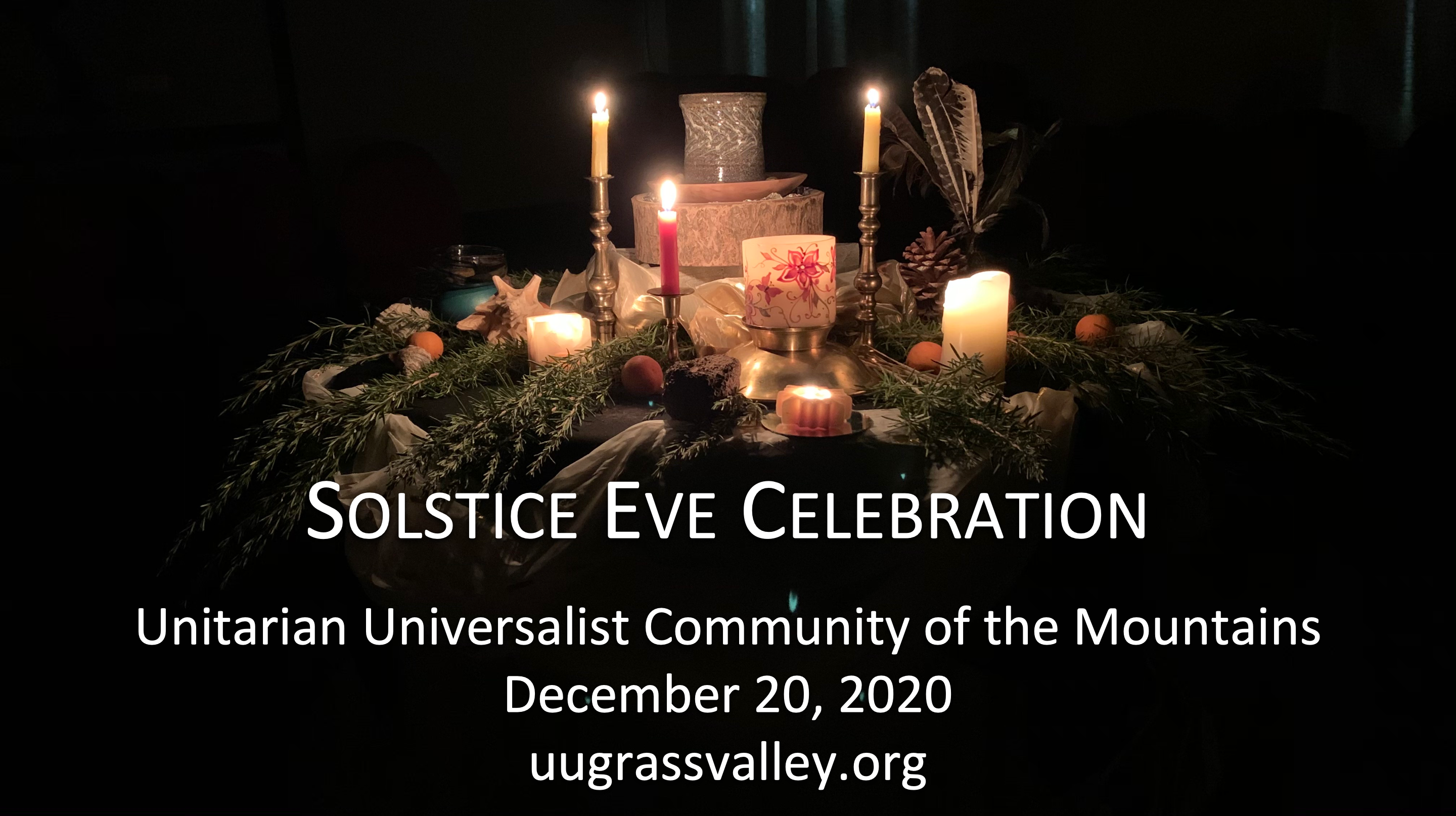
Solstice Eve Celebration – December 20, 2020

A Solstice Celebration to celebrate the dark and the light as we pause to mark the turn around this edge of the year. Chanting, poetry, story, silence and ritual. Have your candle and your noisemaker ready!

Share the link with your friends who might appreciate the service, and take time to settle in yourself.

Beth Karow guides us through the hour, with storytelling by Rev. Karyn Packard, music by Jordan Thomas-Rose and Kate Canan, Beth Karow and Rev. Kevin, a poem by Holly Rice, a stunning solstice altar, Carmen lighting the Cauldron, raucous celebrating and more…


Find a Stillness in the Wholeness and Holiness of the Season – December 13, 2020

Find a Stillness in the Wholeness and Holiness of the Season

Rev. Kevin Tarsa
Unitarian Universalist Community of the Mountains
December 13, 2020
via Zoom

Video of Full Service

A STORY

A story I read about ten years ago has stayed with me.

Shortly after her father dies, a woman’s 8-year-old son begins having severe health issues, which are eventually diagnosed as a form of lupus. For a few years the boy is in an out of the hospital with many, shifting, severe and painful symptoms, and dangerous reactions to the medications that treat the lupus, including heart attacks. He is close to death numerous times, especially while he is in a comma for three months, and not expected to live. Yet, when he is once again awake and alert he is, as much as he can be, his usual, funny, clown of a self.

In the midst of trying to hold herself together and make sense of holding both the joy and the terror of having a beautiful and funny son who is often in pain and not likely to live too much longer, Evelyn, who described herself as a secular nothingist, bumps into a rabbi who had offered a reading at her father’s memorial service. When the rabbi asks her how it’s going, she tells the story, the real story, including of the many well-meaning people she encounters in the hospital who offer religious platitudes and explanations for her son’s illness that are no help and that make no sense to her.

After a meaningful conversation about what religion is and is not, and what causes illness and what does not, the rabbi says, “I have an idea. Why don’t you try celebrating Shabbat on Friday. I’m not trying to convert you. Just clear your table, put on a white tablecloth, get out your nice dishes, the ones you save for company or special occasions. Serve something special or order out, light a couple candles, pour some wine and toast each other.”

So, that Friday evening she makes taco delight, even though it’s messy to make and to eat, knowing that her family likes it. For the first time in a long while they roll their son up to the table. He is being fed through a tube at that point and can’t eat. But when it comes to toasts each other, he toasts, and toasts, and toasts, and they laugh and keep toasting and Evelyn said it was like celebrating Thanksgiving and Christmas and their birthdays all at once, all the holidays they had missed while he had been ill, and they so enjoy these moments with each other that they don’t even watch TV that night and instead the kids play goofy made-up games with each other into the evening.

So, they do it again the next Friday.  And the next.

Evelyn said that in the middle of all the tremendous pain, and worry, and messiness, every Friday they celebrated beauty and joy and each other. It transformed them and their experience of what was happening.

Her son dies about 6 weeks after that first special meal. He dies on a Friday. Friends bring them dinner and they once again hold their family Shabbat as only they know it.  At the gentle invitation of the rabbi, who had been with them in the hospital earlier that day when her son was dying, she attends the Shabbat service at the synagogue for the first of many future times.

(Kathryn Armstrong’s story in Berman, Phillip L.. The Search for Meaning: Americans Talk about What They Believe and Why. United States, Ballantine Books, 1993.)

I have long valued rituals in my life, and when I read this woman’s story years ago, I was taken by the power of such a simple ritual act – a weekly meal set aside to be different from all other meals, an act invited and undertaken without any overtly religious meanings or words attached to it at the time. I was taken with the value of time set aside, repeatedly, regularly, physically, sensually dedicated to simple intention and attention and connection.

Just… just that.

THIS YEAR

Usually at this time of year, the holidays come barreling down upon us with all their frantic expectations, and in some ways they are coming up mighty quickly and with pressure, but there is also new space around them this year, opened up by stay-at-home orders that give us a chance to look anew at what we’ve always done and that invite us to consider what we really want to happen this year and in the future. They can invite a special kind of internal stillness and integrity this time, amidst the losses we are grieving. A stillness from within which we can see and sense what’s around us more clearly and openly.

It’s been an anxious year, for many of us, and it’s likely to be angsty for a while yet. If we want to find stillness in this season, we probably can’t simply will ourselves there, though a few among us do have tried-and-true spiritual practices to draw upon for centering. The rest of us may be able to draw on the familiar rituals of the season to help, the physical rituals themselves, freed from outside expectations and anyone else’s meaning that might interfere – candlelight, fire, singing, food, a nice table and meal, Christmas tree lights and decorations, conversation, even over Zoom or the phone, breathing more slowly. All of these have value, even outside of any explicit meanings we give to them.

THE EYES HAVE IT

A set of detours. And then I’ll swing back ’round.

First, I learned recently that the retinas in our eyes are a piece of our brain. Not merely attached to our brain, but a piece of the brain itself. These windows to our souls, found a way to get outside of our thick skulls so they could take in light, not first in order to see objects, but first to register the rhythm of daylight and darkness, the rhythm of the sun, which then sets all of our internal clocks to match the season and synchronizes our internal organs’ processes, our circadian rhythms. Birds’ skulls are thin. Light can shine right through them and they, like reptiles even have a hole in their skulls that allows even more light to shine through to reach the pineal gland that registers it. Our human skulls are thick, which protects our brains, but does not let the light pass through.

(from interviews on YouTube with Dr. Andrew Huberman, including this interview with Lex Fridman: https://www.youtube.com/watch?v=Ktj050DxG7Q&pbjreload=101)

Through our eyes, we are tuned not only to each other, but first to the light of the season and its rhythms. It is no accident that candles and fire and light figure so prominently in the holidays and holy days of December in the north. They are not merely symbolic representations of something we miss. Human beings figured out long ago, by experiment and experience, which activities help surface feelings of hope and connection and joy and possibility when the nights are longest and food production has dwindled for the year. I think it’s in the gospel of Luke, Chapter 11, where they address seasonal affective disorder. Or maybe it’s the Tao Te Ching.

MOUTHING THE WORDS

A second detour. I’ve come to realize that I self-soothe sometimes by eating, I’ll eat handfuls of something before I realize how much I’ve eaten and without taking time to enjoy the taste after the first bite or two. I’ve learned to try to eat one small piece at a time so I can keep the eating going for longer. I’ve learned that an important part of what soothes us, in the act of eating, isn’t the content of the food itself, as much as the use of our mouths. The movement of our mouths and facial muscles is associated, neurologically, with connecting to other people, particularly in determining whether another person is safe to be with and communicating whether we are safe to be with. Chewing, talking, singing, reading aloud, using our mouths and facial muscles has a calming effect all its own that communicates to our body and therefore our entire being that we are safe, that all is well.

Singing, humming, eating, talking, speaking words out loud have value even outside of the meaning we give them.

SOFTLY, SOFTLY

One more detour. There is a practice in some Buddhist meditation traditions of holding a soft gaze while meditating.

The idea is to look at something without really focusing on it – to hold a soft gaze, kind of like those mystic eye photos that require you to look without focusing in order for the three-dimensional object hidden within them to lift off the page and become visible to you. When we are anxious past a helpful, motivating level of stress, and we start to feel in danger, our vision narrows – our physical vision and our spiritual, emotional, intellectual vision narrow, to zero in on the threats we perceive, closing down our ability to see the rest, our ability to see possibility. It’s a survival move. But it works in the other direction as well.

When we soften our physical gaze, when we look at something gently without zeroing in and focusing on it, our eyes start to take in more of our surroundings, and beyond that, by taking in more of what’s around us, gently, calmly, we start to gain a sense of ourselves within that larger picture – not separate from it looking at it, but part of it. All of which helps us feel more calm, and therefore more open, and able to see dimensions we couldn’t perceive earlier.  Our smart phones and zoom screens, in contrast, keep our eyes zeroed in at specific distances, and so, keep us on alert.

I realized what when I look at my lit Christmas tree in the evening, I use a particularly soft gaze. Occasionally I zero in on an ornament to remember its story, a person, and a part of my life, but most of the time I look at that lit tree for long stretches with a soft, calming gaze.

And I’ve already mentioned that breathing slowly, and extending our outward breaths has a profound calming effect for most of us.

AND?

So, to come back ‘round…

The intellectual, rational side of our tradition, particularly the Unitarian side, comes at things through our heads, analysis, information and our conscious thoughts.

The emotional, compassionate side of our tradition, particularly the Universalist side, comes at things through our hearts and empathy and the powerful engagement of our feelings.

What is so often missed, are the ways that the activity and engagement of our bodies, influence our thoughts and perceptions and our ability to analyze, and influence our feelings and emotions. We are embodied creatures, and though we think we are in conscious control, so much of the time in truth the tail is wagging the dog rather than the other way around. Recent neuroscience simply confirms what human beings have figured out over the centuries, and built into religious traditions, spiritual practices, and our holidays and holy days.

In this week’s wonderful conversations about being a community in these times we asked people to name what we’ve lost this year. So many people named the importance of the physical connections and interactions, the importance of the physical rituals we were used to sharing. We are being given the gift of understanding those needs and benefits more deeply.

The richness of the holiday rituals offers a feast of possibilities for soothing ourselves so that we might find the stillness in the season, and so see more openly and clearly, even and especially while we are sequestered in our separate homes.

Some of us will be held by the miracles in our lives, the oils that we thought could not last, that somehow sustain us and light our way still. Some of us will find joy and guidance toward lives of goodness, truth, love and justice modeled by a courageous and charismatic leader born into poverty in the most humble of places. Some of us will gather and sing and maybe even dance around fires to link ourselves directly to the rhythms of earth and sun and so know ourselves intimately part a turning world that stretches into time long before and after us. Some of us will follow our breath, again and again returning to the moment, that we might awaken more fully to what is, including ourselves. Those of us who already find meaning in the holy days and rituals of the season have doorways to the available stillness.

I invite us all to enter the wholeness and the holiness of these days with a soft gaze. Let your menorah, or kinara, your solstice bonfire,  your Christmas tree or your neighbor’s yard display become the gentle object of your visual meditation. Let special light enter your eyes to feed your spirit. Bring in only the meanings that serve, that center.

Sing carols or chants or nursery rhymes, hum, speak, read stories aloud, call somebody, get on Zoom, let the movement of your face and your lips remind you that all is well. Just remember to lift your eyes and look away from the screen every few minutes.

Dance, move, stretch, reach like nobody’s watching,

And even if it’s only you, consider getting out a nice tablecloth, your good dishes, a candle or two, a glass of a special beverage, and toast a gratitude. Maybe every week.

And to connect yourself explicitly to this community of fellow travelers and its shared hopes, I invite you to light your chalice as a source of light and an object for your soft gaze.  If you don’t have a chalice, I encourage you find a special candle holder, or a treasured bowl or cup. Know that it represents, a community that holds you, or that could hold you. Light a candle or an oil lamp within it. Let your gaze upon it be soft, take in your wider surroundings too, see yourself part of the larger picture, part of the scene that will, in time, lift off the page into whole new dimensions we have yet to see.

I invite you to use what is already in front of you, to find a stillness in this season, in yourself, and in the seasons to come.

So may we be.

Sources

Berman, Phillip L.. The Search for Meaning: Americans Talk about What They Believe and Why. United States, Ballantine Books, 1993.

Dana, Deb A.. Polyvagal Exercises for Safety and Connection: 50 Client-Centered Practices (Norton Series on Interpersonal Neurobiology). United States, W. W. Norton, 2020.

Huberman, Andrew: Neuroscience of Optimal Performance | Lex Fridman Podcast #139
https://www.youtube.com/watch?v=Ktj050DxG7Q&pbjreload=101

E Pluribus Unum – October 25, 2020

Sermon only:

E Pluribus UUnum

Rev. Kevin Tarsa
Unitarian Universalist Community of the Mountains
October 25, 2020
via Zoom

How are you doing? Have you voted?

Next Sunday is the Sunday immediately before the presidential election, but that is so close to E-Day that we’ve chosen to take time this Sunday to check in, to ask how it is with your spirit, to breathe together for a while, to anchor ourselves in what matters, and to steel ourselves to “keep going on” in the direction of our hearts and our values, no matter what happens.…

For so many people on both sides of the political chasm – and I am thinking of people I know and love on both sides, as I say this – that anywhere near half the nation could think and feel so differently is terribly disturbing, disheartening, and frightening, clearly! And for those of us who identify as progressive in some way, particularly those of us who are white and middle class, it is disorienting. It shakes our somewhat sheltered and optimistic faith in humanity and in the promise of the United States as a nation…

The election is being framed as not about a president, but rather about the soul of the nation. And it does feel that way, doesn’t it? If ours were a democracy, rather than a democratic republic – in other words, if every individual person’s vote counted equally and a simple majority determined the outcome – (then) this election would reveal the current soul of the nation. But given the use of the electoral college, and lord knows what other legal and political pathways this time, the election will actually choose the soul of the nation at some level, determining how the soul and spirit of the nation will be shaped for the future as long as most of us gathered this morning will live it.

The soul-shaping stakes do feel very, very high.

AND…given the national identity divide, the work of shaping our selves, our communities, and our nation toward compassion, toward equity, toward justice, toward kindness, and courage will be ever more necessary and important, no matter the outcome of this election.

Me? I much prefer to feel comfortable, thank you. I moved to a new home recently, and what I really wanting to be doing is nesting – putting things away and settling into a quiet, nurturing, comfortable and comforting space. But outside of home, in this larger, social journey we share, I think that the “feeling comfortable” option is off the table for a while for all but the most spiritually enlightened among us.

So, this morning, I want to say:

Let’s trust that we will find our way, no matter what, and no matter how difficult the path.
Let’s (prepare to) keep our hearts open, during and after the election, as challenging as that may be.
Let’s each work like hell for the next nine days toward the election outcome that we seek.
And let’s ready ourselves, steel ourselves, perhaps, for the possibilities to come and the work ahead.

Possibilities?

I’ll start at the end.

A group of colleagues surfaced what they believe are the three most likely election scenarios come November 3rd-ish.

A huge win for one of the candidates. A clear, decisive outcome that is not contested and that both major parties acknowledge.
An outcome that is not clear right away – due to slow returns and ballots still being counted – but that’s looking like it’s going to be clear enough eventually.
An outcome that is clear, but contested or “thrown” into some new scenario (Trump refuses to leave office, for example, or there is violent militia style action by supporters,

This group of colleagues is preparing for that entire range of outcomes, with the expectation that outcomes 2 or 3 are most likely. They are preparing for the possibility of violent voter suppression on election day and violent action afterward. They are going so far as to stock medical supplies, to identify places to bring the injured and to shelter the vulnerable. Just in case.

On the one hand, I want to share that without being alarmist or feeding our fear unhelpfully. On the other hand, I believe it’s important to our emotional preparedness and wellbeing, to at least acknowledge those possibilities enough, and ahead of time, so that should events unfold in chaotic and frightening ways, we can say to ourselves, “Okay, I knew something like this could happen. What do I need to do now? What do we need to do now?”

As one way to give yourself a compassionate and reassuring task, I would encourage you to decide ahead of time, who you are going to check in on, and perhaps, who is going to check in on you. Make a definite plan to find out about someone else’s wellbeing in whatever ways you can.

As a community, look to email from UUCM, to the website, M&F look to uucmConnect, and meanwhile think about ways our community resources might serve safety and wellbeing here for ourselves and for others.  On election night we’ll be holding an open Zoom room all evening so you can stop in any time to touch base, in small groups. We’ll do something similar the next day. On Thursday we’ll host our Singing Meditation, and on Friday our weekly check-in. Watch for opportunities to connect and to conspire as events unfold.

Between now and then, I invite you to work like hell for the outcome you desire. UU the Vote continues its invitations to phone bank right up through Nov 3. Even it that scares you a little, consider calling Florida and Wisconsin voters to make sure they have the information they need to cast their ballot safely and overcome any attempt at voter suppression.

Closer to home, I invite you to ask every person you interact with between now and the night of November 3, “Have you voted?” Offer to help get information if needed. Contact the folks you think might not vote without a little extra encouragement.

Find and share with each other ways to invest in the election during these remaining nine days.

I happy to report the final tally for UUCM’s Vote Forward letter writing effort – UUCM members and family and friends wrote and mailed 4710 letters to voters! Thank you!

As to keeping our hearts open, no matter what:

Given the high stakes of the election, and given that the destructive actions of the current president violate so many progressive values so egregiously – it’s difficult for many not to demonize the people who support him, or at least it’s tempting to place them on another planet or in another species in our understanding of humanity.

I struggle with this. So, when someone’s social and political stance feels inconceivable to me, which happens often, I try to remind myself that my views are surely just as inconceivable to them, and then, when I’m at my best, I ask myself, “Why would a kind, caring, well-meaning human being hold views so different from my own? Which of their fundamental needs are being met there?”

When I watched the Republican convention, and listened to a few everyday speakers from around the country, I recognized and felt, beneath their words, some of the heart and the hurt of members of my own family. People harmed, terribly, by the shortcomings of government bureaucracy, people whose grounding world view and values are challenged and shaken by same-sex marriage, trans rights, the idea that racism pervades their lives, the painful surfacing of US history from the indigenous perspective that topples the founders and the founding of the nation from their bedrock pedestals, the sense of being looked down upon by the permissive, highbrow societies on the coasts….people whose very identities are challenged by an unavoidably changing world.

In an exploration of how congregations are handling the election, Scott Tayler named the wisdom that “If you don’t give someone a chance to say ‘I hurt,’ they will end up saying ‘I hate.’”

Most of the time, the answer to my question, “Why would a kind, caring, well-meaning human being hold views so different from my own?” involves recognizing, eventually, a set of hurts and unmet needs. One of the reasons for the depth of the national divide at this moment, is an inability to recognize, acknowledge, and speak to the hurts and needs on the other side of the chasm. No matter what happens around the election, this is a piece we will need to learn if we want to hold together and if we want to move forward,

Which is not to say we don’t need to place clear limits on people’s behavior along the way, and to protect the vulnerable in our midst, and to resist and protest as necessary. We will want to be ready for these things too.

AND… 

I don’t know how well or how badly people will behave come November 3 and afterward.

Indications are…worrisome.

These are some severe growing pains for this adolescent nation of ours, and there is no way to get around being part of them. It’s our nation, struggling to grow into its promise. In many ways we will need to “make it up as we go.” We, here, will have each other, I trust. We’ll have the values and the principles we say matter to us to draw upon, and we will have our own tradition’s practice in trying to hold theological diversity within a sense of unified community.

Though it’s not the official motto of the US, as many believe, “E pluribus unum,” captures the crux of our history and our challenge.

“E pluribus unum,” it says on the Great Seal of the United States since 1782. “From many, one.”  –  a reference to the original 13 colonies finding a way to join together into a single entity. But the deeper weaving of many into one has always been difficult and incomplete and, like our own religious pluralism, aspirational. As Langston Hughes wrote from within his experience as a black man in the U.S., “America never was America to me.” More and more of us are learning how America has never fully been America to many.

The most encouraging aspects of US history trace the efforts to include more pluribus in the unum. The most painful aspects of US history capture the efforts to exclude people – right up to this day. This is the soul of the nation around which US citizens are voting.

My hope and prayer is that these are indeed the intense national growing pains of a nation in the process of becoming, ultimately, more healthily unum. And that no matter how much America has or has not been America to each of us, we will say with Langston Hughes, as he continues his poem – “And yet I swear this oath – America will be!”

It’s going to take commitment, courage and action on our part.

May we commit, together, to help it be so, come what may on Nov 3-ish and afterward.

Remember, you are not alone, and that we will be finding our way, we will “keep going on,” together.