When the Winds Have Shifted, When the World Comes Undone – February 16, 2020

When the Winds Have Shifted, When the World Comes Undone *
(* phrases from the song “Resilient” by Rising Appalachia)

A message delivered February 16, 2020
by Rev. Kevin Tarsa

Unitarian Universalist Community of the Mountains
Grass Valley, California


Our Heritage of Optimism

Universalists and Unitarians over the centuries have been, by nature and thus by theology, an optimistic lot. We’ve expected things to turn out pretty well, in the end.

Historically, the Unitarian view sees human beings as essentially and inherently good at heart. Not perfect, but gradually perfectible – given the right care, the right support, the right awareness, the right circumstances. Our job, then, is to cultivate the good within us and within each other, to cultivate our character.

The Universalist view sees God as essentially and inherently good at heart. Not an angry and punitive patriarch/judge/prison guard/military general, but rather an infinitely loving father/mother/presence who, most of all, wants us to know ourselves as loved and loving, and who would sacrifice everything in order for us to realize that in the end. Our job, then, is to love the “hell” out of the world.

These two ways of perceiving ourselves, our existence, and our purpose arose in and separated themselves from the dire doomsday warnings of their religious parents. Our people left their religious home, rejecting the reigning message that the sky is perpetually falling, and we that we inherently flawed human beings are falling with it, helplessly, inescapably.

Our people have been people with a can-do, MacGyver-style confidence in ourselves, in human nature and in God’s nature or the nature of the universe. We’ve fortified ourselves with the WD-40 lubricant of universal love and the duct tape of science and human ingenuity, and we’re good to go! No matter how dire things look, we expect things to turn out reasonably well in the end.

This is a product of our mostly middle class, mostly white, mostly American experience of things turning out reasonably well in the end.

Until…

And so when things don’t go as we expect, “when the winds have shifted” and “the world comes undone” (as the song we heard earlier put it,) we’re often at a loss, not at all sure what to do. Whether we have the kind of personality that’s triggered to get out there and fight, or the personality that wants to flee before the coming storm, or the personality that freezes and pulls protectively inward, suddenly it seems like the sky is falling. And since our inherited theologies rooted in an optimistic view of humans and history have not prepared us for such a calamity, we are prone to experience a crisis of faith when things aren’t turning out as we hoped.

When the human cruelty of World Wars I and II challenged not only our collective confidence in human goodness but also in God’s goodness, Unitarians and Universalists were led to examine the truth of their message and their expectations. That crisis of faith led many away from belief in God, giving birth to the humanist movement within our traditions in the 1930s.

More recently, after having had our first African American president, and certain that we were about to elect the US’s first woman president, the 2016 election of Donald Trump, its daily aftermath, and the nation’s potent and seemingly permanent polarization have called into question our confidence in humanity’s forward trajectory, such that, for many of us, it’s not merely a question of U.S. politics, but of human survival on earth. An ultimate concern.

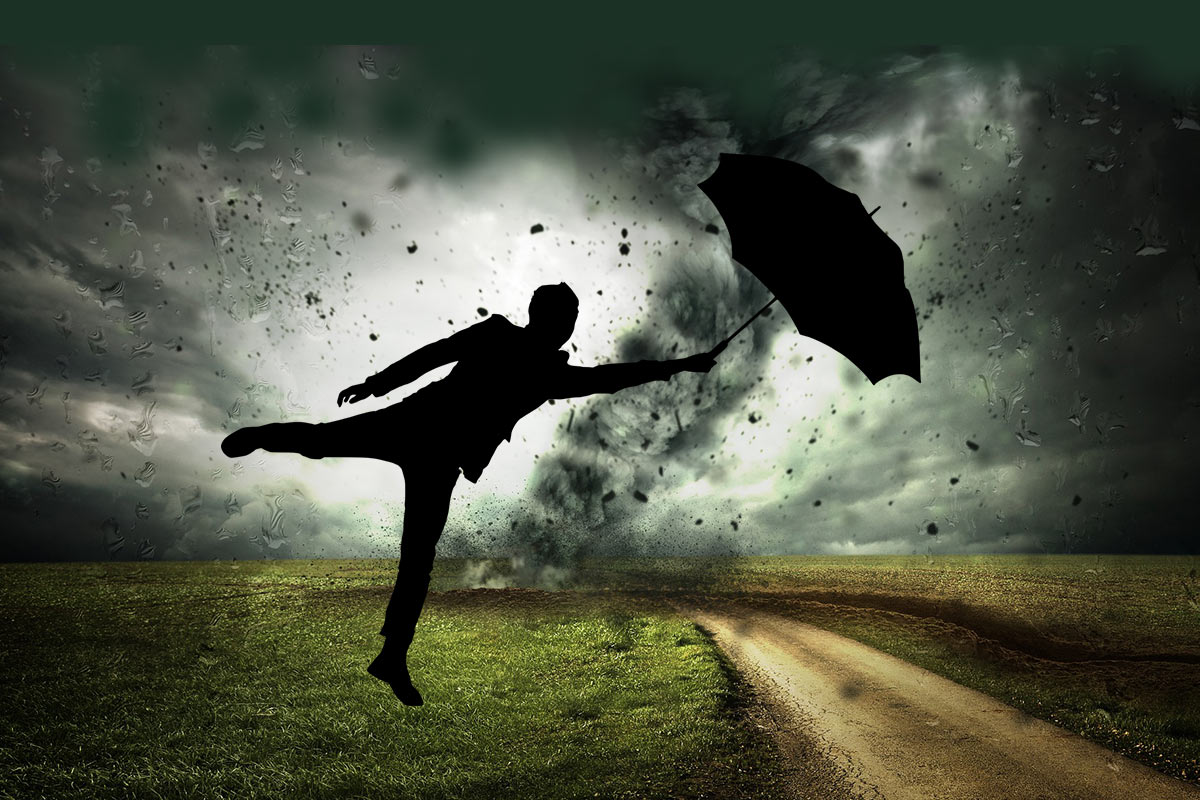
When I shared today’s service title with Anne, who creates weekly Facebook ads for our services, Anne came up with this background image.

It does capture the feelings of some of us, doesn’t it? It’s the look of the last three and half years for some of us.

What does our faith tradition offer us for resources in such a time?

Well that depends on what you think the need is. Is the need to calm our fears? Or is it to help us live into and to navigate our fears?

You will not be surprised to hear me say that I believe we need some of each.

If we are feeling so unsafe that we are trapped in a perpetual state of alarm, we will not be able to access the openness and creativity we need to see possibilities and opportunities and the paths out of the danger. That’s the physiological reality of feeling unsafe, part of us shuts down so we can focus on sheer survival.

So, we need to find ways to calm ourselves enough to access our higher, more creative functioning, and we need to stay alarmed and alert enough to search for and find the road leading through this time to a future infused with more of the values of sustainability, compassion, justice, kindness, openness that we hold so dearly.

Being together in communities like this – being together in person in connecting and supportive ways – is an important part of helping us stay calm enough to see the possibilities and the paths. It’s important to know that you are not alone, and to know it in your body and your heart, not just in your head. And even though the winds have shifted and the world we thought we knew seems to be coming undone, the world might not be ending.

Anne added this image to the background.

It’s almost playful. It could be someone riding the wind, Mary Poppins, style, or it could be someone about to be dashed by the storm. Hard to tell.

The Long View

At a meeting here a couple weeks ago, when people around a table were voicing their laments and fears, Joel looked around the table and said something to the effect of, “It’s been worse.” It was worse in the 60s and 70s, he explained, when King, the Kennedy’s, Malcom X and others were assassinated, when families were divided by the U.S. war against Vietnam. “It’s been worse,” Joel communicated.

That longer view reminds us that this will be neither the first nor the last time the world will appear to be coming undone, no matter how unique this moment feels to us.

It’s the glass half-full approach that can keep us from despair.

One of the most hopeful perspectives for me lately arrived a week and a half ago, in this room, as we listened to the encouragement of George Lakey, a quaker and sociologist who’s been active in and studying direct action campaigns for 60 years. He takes the long view. He pointed out to us that deep political polarization opens up opportunities for significant change. “Necessary change happens during tumult,” he teaches, not during times of tranquility – tranquility, with its tiny, incremental, essentially insignificant changes – “often keeps unjust conditions stuck in place.”

“[Yes,] we’re frustrated and saddened by the first impact of polarization,” he empathizes: “relationships fracture, racism becomes more overt, violence more frequent. However, the volatility also makes positive change easier to get. In the polarized 1930s, [for example] progressive movements got changes they could only dream of in the ‘20s, like unions, labor laws, Social Security, conservation, electricity for millions, bank regulation and better policies for family farmers.”

Lakey referenced the history of extreme polarization in Nordic countries that led them, eventually, to become today’s gold standard for quality of life, economic equity, and shared commitment to the common good.

Lakey shared with us his metaphor of a forge, in which iron is heated up in order to form it. When a society heats up, as painful and as dangerous as that can be, he told us, it becomes much more pliable than when everything’s calm. And being pliable opens the possibility for a society to bend – to bend in very scary direction, yes, OR at long last, in the direction that people have been longing for.

Keeping Our Cool

In one of my first a seminary classes, our professor, a woman of color, pointed out to us that most white, protestant European cultures in the U.S. – the core of our UU congregations historically – like to keep emotions at a cool, contained level. We don’t like to things to get too heated. We have Robert’s Rules of Order to keep things from getting out of hand. We don’t like people to raise their voices or express too much anger, or in fact to express too much emotion of any, kind. Cool, ordered, reasoned calm is our white, protestant culture modus operandi. Or else we get uncomfortable and anxious.

It’s made it difficult for us, over the years, to listen to people of color when they’ve raised their voices in anger, finally, after not being listened to again and again and again. And, our professor taught, it means that in our congregations we are likely to miss out on the emotions that feel good as well, and the emotional strength and depth that are vital for keeping our intellect grounded to the common good and our own spiritual health. Our job is often, she said, to raise the emotional heat, not to lower it.

Moving in the Heat

So here we are, like half of our fellow U.S. citizens, dismayed, frantic even, at the polarization in the nation, wondering and fretting about how to bridge the divide, how to calm the rising tension, how to bring everybody together, when what may be most needed first is to let the heat get hot enough long enough to soften the hell-bent ways of our rising economic inequality and the disregard for wellbeing that comes with it. And then, while all the usual structures are softened, even failing and falling apart, to bring our forces to bear to bend the moral arc of the nation toward justice, toward equity, toward sustainability.

Lakey points out that polarization follows the curve of income inequality, and that income inequality is rising at a faster and faster pace, now larger than it’s ever been. In other words, it’s going to get worse before it gets better. However, the growing high-powered polarization will make genuine change possible, says Lakey. Not certain, but possible. “Where these pliable times take us,” he adds, “[will depend] on the movements we can build,” the sustained, direct-action, non-violent movements we can build.

“[Since the current] division expresses an economic arrangement,” says Lakey, “it’s not something we can fix through urging more civil discourse,” through being nicer to each other. “Even though [we will] want to use our conflict resolution in order to cope, we can also expect more drama at the extreme ends of our polarizations, and more ugliness and violence.

And yet he writes, “I feel lucky to be alive now because this is the best chance in my lifetime to make really big progressive change.” He calls the powerful conditions emerging under the surface and opening new possibilities, “signals of emergence.” “I see evidence, right now, that these trends will give us a chance to gain victories [we’ve never] been able to reach before in this country.”

“Progressives need to breathe deeply,” he writes, “and to make our peace with the reality.”

In These Times

In the Sunday service after the 2016 election, I quoted UUA staff member Sue Phillips. Though the meaning then was slightly different, in this current light it takes on new relevance. Sue wrote:

It will be tempting to hunker down (in the face of these divisions), to retreat into spaces where we might be soothed; our realities affirmed and unchallenged.

Those of us who are mourning must, of course, grieve. But in our grieving we must not hide, or we risk being unfaithful to the call at the very center of Unitarian Universalism: to co-create a world of love and justice….

Creating beloved community is messy, gritty, fearsome, and hard. This is the time we have been practicing for.

The only faithful response to this moment of extraordinary division is to show ourselves and our communities that another way is possible….

My friends, we were made for this work. And now we have to actually do it.

At the time I thought “doing it” meant mending the rift. Now I think it means first utilizing the dynamics that come with the rift.

The very same U.U. optimism that can get in our way can also allow us to look for opportunity in the chaos.

Fixing polarization actually is our job, says Lakey, but it doesn’t look the way we expect. The job of the middle class, and middle-class institutions like ours, is to bridge the dynamics between the poor and the wealthy, to keep them from straying or staying too far apart. And we’ll need to do that through genuinely radical change and new ways of being, through the communities of care and hope in which we bind ourselves, through the connections and coalitions we cultivate, and through the sustained non-violent action we undertake in the midst of the heat.

Addressing the huge and growing discrepancy between those with the most and those with the least cannot happen through simple, small, quiet, calm band-aid fixes or the legislative processes of the current system, says Lakey.

We will need to face directly into the winds, not away from them.

We will need to face into the winds together, drawing on each other while we build new ways forward in the midst of the storm and the heat. We cannot simply wait for it all to pass or to get better on its own.

For the moment, this imagery brings to mind a flock of birds, on the ground or in the water facing into the wind, ready to take off at any moment, counting on the wind coming at them for the lift they will need.

A crisis of faith is also always an opportunity, when the winds have shifted, when the world comes undone, we just might, together. find our most important resilience yet.

So may it be.

So may we be.

Primary Resources Cited, Consulted, Recommended

“Can now really be the best time to be alive? A dialogue across generations” by George Lakey and Yotam Marom. WagingNonviolence.org  December 26, 2019.

“Polarization can bring about real political change. Our past proves it.” by Nathan Schneider. America: The Jesuit Review. AmericaMagazine.org  January 14, 2019.

Lakey, George. How We Win: A Guide to Nonviolent Direct Action Campaigning. Brooklyn New York: Melville House, 2018. Print.

Connected Beyond Belief – January 12, 2020

Connected Beyond Belief

A message delivered January 12, 2019
by Rev. Kevin Tarsa

Unitarian Universalist Community of the Mountains
Grass Valley, California

“Ultimately, the only freedom adequate to human dignity is the freedom to do what love asks of us. And the greatest blessings of life come to us and through us to all the world when, with intimate and freely bonded companions, we are trying together to live with the integrity of faithful love.”     – Alice Blair Wesley in Our Covenant

 Anchored in Covenant

Our Unitarian and Universalist theological history  – the history of our ideas about how things are and which things matter – goes way, way back, but, as Alice Blair Wesley points out, our institutional history -the history we can trace through institutions like congregations – begins in the 1630s, when our religious ancestors in New England, on their way to the American Revolution, made a decision to base membership in their communities not on a creed or a set of beliefs, but on the promises they made to each other about being a member and about being a community. It was about loyalty to the community and its cause.

They rooted themselves and their future in covenants, in mutual promises, rather than statements of belief, and we here in Grass Valley are one of their futures. Just like children who learn the values of their parents but take those values to places their parents never dreamed of, our religious ancestors would not recognize us as related to them, except that: to join this community is, as it was for them, to commit to become “long-term partners in the business of living with integrity,” as Wesley put it (Wesley 17-18).” Living with integrity wherever it leads us, I would add: spiritual integrity, emotional integrity, and intellectual integrity.

This is a hallmark of our tradition – the primacy of integrity, undividedness within ourselves, even when it means we have to let go of the ideas, behaviors, and perspectives of generations when experience, when new knowledge, or when our hearts demand it in order for us to be whole and not split within ourselves.

So, like our institutional 8th or 9th great grandparents, we have two kinds of covenants that members here make with each other toward integrity.

UUCM’s Mission

The first kind covenant is an agreement with and a promise to work toward the reasons UUCM gathers as community in the first place. It’s captured in the mission statement that members articulated and voted on two years ago, a mission that is subject to change if integrity demands it.

I invite us to say it together. Like all covenants, it is aspirational, members commit to keep working toward its fulfillment. Now, as you know, the experience of reading words out loud together varies in terms of the quality of the experience. So, to prepare us, I invite you to engage a technique I use with choirs:

I invite you to speak the first phrase as if you don’t really care, as if you are uninterested and uninteresting: “With courageous love and a sense of wonder”
I invite you to speak the second phrase as if you and the person you are speaking to are both hard of hearing and someone’s using a leaf blower right next to you: “we cultivate our spiritual, emotional and intellectual strength”
I invite you to speak the final portion as if you’ve had way too much caffeine, or are super, super, super excited! Ready? Go! “to create a world more compassionate, sustainable and just.”

Now, I invite you read this congregation’s mission as if it matters, as if you believe, deeply, that living it would make a difference in your life and the life of the community.

I invite you first to breathe a few times to cleanse your palate and to get ready…and to speak the mission with meaning and heart, as if it matters to you.

With courageous love and a sense of wonder
we cultivate our spiritual, emotional and intellectual strength
to create a world more compassionate, sustainable, and just.

Members and joiners of this congregation say, “Yes, I commit to doing that with you.”

Again, if that ever feels like a mission that no longer has integrity, members can vote to change it.

What’s With a Behavioral Covenant?

The other kind of covenant is captured in a congregation’s behavioral covenant. It is another set of aspirational promises, this time about how the members will be with each other, treat each other, journey together, live in integrity with each other.

The current UUCM Covenant of Right Relations was created in 2009, meaning it is due for review, a process just getting underway.

The current behavioral covenant reads:

Recognizing that conflict is normal in human relations and wishing to relate to others as harmoniously as possible, I sincerely intend to:

Treat others with kindness, empathy and respect.
Communicate with patience, flexibility, and a willingness to negotiate in the spirit of meeting as many needs as possible.
Be aware of my own thoughts, feelings, and needs, and share them directly and honestly with others, without judgment or blame.
Invite and listen to all points of view, respecting others’ feelings and needs and encouraging minority opinions.
Take responsibility for my own mental, emotional, and spiritual balance, asking for support when I need it.
Be mindful of the needs of the group as a whole, mourning together when individual needs cannot be met.

I’ve heard people say, “We don’t need a covenant like that, we’re all adults here.” It’s not that we are not all adults, it’s that we are all human.

The Importance of the Quality of our Relationships

Mary Sellon and Dan Smith, who studied religious communities in the 1990s, noticed that:

“…some otherwise excellent programs [had very little] impact, [while] seemingly insignificant or poorly planned events touch[ed] people in significant ways. People dropped out of churches that were vital and exciting. Other people stayed tenaciously loyal to churches that appeared to be ho-hum in [terms of] the programs and facilities they offered. [They] noticed that some pastors flourished wherever they went. [While] others with superior theological and practical training continually failed. ‘What was it that made the difference?’ they asked themselves (xi-xii).”

“Authentic, loving relationships repeatedly surfaced as the … key … element that made the difference (xii).”

Not only did “participants’ sense of fulfillment and commitment [vary] according to the quality of their relationships with each other, . . . “the effectiveness and impact of a congregation’s work. . . [also] varied according to the quality of their relationships with each other (xii).”

Sellon and Smith pointed out that though all of us are committed to the ideal of loving our neighbor, we are often “at a loss for how to [do that] in a contentious [committee] meeting (xi).”

Lisa Ward wrote that “a covenant is not a definition of a relationship; it is the framework for our relating.”

The behavorial covenant is meant to call us to behaviors that support the health and integrity of our relationships with each other, to remind us that it matters. It puts up some helpful bumpers on the bowling lane of congregational interactions not only because it’s good and healthy for our relating with each other, but also because the effectiveness of everything we do – our justice work, for example – is affected by the quality of our relationships with each other. Ideally, our relationships embody qualities like “caring, playfulness, collaboration, authenticity, and deep trust (xii).” These are always works in progress, right?

The integrity of this community requires the integrity of our relationships. This is foundational to the life and effectiveness of this congregation. And this is central for me, a personal and vocational goal to which I am committed.

One of our great Universalist grandfathers, Hosea Ballou, speaking from a tradition that prioritized love above all else, put it this way:

If we agree in love, there is no disagreement that can do us any injury,
but if we do not, [agree in love] no other agreement can do us any good.

A wonderful thing here is that UUCM’s mission names this when it names right up front that members aspire and commit to do all that they do “with courageous love” – and in part to that end, members also commit, in that same mission statement, to cultivate emotional strength.

Mary Sellon and Dan Smith teach that the deep, healthy, and meaningful relationships that best anchor a community like this one require a lot of work and commitment to keep building our skills. We are, after all, human. We have to work at it continually.

Why?

In every congregation I’ve participated in or served, including this one, I have witnessed some of the most beautiful, generous, supportive, kind, loving, brave and nurturing behavior.

And in every congregation I’ve participated in or served, including this one, I have witnessed harmful, small, biting, destructive, rude, unaware, and hurtful behavior. Sometimes my own, of course.

Did I mention that we are human? Did I mention that covenants are aspirational?

It’s not about being perfect, it’s about being committed to work toward health and wholeness. As Victoria Safford points out, covenants aren’t about enforcement, they are about reinforcement – the covenant and we ourselves are “reinforced by forgiveness and by grace, when we stumble, when we forget, when we mess up (“Bound in Covenant “ in the UU World, Summer 2013).”

That’s why we make such promises – to help us stay with it. That’s why this congregation will review its behavioral covenant and also review what UUCM has in place to help us reconnect when we don’t get it right.

Embodied Connection

The final piece I want to bring to this today is to offer a little bit more about how our body is involved in all of this, outside the control or awareness of our conscious thought. It’s one of the reasons we need covenants to assist us, and why religious community matters.

The basis for this is what we are coming to know about the two sets of vagal nerves that run from our brain stem – evolutionarily, the oldest part of our brain – to our internal organs. The back and forth information sharing from organs to brain and back takes place without our conscious thought, thank goodness, it’s what kept our reptilian and mammalian ancestors alive, and what keeps us alive too.

The vagal system is continually monitoring and discerning whether or not it is safe to be with the other beings we are with.

When our vagal system decides for us that we are not safe with another being, our bodies gear up to fight, or to run, or, if all else fails, to shut down. It does not consult the rest of our brain, especially if the danger threat is high. It’s not something we think about. When our vagal system decides for us that we are not safe, when we are geared up to protect ourselves, it also shuts down our ability to be open, to be creative, to connect to other beings, AND it shuts down our ability to communicate to other beings that we are safe to be with.

It’s only when our vagal system decides that we are safe, when our vagal system is calm, that we can convey cues of safety to others. Our bodies our exquisitely tuned to pick up and to give this kind of information. It is transmitted through our eyes, through the sound of our voice, through our body language, and in particular through the expressions and micro-expressions of our faces. And the communication is continually going both ways. We are continually co-regulating each other’s vagal systems. Is it safe? Is it not safe?

Imagine a parent with a crying baby…

What does the parent do? The parent speaks in a soothing, sing-song, voice. “It’s okay, everything’s okay.” Faces close, soft animated facial expressions, lots of eye contact… And that usually helps. The baby calms down. But not only that. When the baby calms, the baby’s calming calms the parent! Who then has more calmness to offer the baby, which calms the baby even more. It creates a spiraling feedback loop that gradually calms both of their vagal systems. They co-regulate each other!

To make this clear, imagine the same scenario with a twist. The baby is crying. The parent speaks in a soothing, sing-song, voice. “It’s okay, everything’s okay.” Faces close, soft animated facial expressions, lots of eye contact… But… the baby keeps crying, maybe getting even more agitated! What happens to the parent? The parent does not calm down. “Nothing’s working! The baby is still crying!” The parent gets frustrated, agitated, maybe worried, which not only doesn’t help the baby, but ramps up the baby’s vagal system even more, which frustrates the parent even more. A different spiraling loop of co-regulation.

You know this plays out with adults too, right? I can see the looks some of you are giving to people you care about.

By the age of 3 or 4 months we are continually co-regulating with others, and not only with humans, but with other animals as well, mammals that have a vagal system that can respond. This is why pets are so important to so many people.

We are built this way for the sake of our survival. As Stephen Porges, the originator and key researcher of polyvagal theory, puts it, we have “a biological imperative” for connectedness.  Not a creed, not a covenant, not a nice-thing-for-a-community-if-you-can-get-it, but rather a biological, hardwired, largely unconscious drive for life-sustaining connectedness, whether we realize it or not.

And we can only reach that sense of connectedness, can only develop the deep and trusting relationships that calm our vagal system, when somebody in the mix has a calm enough vagal system, is feeling safe enough, to give us the cues that calm our own bodies, and help us know that we are safe.

That sense of safety is critical to our ability to optimize our personal and our collective potentials in many directions, says Porges. It is critical to living our mission with courageous love and the kind of wonder that opens us to seeing new ways forward. If we do not agree enough in our vagal sense of safety and trust, no other kind of agreement can do us any good.

Our personal integrity and our collective integrity are very much intertwined. And it’s not all in our heads. It is, very literally, in our hearts, our guts, and hands, our voices and our faces, in not only what we say, but how we say it, and whether and how we look when we say it.

This community is the living laboratory and the nursery for our wellbeing. It is the launching pad for our ability together to move the world toward compassion, sustainability and justice. It starts very close in. Between us.

Our UU ancestors taught that this journey is about learning to walk in the ways of love, as we know them now and as we come to know them in each generation. They realized that a covenant, not a creed, offered the best chance to find our integrity. They understood a covenant as  “declarations of interdependence” (in Victoria Safford’s words) Little did they know. Or maybe, they very much did know [hand on heart].

We human beings are the “promise­making, promise­keeping, promise­breaking, promise­renewing” creature, said Martin Buber.

For the sake of all of us, so may we 21st century covenantal Unitarian Universalists in northern California know ourselves to be.


Sources Cited or Consulted

Safford, Victoria. “Bound in Covenant.” UU World, Summer 2013. https://www.uuworld.org/articles/bound-in-covenant

Porges, Stephen W. The Pocket Guide to Polyvagal Theory: The Transformative Power of Feeling Safe. 2017.

Sellon, Mary K, and Daniel P. Smith. Practicing Right Relationship: Skills for Deepening Purpose, Finding Fulfillment, and Increasing Effectiveness in Your Congregation. Herndon, VA: Alban Institute, 2005.

Wesley, Alice B. Our Covenant: The Lay and Liberal Doctrine of the Church : the Spirit and the Promise of Our Covenant. Chicago: Meadville Lombard Theological School Press, 2002.


Feel the Presence of a Hope – December 15, 2019

A message delivered December 15, 2019
by Rev. Kevin Tarsa

Unitarian Universalist Community of the Mountains
Grass Valley, California

Reading:  “The Moment of Magic” by Rev. Victoria Safford  READ IT HERE

Message: Feel the Presence of a Hope by Rev. Kevin Tarsa

Gail Johnson Vaughan spoke last Sunday of the ineffable nature of transcendent experience – that words are only ever symbols for or approximations of experiences or senses that powerfully transcend our ordinary awareness and knowing. “God,” she pointed out, is one of the words, one of the symbols people use for all that we sense beyond what words can capture.

The celebrations and stories of Yule, Hanukkah and Christmas – both the sacred and the secular versions of Christmas – are also symbols for what words cannot adequately capture. They are stories and holy days and accumulations of rituals that help us know, or find, or remember somehow, who we are and our place in this world, in our communities, and in the larger story of life.

For me, they are all valuable metaphors.

Billy Collins’ “Introduction to Poetry” comes readily to mind: READ IT HERE

Our winter holy days and holidays arrive each year very purposefully when light is in shortest supply in our part of the world. A good number of people have shared with me recently that the time change and the long nights grease a slope down which they slide, with helplessness and hopelessness, toward depression.

These winter holy days and their symbols and stories serve as poems of hope, at heart, each a reminder that buried somewhere within every “now” is “a moment of magic,” a reminder that the light can yet hold, though it appears we have no fuel left, a reminder that it is possible at any time to realize, “Here’s a blessing.”

One of the great powers and staying powers of the Christian story is its message that the transformation of the world and of our our selves can arrive in the most impossible package – in this case a tiny, helpless, currently homeless baby, born to a very young, unwed mother and a working class adoptive father, in the most unexpected and yet common and accessible of places, a stable, the place of very ordinary animals and ordinary people.

The choir is about to sing, in Latin, “O Magnum Mysterium” – “O great and wonderous, improbable mystery, that animals should see the newborn hope for the world lying in a feeding trough.”

Whether or not you believe it is historically true, and no matter where various traditions in Christianity have taken it, it is a story and a metaphor that conveys – beneath the level of words – an accessible, compelling and important truth, a message of hope in troubled and troubling times: that an answer may arrive, when, where, and in whom we least expect it.

Music O Magnum Mysterium by Morten Lauridsen   LISTEN HERE

I have sometimes been a person who “tie[s] a poem to a chair with a rope and [who tries to] torture a confession out of it.” My own relationship to these winter holidays and holy days weaves in and out from year to year, between the awe of “O Magnum Mysterium” or awe in the extraordinary universe into which we have been born (stuff of stars that we are) and, on the other end of the spectrum, “Bah Humbug!”

In the spirit of this month’s theme of awe, I believe that it is most helpful, if we can bring ourselves to do it, to hold these holidays and their stories “up to the light like a color slide,”

“to press an ear against [their] hive.”

‘to walk inside [each holiday’s] room and feel the walls for a light switch.’

‘to waterski across their surface[s] waving at their [ancient, anonymous] author[s] on [a far] shore].

Interrogating these holidays and traditions does have an important place in each person’s spiritual and intellectual journeys, and only you can know if this is a year you really do need to tie any of them to a chair with a rope and torture a confession out of them.

If this is not one of those developmental moments in your journey, I expect that you may find more blessing and more hope by gently dropping your imagination in and allowing [it] to probe its way out.

One of my favorite poetic approaches to the Christian story of Christmas comes from Universalist minister Carl Seaburg. Though he was an outspoken proponent of disciplined theological scholarship, his own theology was once described as “a lyrical Universalism.” In fact, he wrote the text to a dozen of our hymns. “Is it not our business to be artists of the spirit?” he once asked.

The many and anonymous authors of religious traditions are all artists of the spirit. Here is Carl Seaburg’s “artist of the spirit” take on the Christian story of Christmas, his invitation to drop our imaginations into its metaphors, into its tangible images of sky, humanity, sorrow, searching, longing, and love, without telling us exactly what it means.

In the gentle of the moon, in the garnet of a star, feel the presence of a hope where the crowding shepherds are.

Soon the apple tree will bud, and the crimson fruit will fall, but within the stable shed, there’s no thought of that at all.

Touch the treasure of a faith that the mythic Easterns hear. See the measure of a love come candescent down the air.

Music  In the Gentle of the Moon by Carl Seaburg, arr. K. Tarsa 

May you feel the presence of a hope this season,

in the circle of family, friends or community with whom you gently crowd around what matters,

in the gentle of the moon and the sky and reassuring annual rhythms of the solstice,

in the treasure of the faith that you hold, after a lifetime of searching,

in the measures of love you are present enough to notice coming candescent, glowing, down the air when and where and in whom you least expect.

So may it be.  Blessed be. Amen.


What’s Wrong with God? – December 8, 2019

What’s Wrong with God?

In my opening words I told you about bringing my dad to a UUCM service, and his amazement that we never mentioned God.

During that service I had a deeply moving journey into the sacred.  He’d had a different experience. He did not make dispersions, he simply spoke his observation – somehow we had been able to offer a Worship Service without mentioning God. What exactly were we worshiping, and how can you worship without speaking the name?

On the flip side when I serve as your Worship Associate, I find myself feeling some trepidation if I choose a reading or hymn that includes the word God – like the verses we sang this morning in Morning Has Broken — “sprung in completeness where God’s feet pass.”

We can sing “Spirit of Life come unto me”. We can muse on messages or guidance from the Universe. We can tiptoe into uttering the word “divine” – but seem to get increasingly uncomfortable if we expand it into the word “divinity.

So, what’s wrong with “God”?

Mind you, for me this has nothing to do with the questions of whether or not God exists, and I’m not interested in the misbehavior of a perceived deity that some call “God”.

I’m interested in what some here see as a  a taboo or at least a hesitancy against speaking this specific little three-lettered word in our services –  g-o-d hmmm

The words  Holly Near’s song, I ain’t afraid jump into my head.

I ain’t afraid of your Yahweh
I ain’t afraid of your Allah
I ain’t afraid of your Jesus
I’m afraid of what you do in the name of your God

……………………

So much war, so much horror, so much justification of oppression, racism, homophobia, poverty has been done in the name of one god or another – happening today as well as  throughout history…

The Hebrew Bible is full of them: Joshua fit the battle of Jerico for example. Holy wars were fought to rid the “Holy Land” of Muslim infidels. Wars were and are fought to suppress paganism, they are fought to resolve conflict between denominational rivals, think of Ireland or the Shiites vs the Sunnis.

I ain’t afraid of your churches
I ain’t afraid of your temples
I ain’t afraid of your praying
I’m afraid of what you do in the name of your God

The early religions of our most ancient ancestors were born of their wonderings, which in turn gave birth to creation stories to to make sense of how all this came to be.  They conjured up gods and goddesses – and ascribed to them the powers to create, to reward, to punish.

Priests and priestess stepped forward as intermediaries between mortals and these powerful and often vengeful deities. They raised up grand temples and sacrificed the innocent to gain favor and appease the gods.

Could it be we avoid the word “God” because we are rebelling against the way in which “God’s will” has been used to justify vast accumulation of wealth by “his” churches, and “his” chosen ones? – to justify lynchings, burning of crosses? To justify systemic intolerance – consider how state and federal legislators and the President – use their “knowledge of “God’s will” to create laws and policies limiting human rights  or prioritizing “religious freedom” over the right to access needed health care when the life styles of those in need conflict with the religious beliefs of the health care providers.

Could it be that we shutter at using the word ‘God’ because we are worried we will be mistaken for people that use religious freedom as a discriminatory sword?

In 2005 the Sacramento Business Journal chose to honor my work for children in foster care at their annual Women Who Mean Business luncheon. The five honorees were to share the secrets of our success in response to questions from a moderator. Just before our lunch was served the moderator came to the table of each us and let us know the first question she would ask– “please describe yourself in one sentence.”

So much for my appetite! I looked around my table at the people I had invited to support me.  In a mild panic I pleaded “help!”    My dear friend, and mentor, an attorney, looked at me kindly and confidently. “you are a woman who is divinely blessed.”  So simple, so absolutely true, for he and I often shared how my ability to do what so many thought impossible for children waiting in foster care, was because of my ability to download from some source beyond my comprehension, resources that opened the doors to power, that changed beliefs, that toppled barriers for the children I care so much about.

“Yes,” I told my tablemates, “I am a woman who is divinely blessed with gifts and talents to make a difference in the lives of children.”  Sitting next to me was someone I am close to. He looked horrified.  “What if they think you are….”  What? A right wing extremest,  or a new age weirdo, or “heaven knows what?

“What if they do,” I responded, “The way they understand “that which is more than we can comprehend” doesn’t matter to me…. Call it The Big Guy, call it the universe, call it God, we are all drawing on the same source.”

Maybe we shy away from the word and/or concept of God because of the way the holy books, (written of course, by mere mortals ) have been turned into inviolable rules – laws, with threats of eternal damnation for those who break them.

What a powerful way to control the masses … an all-seeing and vengeful god from which no sinful act or thought can be hidden. All the more convenient when the sinner could increase

the wealth of the church by purchasing indulgences to buy off years in purgatory.

Once again Holly Near sings

I ain’t afraid of your Bible
I ain’t afraid of your Torah
I ain’t afraid of your Koran
Watch out for the threats of purgatory

…………………

But then again, more I think about it, the more I wonder how much what seems like an aversion to the word God, comes from the wounds so many of us carry, including myself, from growing up in a theology that told us we were born sinners, unworthy of God’s (or anyone else’s) love and unless we repented our sins and accepted Jesus as our Lord and Savior. By no other route could we escape the inevitability of burning for eternity in the fires of hell.

In churches everywhere in our nation the messengers of that vengeful god are raining down trauma with those repeated messages: we were defective before we were born, that our very thoughts prove how unworthy we are by nature.

This may well be the strongest reason some of us recoil from the use of the word God. How many of us have a personal Pandora’s Box where we unconsciously tuck away traumatic experiences too toxic to hold in the light,  and the negative stories of who we are and what has happened to us  a result.  These stories can be really destructive. They trap us.  No wonder we want to lock them away.

Certainly our Pandora’s Boxes, and all our defenses, are important. They help protect us. They wall us off from the recurring, controlling, scolding, messages that have been used against us.

They also wall us off from other people, from nature, and, when they have been hurled at us in the name of God, they can wall us off from a level of consciousness that many experience as “larger than what is contained by your skin”, to quote Michael Pollan.

Perhaps the word ‘God’ has an uncanny way of finding those hidden triggers inside us that open that Pandora’s Box of shame and anger – and we’d so much rather keep that box tightly closed.


Reflection Part 2

……………………………………….

Eckhart Tolle, in “The Power of Now” shares his belief, that in essence, there is and always has been, only one spiritual teaching, although it comes in many forms.  “and some”, he says “such as ancient religions, have become so overlaid with extraneous matter that their spiritual essence has become almost hidden.”  He explains that his source of wisdom is not external, but from “the one true Source within – a place within us that we already know, and “where truth is recognized when it is heard”.  Take a moment to consider where your source of wisdom dwells.

What I really want to do today is enlist your help to explore ways we can communicate with each other about how we each experience the deeper meaning and transformative power of whatever you want to call that which is beyond our capacity to understand.

– the ability to feel awe, not just “oh isn’t that pretty”, but “breath-taking, beyond words, that full – beyond physical experience of awe that takes us into an unexplainable oneness.

– the sense of wonder so strong that we refer to it in our mission statement.

– the many ways we live through experiences that feel transcendent .

Philosopher William James was not afraid to call the question: He said the mystical experience is ineffable,” yet as  Michael Pollan says, “we try very hard to eff it.”

Some cultures, and subcultures see access to the sacred as the natural state of the human person – a state that is clouded by the incessant chatter of our minds. We are offered many paths to enter this sense of oneness – a richness of meditation techniques – yoga, transcendental meditation, Buddhist meditations, mindfulness meditation, music, chanting, our own monthly singing meditation.

Nature, the river, the night sky,

Ingestion of psychedelic herbs shown to provide a direct, personal, and vivid transcendental entry into an experience of the oneness of all there is.

I find it interesting that the exploding field of neuroscience gives us physical evidence, detected by brain images, that there is a neurobiological home for spirituality.

Rather than  merely grounding the basis of spirituality in culture, neuro psychology shows us a universal, cognitive basis for spirituality. There is even growing neurological evidence that early religious practices and expanded consciousness helped shape the very structure of our brains.

Whether the thing that makes an individual feel connected to something greater, involves church, the river, or a stadium full of sports fans, a certain part of the brain activates.

This sense of wonder, of access to the infinite is now beginning to be understood as a normal, though not always realized, human neuro-psychological ability.

Wow!

And just to keep things balanced, Tony Jack, director of the Brain, Mind, Consciousness lab at Case Western Reserve University explains that analytical thinking , and spiritual, empathic thinking, rely on different neural pathways and processes. Analytical thinking and spiritual empathic thinking… He says that although they can’t happen at the same time in the brain, both modes are necessary, like breathing in and breathing out. “You can’t do both at the same time, but you need both to stay healthy and well,” he says.  That stops me in my tracks.

So clearly, there are many, many pathways to having a deeply human spiritual experience, where we can, and often do, enter something that might provide insight or even  answers to the BIG questions we, and our ancestors, struggle to comprehend.

Whether we identify as UU humanists, UU theists, UU mystics, UU Pagans, or UU Warrior fans, most of us have had those experiences or seek to have them.

Speaking for myself when I am in such an experience, and also after I’ve left it, I long to communicate it to someone else, — and there are so many of those “someone elses” in this room – to have another, perhaps you, look me in the eye and grok what I have seen.

Am I the only one?  But do I have to edit the words come easily to me?

Tolle says ” don’t get stuck on the level of words. A word is no more than a means to an end. It’s an abstraction.”  But don’t, he advises, let your aversion to the word cut yourself off from the infinite reality that the word stands for.

As Michael Pollan, in his book How to Change Your Mind, talks about his direct research into the use of psychedelics, he describes the consciousness that beheld his mystical experiences as “not my normal consciousness. It was completely unperturbed. It was dispassionate. It was content as I watched myself dissolve over the landscape. And what I brought back from that experience was that I’m not identical to my ego, that there is another ground on which to plant our feet and that our ego is kind of this character that, you know, is chattering neurotically in our minds.“  But Pollan laments that he sounds “loopy” when he tries to communicate the trancendece of his experience.

Have we allowed the religious purists to usurp the language of the sacred? How do we remove the stranglehold on our spiritual vocabulary? Can we reclaim  the words of the ancient wisdoms?  Allow the word ‘god’ to be used as comfortably as the word ‘goddess”?

Words are only words. And taking an experience of the infinite and condensing it down into any word can, at best, be an abbreviation or acronym. How can you crunch the sacred into a tiny set of letters, be they W-O-W (wow!) or G-O-D (God), or anything else?

‘God’ isn’t the only word on our list of seemingly verbal taboos.  We have members here, perhaps you are one of them, who fear a modern day / UUCM “off with their heads” response if they use the words ‘prayer’, ‘church’ ‘divinity; ‘holy’, others that I’m sure you could add.

Perhaps its time for me to examine the contents of my own Pandora’s Box.  What triggers am I worried about unleashing and how do I use that fear to limit my ability to live from my essence?

Is it my fear of those triggers that gives me a reason to resist any word used to communicate a spiritual understanding? And does that resistance limit my ability to access what the essence of the word represents?

If I had a ribbon hanging from my nametag it would say UU Mystic.  What would yours say? Since we, at UUCM are inclusive, and hungry for diversity, just think of the juicy dialogues those ribbons could engender.

So… what’s wrong with God? Is it the word or the concept of something greater than ourselves?

Even atheist Albert Einstein,  says “My religion consists of a humble admiration of the illimitable superior spirit who reveals himself in the slight details we are able to perceive with our frail and feeble mind.”

That’s my point.  I don’t care what words are used here for that which is beyond the ability of our “frail and feeble minds” to perceive. I am hungry for my experience of community to unapologetically include dialogue into the the sacred – Call it God, or call it the illimitable superior spirit, or call it a touchdown pass in the last 20 seconds, just don’t let what each calls it stop us from exploring the experience with each other.

The next time you hear the word God in this room, I invite you to consider it an acronym for something that is beyond our human capacity to understand, something infinite, universal, and un-nameable.

And when we sing our closing hymn… notice how you feel this time when you sing “sprung in completeness where God’s feet pass.”

Mindfulness – November 24, 2019

Mindfulness

A sermon delivered November 24, 2019
by Rev. Kevin Tarsa

Unitarian Universalist Community of the Mountains
Grass Valley, California


Mindfulness Aspirations

I begin with a poem by John Travis, founder of Mountain Stream Meditation Center in Nevada City, long time teacher at Spirit Rock Meditation Center. He very recently published some of his teachings in a book titled Taking the One Seat.

Chapter 1, “Calming the Muddy Water” begins with this:

Like a great blazing fire,
body came to rest on the cushions,
fired up to stay awake and present,
only to find bitter-sweet drifting off,
old stories holding court,
while body cried out, “Pay attention to me, I’m the most important.”
Everybody, everybody, demanding attention.
Nobody getting first place today.
Maybe enlightenment can wait.
Where are my car keys?

Ring familiar to anyone? Like anyone who has ever sought to meditate?

It rings familiar to me.

I am not an expert meditator, nor a Buddhism scholar, nor particularly skilled in formal mindfulness practice…however… I do continue to aspire to mindfulness, rather than the busy fullness of mind which is so often the reality for me.

I desire and aspire to bring full and loving attention to the present moment.

I desire and aspire “to hold painful experiences in awareness without overidentifying with them or desperately trying to fix them.”

I desire and aspire to seeing “reality exactly as it is, on purpose, and without judgement.”

I aspire to mindfulness, how about you?

Mindfulness Everywhere

A number of mindfulness teachers point out that not too long ago the concept of mindfulness was primarily the province of Buddhist practitioners, but that now mindfulness is touted everywhere!

As of yesterday Amazon had over 60,000 entries listed under “mindfulness meditation.” When Gil Fronsdal, from the Insight Meditation Center in Redwood City went looking about seven years ago, he found books on Mindfulness and Poker and Mindfulness and Angry Birds. Mindfulness Based Stress Reduction is now a mainstay in the corporate world.

There are tremendous resources out there now for all kinds of people of all ages and personalities and lifestyles, and yet, the experience of mindfulness remains elusive and aspirational, as perhaps it always must remain.

The predictable irony for me this week, is that as I was preparing for this service focused on mindfulness, I felt more distracted and agitated then I’ve felt in a very long time. I found it especially difficult to meditate and to focus my attention at all.

I’m not sure why that would be…except for all the reasons that any of us have to be slightly off kilter or on edge these days – predicted power shutoffs and risks of fire, impeachment hearings and mindboggling political stances, losses near and far…and the jingle of the approaching holidays.

A UU Thing to Do

I think the pursuit of mindfulness and meditation are particularly helpful spiritual practices in our Unitarian Universalist tradition, given the open path and the wide range of religious beliefs of our members. They are practices that can serve theists and non-thiests and in-betweenists and nothingists alike.

And the possibility of seeing reality as it is, without running from it or getting caught up and lost in our reactiveness to that reality, serves our Unitarian Universalist values that ask us to attend to well-being, sustainability, compassion and justice in this life and this world, not the next world or some other world.

I like Jon Kabat Zinn’s definition of mindfulness as a starting place: “Mindfulness is [the experience of) awareness that arises through paying attention, on purpose, in the present moment, non-judgmentally…in the service of self-understanding and wisdom.”

So, in these times, and at this time of year, just before Thanksgiving launches us into holiday energies, I thought it might be of use to invite a simple experience of awareness this morning – the beginning mindfulness practice of bringing our attention to our breath, a practice we might draw on in the weeks ahead.

Those of us who are seasoned meditators will be ready. Those of us who have tried meditation will have some sense of what we’re getting into. And for those who think the whole idea is rather woo-woo, or who are preparing to pull some hair out at the mere thought of mindfulness meditation and attention on our breathing, I want to throw your curious and rational mind a rope to hold on to.

Polyvagal Theory

Amy Renee and Allison Rivers Samson each turned me on to Polyvagal Theory, which I’m starting to read about and study because I think it has very critical things to say to us as we seek to create community that matters now and in the future, community that connects and affects us, and community that serves the cause of good in the world.

This morning I’ll offer just a tiny piece: inspired by the fact that more than two thousand years ago Gautama Buddha was teaching the value of paying attention to one’s breath, and the fact that now, scientific inquiry is shedding light on why that works.

Dr. Stephen Porges, is the originator of Polyvagal Theory, and it’s from his (The) Pocket Guide to Polyvagal Theory that I am drawing my information this morning.

(To quote (approximately) my colleague, Theresa I. Soto, “Now don’t you fall asleep just because I said something sciencey.”)

The vagal nerve in our bodies runs directly from our brain stem to our internal abdominal organs. It is an ancient development in our evolution, a nerve shared by our long-extinct reptilian ancestors. One set of fibers, the older set, runs from our brain stem, the oldest part of our brains, to the organs below our diaphragm – our guts. A slightly newer set of fibers runs from the brain stem to the organs above the diaphragm, or heart and lungs.

I just said that these sets of fibers run from the brain to the organs, but it’s actually the other way around. Only 20% of the information traveling along the vagus nerve goes from the brain to those organs. 80% of the information – the vast majority of it – goes from the organs to the brain, telling IT what to do. Gut instinct determines a whole bunch of our behavior, without our conscious mind, without our prefrontal cortex, ever getting involved or even knowing about it.

It was UU minister and meditation teacher Doug Kraft, long-time minister in Sacramento, who pointed out that the Pali term that gets translated into English as “mindfulness,” the word “sati,” doesn’t distinguish between mind and heart the way the English word “mindfulness” does, losing half its meaning. As Doug notes, “sati” could better be translated as mindfulness-heartfulness. And no wonder, the heart has a hotline directly to the brainstem.

These ancient parts of our neurology are all about figuring out whether we are safe or not – whether we can stay calm, or whether there is danger and we should ramp up enough energy to flee or to fight. Or, if it looks like neither of those options has a very good chance of succeeding, whether we should simply shut down as a last resort, and appear dead in some way. Physically or otherwise.

Ancient responses that we still use, unconsciously.

By Breath

I will note that the anxiousness of our time keeps us continually ramped up to fight or to flee (you’ve been telling me this for three years), or if we are overwhelmed, to shut down (you’ve been telling me this for three years).

By attending to our breathing, we can help calm those ancient survival mechanisms, and in so doing, improve not only how we feel, but also increase our capacity to heal, to be open, to be creative and to connect to one another, to know each other as “safe.”

By taking deep breaths (if we can), particularly by taking long, slow out breaths, we send a signal from our heart and lungs to the brains tem with the message that all is well, because it’s only when there is no danger that we would feel safe enough to take a long slow out breath.

If there were danger, we would need to be breathing faster to be ready to take off or to fight. Breathing fully and slowly calms our system. In fact, Wally Holtan told me that it’s in really extending that out breath, so that abdomen pulls inward, that we most affect that vagal nerve.

We don’t control that vagal system directly, it operates on its own, but we can influence it by our conscious choices, as the Buddha knew so long ago.

There’s so much more to know about the vagal system, but for today, let’s breathe….

Just Breathe

I invite you to find a comfortable, upright position, (stretch first) with an easy sense of height, feet resting calmly, hands resting in your lap, or on your thighs, shoulders released, eyes closed if you are comfortable doing so. wave of relaxation.

I invite you to follow a wave of relaxation flowing from the crown of your head, down through your body – forehead, behind eyes, cheeks, jaw, neck, collarbone, shoulders, arms, fingers, torso, chest and abdomen, pelvis, legs, thighs, knees, shins, ankles, feet toes…..letting a pool of relaxation gather around your feet.

Bring your attention to your breath, and rather than fill up first, which is a very American thing to do, let’s empty first – send a message to that vagal nerve right away that all is well. Long slow full breath OUT. Then simply relax and receive a breath inward, full and downward. OUT-IN. Once more, OUT-IN.

Then simply relax and breathe easily – in your own most comfortable way, at your own pace.

Keep your attention on your breath. It may help you to keep your attention focused on the movement of air in and out of your nostrils – warmer on the way out, cooler on the way in…

If your mind is moving to other things, as it is wont to do, just notice that, maybe acknowledging to yourself “hm, thinking”, and bring your attention back to your breath.

You may find it helpful to use a practice shared by Pema Chödrön – to focus only on the out breath, not worrying  about the in breath, just the out breath.  Or the other way around…

It may help to give your mind something to do in order to keep your attention on your breath, perhaps count your breaths, up to ten, in any way that you choose –Use what works for you to keep your attention on your breathing.

[…….quiet attention to the breath for a time……]

[Piano begins, to bring people gently out of the silence and focus – Meditation on Breathing chords. Continues under the remainder of sermon.]

How are you?

and there’s more…

Allow me to intrigue you with this thought:

The vagas nerve links, at our brain stem, to the nerves that operate our facial muscles, our larynx and our pharynx that operate our voices, and the muscles of our middle ear that allow us to tune our hearing to the wavelengths of human voices.

So, when we sing together, which naturally extends our out breath, uses our facial muscles, and our voices, and our ears tuning to hear each other, we are activating and marshalling all kinds of internal resources to calm our vagal system, helping communicate to our brain that all is well, that we are safe, that we can be “peaceful and at ease” – all of which allows us to connect to each other.

And that’s only part of what’s going on in the vagal system when we sing together.

Look for chances to breathe this week, with intention and attention.

Look for chances to…

[SING Meditation on Breathing]

“Breathe In. Breathe out…”
humming
just breathing.

So may we be.

Works Cited/Consulted

Chödron, Pema. Awakening Loving-Kindness. Shambhala Publications, Incorporated, 2017. Print.

Gunaratana, Henepola. Mindfulness in Plain English. Wisdom Publications, (2002) 2015. Print.

Kabat-Zinn, Jon. (Mindfulness definition at Mindful.org)

Kraft, Doug. Buddha’s Map: His Original Teachings on Awakening, Ease, and Insight in the Heart of Meditation. Blue Dolphin Publishing. 2013. Print.

Heller, Rick. Secular Meditation: 32 Practices for Cultivating Inner Peace, Compassion, and Joy: a Guide from the Humanist Community at Harvard. New World Library, 2015. Print.

Porges, Stephen W. The Pocket Guide to Polyvagal Theory: The Transformative Power of Feeling Safe. W. W. Norton, 2017. Print.

Travis, John M. Taking the One Seat. Koho Pono, LLC, 2019. Print.

Expectation: I Am That I Am – September 9, 2019

Expectation: I Am That I Am

Rev. Kevin Tarsa
Unitarian Universalist Community of the Mountains

A sermon delivered September 8, 2019


Of Beer and Balsamic

This morning I’d like to talk to you about…[hold up bottle]…beer.

 [open, take swig]

Well, beer and…[hold up bottle]…balsamic vinegar.

I don’t actually care for the taste of beer, it’s too bitter for me after a couple swallows, so this is root beer.

I don’t care for the taste of beer, but then I’ve never had it with balsamic vinegar in it.

Someone discovered that adding balsamic vinegar to beer improves the flavor of the beer for most people.

If you give a beer drinker two unidentified bottles, one plain beer, the other the exact same beer with balsamic vinegar added, and ask the person which tastes better, the vast majority of people prefer the beer with the vinegar in it.

Unless… you tell them ahead of time that the one bottle has vinegar in it. When you do that, most people prefer the plain beer and dislike the taste of the beer with the vinegar.

I learned this in a TEDx talk that was listed in our Soul Matters packet for this month’s theme of expectation, a talk by Dan Ariely of Duke University and his Center for Advanced Hindsight. In the wake of the beer experiments, Ariely wanted to know what was going on – why people clearly preferred the taste of the beer with vinegar when they didn’t know it was in there, but didn’t like the taste when they did know the vinegar was in there.

Was it simply a clash of incoming information? he asked – the brain hearing vinegar and thinking “YUCK!,” the mouth tasting vinegar and feeling “YUM!,”  with the conflicting results simply cancelling each other out? Or was there more going on?

To find out, he played with when the researchers told people about the vinegar.

As before, they told some people about the vinegar up front, then had them taste both beers, and then make their decision about which beer tasted better. This time however, they had some people taste the two beers first, and then they told them about the vinegar before the people made their decision about which tasted better.

If the issue was having two conflicting inputs – the brain saying “Yuck!” to vinegar, and the mouth saying “Yum!” – it shouldn’t matter whether you tell people about the vinegar before or after they taste it, the brain will still say “yuck” when it hears vinegar, and the Yum and the Yuck will cancel each other out.

But the people who tasted the vinegar beer first and were then told about the vinegar before they put in their vote, liked the vinegar beer just as much as people who were never told about the vinegar at all.

This implied that the people’s expectations about vinegar changed the way their taste perception worked, made tasting a different neuro-chemical experience, a different physical experience than if they hadn’t known about the vinegar.

Of Gray Water

In a related story:

This past week held the dates of my mom’s and my dad’s birthdays, as well as their wedding anniversary. One year, about this time, when I was quite young, my brothers and sisters and I decided we would make my parents a celebratory meal all by ourselves. And we decided that what would make that meal especially fun and festive (I think this was my idea) was to add food coloring to every dish of the meal.

I remember vividly the sickly green color of the cake we served for dessert, but my strongest memory of that meal is of the glasses of drinking water. Probably thinking fun rainbow colors, we added several different food coloring colors to the water, and as you might expect, in mixing several colors together we turned the water a dingy, opaque, gray/black.

I could not even get that glass to my lips without closing my eyes. As long as I couldn’t see it, it tasted fine, but still, after an initial sip, I could not drink that water without gagging.

So what?

So as we begin exploring this month’s theme of expectation, where is the spiritual message in the story of beer and balsamic vinegar and dingy dark gray drinking water?

For me, for today, the message is that the reality we experience is colored or flavored by our expectations. We know this already, but more than that, what is affected by our expectations is not merely our thoughts and feelings about an experience, but the very experience we experience. What we are able to experience in the first place, is affected by our expectations.

It’s not as simple as, “Does vinegared beer taste good to us or not?”

It’s “Will our expectations allow us to taste the goodness of vinegared beer?”

…or the goodness of the person next to us,

…or the goodness of our lives and the world,

…or the goodness of our selves?

Our expectations shape what we are able to experience. So, what does knowing that ask of us?

Now what?

Alice Walker suggests that we “Expect nothing. [And] Live frugally on surprise.”

I love the way she puts that: “Expect nothing. Live frugally on surprise.”

Which is sort of where I’m going to end up in a moment, but let me get there with the help of Gil Fronsdal. I’ve been listening to Gil’s dharma talks online. He teaches at the Insight Meditation Center in Redwood City, which makes transcripts and recordings of almost all their talks available at audiodharma.org. (I commend it to you.)

Gil teaches that it’s not realistic to have no expectations. It’s not really possible. Expectations help us predict and plan and survive.

But at the same time, because expectations are rooted in our past experience, not the now, they always risk causing us to miss or misperceive what is true and real in this moment.

So, if someone was rude to us yesterday, and we expect that to be true the next time as well, we limit our ability to see them and may not be able to taste the kindness that they are offering today. Or if someone treated us well yesterday, and we expect the same for the future, but today they have a headache and are a little short with us, our expectation will make that shortness a much bigger deal than it otherwise might have been, causing us grief and suffering.

Gil points out that when we are “living through the lens of expectation . . . it’s like having blinders on.” It limits our ability to see what is true. Everything gets measured through the narrow window of what we think is going to happen or think is supposed to be happening.

We then miss all kinds of beautiful and wonderful – and dangerous things, too – unfolding around us, because we limited by looking for what we expect to see.

Being Present to What Is

The goal of mindfulness practices like meditation is to help us be fully aware of and present to what is – not to what was or will be or might be or what we want it to be….but to what is. And that includes, very importantly, being fully present to ourselves as we are – not as we will be or might be or want to be or think we should be – but as we already are right now.

Coming to terms with who we really are  – our authentic, true, unarmored and unadorned self – is key to our ability to see and respond to other people’s authentic, true selves, key to our ability to taste their inherent goodness, vinegar and all.

“…Be very careful with expectations and your attachment to them,” advises Gil Fronsdal, “because sometimes expectations can really derail us.” An understatement, right?

For me personally, it’s my expectations about myself that are the biggest de-railers, expectations that come from a lifetime of internalizing other people’s expectations, sure  – expectations for boys, for Catholics, for gay people, for Americans, for musicians, for white people, for ministers, for eldest sons, for people with gray hair – but I have learned to generate plenty of unrealistic self-expectations of my own. I’m really good at it! No, I am great at it!!

Much of my spiritual work these days involves learning to notice my unhelpful self-expectations and my attachment to them so that I can learn to open myself up to seeing what is real and true in me rather than getting stuck in what I think ought to be true.

Whether your de-railing expectations are primarily about yourself, or about people in your life, or about your journey, or about the state of the world  – Gil Fronsdal suggests that the path is not to live without expectations, but to become aware of your expectations, to notice them and how they are operating, to recognize whether and how you are attached to them,

…and then, not to live without expectations, but to expect anything.

I like it, it’s the glass half full approach.

Expect Anything

“Have expectations” Gil teaches, “but expect anything. Expect the unexpected to happen.”

As Gretchen Haley put it in our opening words:

         Make space in your heart 
to be surprised
Make room in your soul
For a new story to take shape
Let astonishment be possible

“Have expectations, but expect anything.”

Gil Fronsdal invites us to have a simple response always at the ready. I invite you to try it this week and see if it makes a difference for you. The ready response is: “Of course!”

So, if on your way home you have a flat tire or you stub your toe, “Of course!”

If this afternoon a neighbor stops by with a wonderful and completely unexpected gift, say to yourself, “Of course!”

If you get a sore throat tomorrow, think to yourself, “Of course!” (Oh, the unpleasant one’s are more difficult, aren’t they?

If you win the lotto this week, whisper, “Of course!”

If the politics in our nation all of a sudden sort themselves out next Saturday afternoon, and everyone decides to live by your ideals and values from now on, shout, “Of course!”

Now, it’s important to say that responding “Of course!” does not mean ignoring and accepting harmful behavior or dangerous circumstances. It means seeing them clearly for what they are by not getting caught up in our expectations around them. Then we can respond most honestly and skillfully.

Expect anything, Gil says, and though you won’t get everything you want, you’ll travel through the world more safely.

It’s an echo of the William Blake poem from which I often quote in the Joys and Sorrows ritual, words of one of our UU hymns which speak of joy and woe being woven together through our lives – always:

“It is right we should be so, we were made for joy and woe, and when this we rightly know, safely through the world we go.”

Of course!

[grab beer bottle]      And perhaps more tastily through the world we’ll go, too.

[take a swig]

May it be so.

Sources/Resources Cited

Ariely, Dan. When Expectations Override our Senses. TedxTunali.

Video: https://www.youtube.com/watch?v=JTTBruF21Fk


Fronsdal, Gil. Dharmette: Expectations.

Transcribed and edited from a short talk on July 6, 2016.

Audio:   https://www.audiodharma.org/talks/audio_player/6836.html

Transcript: http://media.audiodharma.org/documents/20160706_Gil_Fronsdal_IMC_Dharmette_Expectations.pdf


Haley, Gretchen. Let Them Go.


Walker, Alice. Expect Nothing.  https://www.poemhunter.com/poem/expect-nothing/


God? – August 25, 2019

“God?” – Sermon by Jeff Stone
August 25, 2019

I have an acquaintance who, a couple of years ago, wrote and published a book about coming to terms with the end of life. She told me that when she has presented this book at public readings, it is not uncommon for one or two people to get up in the middle and leave feeling quite upset. In one case a medical doctor, a specialist, stood up and yelled out something about not planning to have to face the end of life. I’m not sure what he meant, but I was surprised at how difficult it is for some people, even, in this case a medical doctor, to acknowledge what is fairly obvious, that we all die. Why do some people come to terms with the idea of death more easily than others?

When my son was around seven years old, I found him walking around the house chanting, “we’re all going to die, we’re all going to die” over and over. After initial puzzlement and even a little alarm, I realized that he was trying to come to terms with this momentous fact in his own way. I wonder if some folks never really got to assimilate this information as a child. Perhaps adults get in the way by, with good intentions, urging their kids to not worry about something so far off or trying to make it alright by telling the child that the deceased is in a better place now, like heaven, and that you will see her again, and so forth, which may help to soothe the feelings of the child, but will also shield the child from having to come to terms with the absence of a loved one.

I had a very close friend, Jerry, who thought life was a big mistake. He resented his parents for bringing him into the world and would not speak to them. Paradoxically, the worst part of life for him was that it ended. I remember how for awhile he volunteered to lovingly hold Aids babies, babies who at the time were doomed from the moment they were born. He found it fulfilling work, though he ultimately quit in disgust because of politics in the volunteer organization. Jerry’s personal bible was a book titled “The Denial of Death” by Ernest Becker, an interesting and influential thinker who believed the fear of death and the denial of that fear was the hidden motivator behind most of our beliefs and much of our behavior. I got into many arguments with Jerry about whether life is worth living. I learned how hopeless it is to try to talk someone out of suicide that way. He ultimately settled the question by taking his own life, a very great personal loss for me and other folks who appreciated and loved Jerry more than he did himself.

For myself, I am not eager to die, but I don’t feel particularly cross at the universe about the reality of death. Perhaps it is my disposition, but I also think that it has to do with my sense of gratefulness for being alive and faith that there is something good in myself and life in general which makes it all worthwhile.

My son used to ask me if I believe in God. I said, in effect, I’ll get back to you on that. I never gave him a definitive answer. Rationally I couldn’t believe in God, but I wasn’t willing to commit to that view because it was evident to me that I would be giving up too much.

So I have this faith in something that can be called God, or a higher power, or something divine that I feel in myself. The name “God” is so loaded that it isn’t always helpful and doesn’t suit everybody. But for me, partly because of it’s ambiguity, and therefore it’s spaciousness, I like to use it. So if I say I believe in God, it doesn’t necessarily mean to me what it may mean to someone else, and it doesn’t necessarily even mean the same thing to me at all times. But it feels right and it feels natural. It is that naturalness that makes me wonder if believing in God isn’t somehow in my genes.

I find that it helps me to believe in God, and so I do, most of the time. It is not a matter of ultimate truth, or something that requires proof. It’s a useful act, to choose to believe. I’m not talking about philosophy or science. I’m not talking about making something up as a game. I am deliberately choosing to believe in something that may or may not actually exist in an objective sense, but by taking that leap, I am setting up a dialogue between me and something greater than me that seems real, that embodies wisdom and compassion.

Now wait, you may say. How can you choose to believe something? Isn’t a belief just there? You either believe or you don’t. Well, if people can’t choose their beliefs, then why do some churches work so hard at impressing upon their members what they should believe. I’d say most of the time we choose our beliefs, but we choose them unconsciously. If you can do it unconsciously, why not do it consciously?

I have a voice, not just the one coming out of my mouth, but the one I hear as it jabbers to me in my head. I have other voices in my head. Mostly they come from places in me that have agendas of one sort or another, like the voice that worries about my health, or the one that gets angry at me for being too quiet when I’m feeling shy. But there is a voice I’ve come to recognize as being different, being wiser than my everyday thoughts. It’s not necessarily a voice that comes to me unbidden. Usually I need to seek it out when I wish to hear it. I think of it as the voice of God. It is there for me when I need it, whether for re-assurance, or to impart some needed wisdom. Sometimes I dialogue with that voice on paper. Sometimes I pray to it. Sometimes it answers me.

I have faith in that voice I call God. It’s a voice that I instinctively learned to trust before I gave it a name. You may have something similar, but you may not think of it as a voice. It sometimes just seems to be a feeling or a notion or a sense of something. Maybe it tells you whether you are in danger, like whether you can trust someone you meet on the street. Perhaps you have that something in you which seems to be wise and on which you can rely in a pinch. Perhaps you put faith in this secret sense that you have because it has been there for you before and because it is so personal. I call this voice God, but other people might have different names for such a voice, like higher self, soul, or maybe just street smarts.

Of course, you do have to be careful with voices in your head. This is a matter of discernment, learning to discern one voice from another. If you have a voice you call God, you need to be wary of imposters. They happen. It takes practice to learn the quality of a voice, the mood of the voice, the kind of things you’d expect that voice to say.

I don’t need God to explain the world, nor do I think that life without God is uninteresting. There is plenty of wonder in beauty, art, science. I don’t need God in order to feel awe of the universe as I look up at the stars, or contemplate the amazing mechanisms at work in genetics and evolution. I don’t need God to explain how life could exist or how complex it is. But I love the feeling of devotion and prayer, the thrill of feeling energy through my body that seems to come from a divine source. For me it does come from that source and I’m OK with the possibility of being wrong. In fact I am probably wrong no matter my point of view. Existence and everything in it may be beyond my ability to explain it all. It is fun to try to explain, at least for some of us, and useful too. So I don’t disparage any of that. But the point, for me, is that it isn’t about getting it right. It’s about embracing the process. For me, it’s about being human. And this process can live alongside other ways of seeing the world without interference, such as through the lens of science, which, obviously, has tremendous utility and teaches us so much about the world, and really is about getting it right.

I like the term “higher self” to refer to that wise and mysterious voice I sometimes call God. But then, what is my lower or small self? I think of that as what I usually refer to when I say “I”. It is my everyday self that handles the mundane stuff in my life. This lower self is sometimes referred to by the Freudian term “ego”. One might also call it our personality. I think this is the part of us that fears death. I don’t detect fear in my higher self, especially about my own death. But my ego, or personality, lives in fear of all kinds. It is insecure, unsure of itself. It is competitive, it is concerned about how it looks. This is the part of me that is afraid of dying, but it doesn’t feel real, rather like a construct made up of traits and memories. I think when I am afraid of death I am strongly identified with my personality.

I propose that spirituality, in any form that is palatable to you, can be an antidote to the fear of death. That doesn’t mean you have to believe in God. That is personal to you. When I say spirituality I’m referring to a way of getting beyond the ego, beyond the personality. It is acknowledging that perhaps our brain doesn’t only work through rational thought, but also through intuition, through unconscious processes. The more we trust in these processes, the more they can enrich our lives. And here may be one key to accepting death. Fear or anxiety around death is not an intellectual position, it is more of an irrational emotion, that seems to come from the ego. When we get beyond the ego we can find that what we are may be more than what is contained in our skin. That what we love or can love is not just ourselves but is also all around us. Like an ocean wave we eventually just sink back into the ocean. Do we really need to know with certainty what happens after that?

I took an acting class once, and one exercise we did in this class was to close our eyes and let ourselves fall back, where behind us was another student waiting to catch us. It was an exercise in trust. If we can trust enough in our inner resources, as well as the resources in our loving community, we can let go. Let go of the fierce grip on trying to understand and control the world around us. Let go and fall back into the arms of whatever it is we have faith in, whether it is God, or love, or whomever or whatever we’ve learned to trust. If we have that trust, if we’ve found a way to foster that trust, we are ready for whatever does or does not await.

Where do we come from? What are we? Where are we going? – May 26, 2019

Where do we come from? What are we? Where are we going?

Rev. Kevin Tarsa

Unitarian Universalist Community of the Mountains

A sermon delivered May 26, 2019

May theme: curiosity


 “Let us learn the revelation of all nature and thought: that the Highest dwells within us, that the sources of nature are in our own minds.”

~ Ralph Waldo Emerson in “The Oversoul”


Where do we come from?

I share, in new member classes, that the evolution of religion over many thousands of years traces the gradual movement from external authority to internal authority.

In early human religiosity, the ultimate sources of power and influence were outside of humanity, in the sun, moon, stars, oceans, mountains, weather, earthquakes, volcanoes… Ultimate power and control were ascribed to the most powerful realities that people experienced, personified sometimes as goddesses, gods, and deities of many kinds.

The next ring inward, included powerful animals and trees and plants, sacred objects and images that represented the larger powers that controlled the world and peoples’ lives.

When humans began to live in larger, more layered and more organized groups, power and authority became located in human structures and institutions, seen as gateways to the ultimate powers: temples, religious traditions, rituals, sacred texts and human intermediaries – the designated priestesses, priests and shamans who interpreted the traditions, and sacred signs and writings for everyone else, who communed directly with deities and served as bridges between the human realm and the sacred realms.

With the development of the printing press and more efficient forms of transportation, knowledge and awareness spread – not only geographically, but through more of the layers of given societies. More and more people no longer needed to rely solely on the designated, educated, religious leaders for information, people could read and interpret sacred texts like the Bible for themselves, and so the source of religious authority moved from the institutions, toward the individual. This is when many new varieties of Christianity sprang up in Europe, because people were interpreting the writings for themselves and coming to all kinds of different conclusions. Imagine!

But no sooner did certain people break from a tradition, than they set up their own tradition as the one true religion, proclaiming that they themselves, and their particular interpretations, were THE new and final source for all religious authority.

As Helen Keller put it, “The heresy of one age becomes the orthodoxy of the next.”
It is out of one of those chapters of someone’s new and rigid version of Christianity in the 1500s that Unitarianism and Universalism arose and branched off from Calvinism, a very specific and narrow interpretation of Christian scripture. Our ancestors, from many different streams, were heretics in their times, a word that means, we know from its Greek roots, “people who choose.”

By the early 1800s, Unitarians had shifted to an understanding of Jesus as a fully, albeit exceptional, human being, not uniquely divine;  to an understanding of the Hebrew and Christian bibles as human works that needed to be studied as we would study any historic human document, based on what we know about the times and the people; and to a belief that humans are morally and spiritually obligated to apply reason and current knowledge to all religious exploration and understanding.

It was a way of thinking that had been foreshadowed earlier in that diagram of a solar system painted on the ceiling panel of a Unitarian church in Transylvania, no matter what the Catholic church had insisted upon for centuries. The primary source of religious authority was moving then, in our Unitarian and Universalist ancestors, from ancient texts, traditions and institutions, to human knowledge and awareness. It was reached, as William Ellery Channing preached, by each person’s God-given capacity to reason.

What are we?

And then, hot on the tails of that shift in the United States, came the Transcendentalists, who pulled the ultimate source of religious authority completely inside the individual – sort of.

“The soul,” Emerson wrote, “is the perceiver and revealer of truth. We know truth when we see it, let skeptic and scoffer say what they choose.”

Almost all of the New England Transcendentalists were Unitarian or strongly associated with Unitarianism. Many were, like Emerson, Unitarians ministers. Still, they were in some ways a varied lot: Margaret Fuller, Henry David Thoreau, Amos Bronson Alcott (Louisa May Alcott’s father), Elizabeth Peabody, Theodore Parker, George and Sophia Ripley, among others. They were called “the club of the like-minded” by outsiders, a description that they more-or-less accepted, saying that they truly were “like-minded” …in that “no two [of them] were of the same opinion.”

What they did hold in common, was an “emphasis on the primacy of self-consciousness” (Gura),  the idea that one’s own consciousness is THE legitimate access point to knowledge and truth, and that everyone has direct, intuitive and immediate access to all things divine…if we would but open ourselves to it and not let anything get in the way.

Emerson again:

“There is a deep power in which we exist and whose beatitude is accessible to us.”

He referred to this deep power and ultimate unity as the “oversoul.”

Emerson preached that there is no need for a church, for a priest, for a preacher, for a sacred text, for rituals, traditions, or anyone else’s ideas. Every person, of every social and education level, at every age in one’s life, can access ultimate reality through their innermost awareness.

“It comes to the lowly and the simple; it comes to whosoever will put off what is foreign and proud; it comes as insight; it comes as serenity; it comes as grandeur. . . Within us is the soul of the whole.”        ~ Emerson

It is a mystical approach, inspired by Vedic texts and European philosophies, and beamed through this America-crafted lens of Ralph Waldo Emerson.

For the Transcendentalists, the final authority for knowing what is true is one’s personal experience and direct, intuitive perception and knowledge.

“We know truth when we see it.”

Theologically, this is pretty much where we still are in our tradition and our nation 150 years later. Although they were both revered and ridiculed in their time, Emerson and the Transcendentalists shaped American thinking significantly, and pointed U.S. culture toward prioritizing individuality and toward the primacy of personal consciousness as the source of authority.

This is evident, I think, everywhere in our national politics now, wherein people come to their own felt conclusions regardless of outside information or evidence that challenges those conclusions.

The thing is, if we follow our tradition, the use of our reason and the application of our accumulating knowledge ought to lead us to the realization that we individuals are not the center of the universe after all, heretical as that message may be in our circles.  The world and truth do not revolve around us individuals and our own consciousness.

Ongoing human research keeps pointing out to us that what we are able to see, perceive and understand is shaped and bounded by our genetic blueprint, our life experience, our physiology, our psychology, our neurochemistry, our diets …and the sound of our names.

Okay, to explain that segue…

A relative of mine, Nicholas, just announced his engagement to his fiancée, Nicole. How much more similar could those names be? I think of my friends, Paula and Paul, and Jeanine and George. My first love’s name, early in my young adult life, was Colin. Colin and Kevin. Of the five sounds in our two, brief names, three are exactly the same.

It’s referred to in the research as “the Name Letter Effect” – people disproportionately choose spouses, places to live, and occupations with names similar to their own. We think we are making these intimate and vital life decisions based on our careful evaluation and awareness, when something as simple as the spelling or sound of our names is actually pulling some of the strings.

These kinds of things fascinate me because of what they reveal about human nature in general.  I am intrigued by the way that what I eat influences how and what I think and feel. That sitting in a hard chair (as opposed to a soft chair) makes people more uncompromising when they are negotiating.

That having the microscopic parasite Toxoplasma Gondii, which infects almost ¼ (about 22.5%) of Americans older than the age of 12, makes people more extroverted and less conscientious than people without the parasite. All these amazing subtle influences that shape our feelings, our thinking and our behavior without our knowing it, when all the while we think we are choosing freely and with complete conscious control.

Again and again, the message is that we are not as conscious as we think we are of our own biases, of the limits of our perception and awareness, of the invisible influences on our choices and our actions.

Religions In the Hands of an Angry God

The NPR show and podcast “The Hidden Brain,” looks at just these kinds of invisible influences upon us. A recent episode asked, “Where does religion come from?” In it, the host, Shankar Vedantam, highlights the work of Azim Shariff, a psychology professor at the University of British Columbia, who studies religion from a psychological perspective.

Shariff begins with the assumption that religion arose, evolved and continues because it offers some sort of survival advantage in terms of natural selection, allowing people who are religious to survive and pass on their genetic material to their offspring.

Shariff points out that for most of human history we lived in small groups in which everyone knew everyone and in which everyone knew everyone’s behavior. It is difficult, in small groups, to get away with cheating, or stealing, or killing, or not contributing to the work needed. But when human groups became larger than 150 or so, to 500, to 1000, to 10,000 people, those natural small group controls on behavior were no longer sustainable. People could cheat, and steal, and kill and free-load and get away with it, which is not helpful to the health and sustainability and genetic survival of the group.

Shariff and others say that religion arose as a cultural innovation to allow us to succeed in these larger groups by enhancing trust and cooperation. This is not a new concept. But not just any religion, Shariff says. What worked best to corral human behavior was the idea of “a supernatural punisher” – a large, all-seeing, all-knowing, punitive God. The perfect opposite of what our Universalist tradition teaches. It turns out that believing that you are a “sinner in the hands of an angry god” confers an evolutionary advantage on you and your people.

Oh, crap.

In one study of college students, Shariff discovered that the more a person believed god to be on the punitive side of the spectrum, the less likely the person was to cheat on a test, whereas the more a person believed their god to be loving, the more likely they were to cheat on a test.

Again. Oh, crap. Not a great selling point for Universalism and liberal religion.

Shariff says that “the societies that have been able to grow [the] largest with the religions that they believe in, have had this idea of supernatural punishment at their core because it is an effective deterrent” and an effective connector to people you’ve never even met.

Shariff points out that “All the world’s major religions today arose at times when human societies were struggling with the challenges of size, complexity or scarcity,” and therefore struggling with trust and cooperation.

Believing in a big, bad God helped large societies, in many cases.

The good news/bad news in these complex times, when trust and cooperation are a challenge,  is that there is a chicken and egg reality here: Which kinds of religions reign in a given time and place is context dependent and can change. For example, small groups and societies tend to have small gods who are not particularly powerful or punitive. And “local conditions, like individual ecosystems, can create conditions where certain beliefs flourish and where other beliefs fade away,” says Shariff.

Now, what is considered sacred isn’t necessarily something religious – we sacralize things like freedom, patriotism and our nation, for example – so there are ramifications for our country.

Shariff says that the countries in which religion is least important are the countries with the highest faith in the rule of law and trust in institutions.

On the flip side, as Shankar Vedantam explains:

“Azim thinks that if regulations and good governance provide the trust and cooperation that religious bonds once provided, new kinds of faith might flourish – religions that don’t have an angry god who threatens to punish you if you step out of line, religions that don’t talk a lot about hell and damnation but instead spend more time on building community.”

Where are we going?

So where does that leave us, and what does all of this have to do with curiosity?

I say that we turn to Catholicism.

For a moment.

There is, in Catholicism, a little known and not actively publicized escape clause.

For all its clear dogma and firm listing of what is okay and what is not okay, Catholic tradition notes, in the fine print, that in the end, each Catholic may appeal to the primacy of their own conscience. No matter what the church tradition teaches, one’s personal conscience is the final arbiter when navigating difficult moral questions.

(Pope Francis caught flack and was publicly accused of heresy when he reaffirming the primacy of conscience two years ago, in November 2017. He said that priests are supposed to inform Catholic consciences, “not replace them.”)

I say that what we are called to now is not so much a primacy of isolated personal consciousness as our Transcendentalist forebears taught, but rather to a primacy of conscience that is informed not only by our incomplete consciousness, but also informed by a sense of humility that recognizes that we don’t know everything, even and especially about ourselves….that understands that we must draw on sources of authority both inside and outside of ourselves in order to know what we need to know and need to do…that recognizes that we, as individuals, are not the center of the universe around which all else revolves…that we are not isolated beings.

I’m not suggesting that we let go of our inner authority completely, but that we add to it, couple it with an openness to outer sources of knowledge and authority. It’s part of our maturation as a religious tradition. UUism is rather young, in religion terms, and much like adolescents who need to define themselves – often angrily and with a great deal of drama – as separate from their parents in order to grow into who they are and will become, UUism has defined itself by what it is not, and by a powerfully self-centered theology. Maturing as a faith will require that we remain true to our own consciousness while keeping our hearts and our heads open to answers beyond our own.

A Primacy of Conscience requires that we stay genuinely and endlessly curious.

For the last two and a half years I have been repeating to myself the mantra, “Get curious, not furious. Get curious, not furious,”not always certain that getting furious wasn’t the better way.

But in these times, staying curious is essential.

Emerson valued curiosity as a path to overcoming the fear of not conforming, curiosity as a path to being an individual. Curiosity, especially considering what we are learning about human nature, is also a path to overcoming the fear of being more than an individual, of being thoroughly and intimately interconnected and interdependent.

Emerson saw curiosity as an avenue to staying ever receptive to the ultimate oneness of nature that is named God by many. As many of us might put it, curiosity is about staying ever open to the spirit of love, as we know it now and as it will continue to be revealed.

Deeply curious may we ever be.


Sources

Emerson, Ralph W, and Edward L. Ericson. Emerson on Transcendentalism. New York: Ungar, 1986. Print.

Gura, Philip F. American Transcendentalism: A History. , 2007. Print.

Vedantam, Shankar, host. “Where Does Religion Come From? One Researcher Points To ‘Cultural’ Evolution.” Hidden Brain, NPR, 6 May. 2019. https://www.npr.org/2019/05/06/720656274/where-does-religion-come-from-one-researcher-points-to-cultural-evolution

Winfield, Nicole. “Pope Francis reaffirms primacy of conscience amid criticism of ‘Amoris Laetitia.’” America: The Jesuit Review. November 11, 2017. https://www.americamagazine.org/faith/2017/11/11/pope-francis-reaffirms-primacy-conscience-amid-criticism-amoris-laetitia

And several online articles regarding unexpected influences on human behavior.


At the Edge of Hope – January 13, 2019

“At the Edge of Hope” –  sermon by Rev. Kevin Tarsa
UU Community of the Mountains
Grass Valley, CA
January 13, 2019

INTRO

You’ve been telling me, many of you, that hope is in short supply these days, a rare and precious commodity, what with the climate crisis and scientists’ dire warnings of immanent danger, the current manufactured political emergency rooted in values antithetical to so many of our own values, increasingly intractable division in the nation, the dismantling of so many protections, and, on top of it all, the day to day challenges in our lives, close to home and close to heart.

So I’ve been thinking about hope – yours, mine and ours – in the context of these times.

In my office I have a deck of cards with meaningful quotes on them, a gift from a friend. Periodically I pull out a new card, and the CARD that came up this very week offered the words of Napoleon Bonaparte, who claimed that “A leader is a dealer in hope.”

A leader is a dealer in hope.

Psst. Wanna buy some hope? Top quality hope? I know you do!

I don’t actually have hope to sell you, I’m afraid, but I may try to sell you on hope.

FAITH IN POSSIBILITY

Years ago, a congregant stopped me in the middle of the aisle after a service one Sunday, to ask, “Where do you find hope?” She knew that I was navigating the painful sadness of an unexpected divorce, leaving behind the house and so much else that we had shared, and that my family had spent the previous year and a half caring for my mother through her journey with cancer and death. When that congregation member stopped me to ask about hope, I stopped for a moment too, listened internally, and responded uncharacteristically quickly. “I have faith in possibility,” I said, listening for truth in the words even as they were coming out of my mouth. “The future is not yet determined, and my life experience leads me to believe that many things, if not exactly all things, are possible.”

It was an intuitive response rather than carefully formulated response. Enough events in my life that I was certain would be fabulous, had fallen flat or outright bombed, and enough of the occasions I was sure would crash in disaster had succeeded wildly, that at some level I had become prepared to be surprised. Life had taught me that you just never know, no matter how certain something seems.

I’ve named here many times that this is a foundational perspective for Unitarian Universalists: You just never know, and so we remind each other to hold open a space for uncertainty. It’s Allan Watts’ “wisdom of insecurity” of which I spoke in December.

This is, to be sure, a double-edged uncertainty: It allows that what we think of as “good” is always possible, no matter how things look. And it allows that what we think of as undesirable or “bad” is also always possible, no matter how things look.

That flip side is a particular downer if we have anchored ourselves in optimism rather than hope.

OPTIMISM vs HOPE

Many wise persons make a distinction between optimism and hope, and do so in a variety of ways. Lately I’m contemplating Archbishop Desmond Tutu’s take on it.

In his conversations with the Dalai Lama, captured in The Book of Joy, Archbishop Tutu said that optimism “depends on feelings more than the actual reality. We feel optimistic, or we feel pessimistic.” Optimism is not a very solid foundation, he suggests. It is too subject to the mercurial nature of our feelings and our changing circumstances.

In an online article in Medium, Sharon Ackman relays the story of Jim Collins’ interview with Commander James Stockdale (in Good to Great):

“…during the Vietnam War several thousand American servicemen were captured by the North Vietnamese, and taken as prisoners of war. They were held in tiny cells where they were tortured, beaten and starved. Some were kept for years in solitary confinement. At the end of the war, only 591 returned home.”

. . . Medal of Honor recipient Commander Stockdale was later asked who had not made it out of the camps. “That’s easy,” he said. “It was the optimists.”

He continued, “…they were the ones who said, ‘We’re going to be out by Christmas.’ And Christmas would come, and Christmas would go. Then they’d say, ‘We’re going to be out by Easter.’ And Easter would come, and Easter would go. And then Thanksgiving, and then it would be Christmas again.”

“It sent those POWs on a wild rollercoaster of false hope and delusion, only to come crashing down,” writes Ackman. “It shattered their endurance and ultimately their will to live. As Stockdale [recalled], ‘they died of a broken heart.’”

Ackman concludes that it was pessimism that had helped the survivors to survive. I would suggest that it was realism and hope that allowed them to survive, rather than pessimism. Either way, optimism did not serve them well.

HOPE

Now, hope,” Archbishop Tutu says, “is different in that it is based not on the ephemerality of feelings, but on the firm ground of conviction.” Commander Stockdale, of his own surviving said, “I never lost faith in the end of the story, I never doubted not only that I would get out, but also that I would prevail in the end and turn the experience into the defining event of my life.”

One can feel happy, one can feel optimistic, but one doesn’t feel hope, so much as have hope. “I believe with steadfast faith that there can never be a situation that is utterly, totally hopeless,” said Tutu.

I.e. there is always a possibility for good, for benefit. You just never know.

“Hope is deeper [than optimism,]: Tutu said, “and very, very close to unshakeable. It’s in the pit of your tummy. It’s not in your head. It’s all here,” [(pointing to abdomen). At the gut level] – a “dogged, inextinguishable hope.”

NOT THE EASY PATH

These days, when people tell me they are looking for hope, when I’m wanting to find hope, I’m aware that what we are saying, most of the time, is that we want to feel better. We don’t want to feel the discomfort or pain of despair.

Many of us have been telling each other stories about how we’ve been numbing ourselves in response to national and world events – binge watching television, overeating, drinking, over-working, over-functioning, staying in bed, distracting ourselves in any number of ways …

Archbishop Tutu offers a helpful insight. He points out that despair and cynicism and resignation are, in essence, self-soothing postures in their own right. They form an easy, self-serving, soothing path, as much as we might complain about them. They don’t merely lead to numbing, they are themselves forms of numbing.

We complain about them, but feelings of despair, resignation and cynicism ease (things) by letting us off the hook, in that they do not require what Tutu calls “the raw vulnerability and tragic risk of hope.” We draw on despair to protect ourselves from the real vulnerability and risk of hope.

Tutu says that, “To choose hope is to step firmly forward into the howling wind, baring one’s [skin] to the elements, knowing that, in time, the storm will pass.”

The good news (well, it’s all good news, I just wanted something easier for once), the good news, the saving news, is that we are not alone.

ANNE LAMOTT STORY Part 1

In her recent book, Almost Everything: Notes on Hope, Anne Lamott writes of her lifelong obsession with the thought of jumping when she is in high places from which jumping might be possible. She does not see this as suicidal, but the thought has energy.  Anne made an agreement with her psychiatrist that whenever she had the thought of jumping, she would tell whoever she was with

“As you might expect,” writes Lamott, “this admission tended to throw off my companions, who saw it as a buzzkill”

When she dutifully tells [the people she is with,] they “usually want to have little talks about the preciousness of life, [and] permanent solutions to temporary problems.”

“Blah blah.”, she writes.

“Only three words spoken to [her] at these times have ever helped.”

ANNE LAMOTT STORY Part 2

Anne was invited to offer a lecture and a sermon in Cairo, Egypt. Her host in Cairo, a Coptic minister drove her up Mokattam Mountain to spot overlooking the area where tens of thousands of garbage collectors sort the city’s garbage

Anne and the minister walked to within a few yards of the cliff’s edge. She thought about jumping, of course. “How could I not?” she writes.

So she cleared her throat and said shyly to the minister: “I have to tell you something sort of embarrassing. I promised my psychiatrist I would tell whomever I was with when I was in any high place that since childhood, whenever I’m very, very high up, I think about jumping.”

“He didn’t miss a beat,” she writes. With a wave of his hand he said, “Oh, who doesn’t?”

And the energy of the thought of jumping lifted.

THE LIMITS OF HOPE

There are all kinds of ways to learn that we are not alone, one of the ways we anchor hope here (gut), rather than here (head). Sometimes it’s as simple as that Coptic minister’s variation on “me too,” awareness that other people feel or think in similar ways, or when someone really sees us or listens to us.

In the most challenging times in our lives, it’s a deeper need and realization – to know that no matter how tragic and painful and hopeless our circumstance seems, someone else, somewhere has experienced the same thing, or much, much worse, …and has survived in body and/or in spirit, and been able to find meaning, connection, and even joy beyond that experience.

In that light, I do want to acknowledge the limits of hope, in a way that points us forward.

OF DEEP LOSS

Between the date I interviewed for an internship in Massachusetts, and the date the position began, a beloved young woman, a member of the congregation I would be serving, was murdered by her boyfriend. It was a tragedy for that entire community, that congregation, and, of course, the family.

At the congregation’s annual auction fundraiser, the mother of that young woman purchased the opportunity to name a sermon to be preached by the minister. “Got hope?” she titled it.

As he often did, the minister sought ideas and wisdom for the sermon from colleagues as well as from staff. I usually need time to consider answers to such queries, but I responded with uncharacteristic speed.” It was not my wisdom, this time, but wisdom I had learned from John Schneider, who mentored me in the ways of grief.

“Sometimes, some rare times, a person simply cannot have hope. Some experiences are so painful, that for a time, holding hope is not possible. In fact, the expectation that a person should have hope only adds to the burden, compounding the pain.” I shared the companion piece of John’s insight. “What is possible in such times, is that others can hold that person’s hope for them, until such time as they can hold it again themself.”

Of all the wisdom and insight that the minister shared with the grieving couple, this is the insight they found most helpful.

Knowing two Unitarian Universalist ministers whose daughters had been murdered, I offered to connect the couple to one of them, so these parents would know that they were not alone. Of course, they knew here (head) that they were not alone, but so they would also know here (heart) and here (gut) that they are not alone. 

GETTING PERSPECTIVE & HAVING FAITH

The Dalai Lama and Archbishop Desmond Tutu have each been through tremendously tragic, painful experiences, and both are tremendously hope-filled. They both teach that part of what we need in order to cultivate hope is to keep things in proportion and to find a wider perspective. Understanding that you are not alone in your experience – is one powerful path to gaining perspective.

Archbishop Tutu says we must also have faith ….in something, in, if nothing else, “the very persistence of life to find a way.”  I’ll share again Alan Watts definition of “faith as “an unreserved opening of the mind to the truth, whatever it may turn out to be.” In other words, faith in possibility. You just never know.

INTO THE ARMS OF OTHERS

But it’s another observation from Archbishop Tutu’s that I want to leave you with today. “Hope,” he said, is also nurtured by relationship, by community.”

“Despair turns us inward. Hope sends us into the arms of others.”

My experience is that not only does hope send us into the arms of others, being in the “arms” of others – in the hearts, compassion, witness, kindness and care of others – feeds our own sense of hope. Once again, it’s about not perceiving ourselves to be alone. Relationship is both a source of hope and the result of having hope…

In relationship, our capacity for vulnerability and risk, become key, and important for us to cultivate together. (This will be the focus of one of our services in March.)

To choose hope is to choose to reach out to others with whatever hope we do have. And to choose hope is to reach out to others in order to find the hope we are seeking. As Archbishop Tutu points out, “Hope is not generated in solitude.”

THE WHY OF IT…

I’m sorry, I can’t sell you some ready-made hope. But I will do my best to sell you on hope and to point you toward each other, so that you may find and strengthen hope in each other, and so that we will all be ready to hold hope for one another in the really tough times, when one of us cannot hold hope ourselves.

Anne Lamott says that “Love is why we have hope.”

It’s also true, I say, that hope is why we have love.

My hope is that this congregation, this community, becomes ever more a place where people can figure that out and cultivate both love and hope deeply and for the long haul.

You just never know.

May we be so.

SOURCES REFERENCED OR CITED

Ackman, Sharon. “Soldiers with this trait are survivors in life and war.” Medium. August 3, 2018. Online. https://medium.com/@sharonackman/soldiers-with-this-trait-are-survivors-in-war-and-life-2b7c6ad34afb

Bstan-ʼdzin-rgya-mtsho, Dalai Lama, Desmond Tutu, and Douglas C. Abrams. The Book of Joy: Lasting Happiness in a Changing World. 2016. Print.

Collins, James C. Good to Great: Why Some Companies Make the Leap … and Others Don’t. New York, NY: HarperBusiness, 2001. Print.

Lamott, Anne. Almost Everything: Notes on Hope. 2018. Print.

Watts, Alan. The Wisdom of Insecurity: A Message for an Age of Anxiety. New York: Vintage Books, 1951. Print.

Religious Naturalism: Let the Mystery Be – Dec 9, 2018

Religious Naturalism: Let the Mystery Be
a sermon by Rev. Kevin Tarsa
UU Community of the Mountains
Grass Valley, CA
December 9, 2018

Opening Words by Chet Raymo

“I have a friend who speaks of knowledge as an island in a sea of mystery. Let this then, be the ground of my faith: All that we know, now and forever, all scientific knowledge that we have of this world, or ever will have, is as an island in the sea [of mystery]. And still the mystery surrounds us.” 

Time for All Ages   Snow Music by Lynne Rae Perkins

Music Holy Now by Peter Mayer. (see/listen at https://www.youtube.com/watch?v=KiypaURysz4)


Sermon: Religious Naturalism: Let the Mystery Be   by Rev. Kevin Tarsa


LET THE RIVER RUN

[1-minute video of the Yuba River in the spring]

I know that many of you feel a profound sense of connection to the Yuba River and its tributaries, its forks and its surroundings. Several people offered photos of the river to represent what is holy to them. That video was taken at the end of the Buttermilk Bend Trail at Bridgeport, in the spot where a friend and I once watched a river otter work its way upstream just a few feet from us, along the edge of the rushing water.

Even though I am new to this area, I too feel a powerful connection to the river and to my experience of it, and often, after I am there, I wish I could bring the river home with me.

This usually brings to mind an image from Alan Watts, something I read over 30 years ago: He wrote,

“…you cannot walk off with a river in a bucket. If you try to capture running water in a bucket, it is clear that you do not understand it and that you will always be disappointed, for in the bucket the water does not run. To ‘have’ running water you must let go of it and let it run. The same is true of life…” he adds (Watts 24).

The book’s curiosity-piquing title is The Wisdom of Insecurity. It has shaped my thinking and awareness ever since I read it right after college, and simply remembering the title is enough to get me contemplating anew.

I’ve mentioned this title and concept here before to a number of heads nodding in recognition. In these times, in which so much seems less secure than it did a couple years ago, in this month inviting us to focus on the idea and the experience of “mystery” in our lives, an invitation to come to terms with the inherent uncertainty of our existence feels important, an invitation to consider (despite any of our natural human resistance) the wisdom of insecurity.

It’s tempting to think that we are experiencing an especially uncertain age. Allan Watts said the same thing that about his times when he published The Wisdom of Insecurity…in 1951. In truth, he wrote then and says to us now, “our age is no more insecure than any other (15),” though our perceptions of security do wax and wane, I would note.

I have titled and framed today’s focus within religious naturalism. Lest this feel like a bait and switch, I’ll assure you that the wisdom of insecurity is not only a very Buddhist kind of perspective, it is also a naturalist perspective, and I’ll focus on that aspect of religious naturalism today.

Years ago I told someone I was preparing to speak in a service about religious naturalism and they got a strange look on their face. The person thought I was going to be speaking of “naturism” – i.e. social nudism. Now religious nudism would be a fascinating topic, I am sure, but in case you are about to be disappointed, I’ll let you know that naturalism is something else.

Although………. there is a kind of spiritual, psychological and intellectual nakedness and vulnerability that comes with naturalism.


WHAT IS NATURALISM?

Sometimes when I name religious naturalism a person will reply, “Oh, I love nature too.” Naturalism includes a valuing and even love of nature, but is more than that. The defining aspect of naturalism is the stance that nature is all there is.  That there is nothing else, nothing that is not natural. It is to say that there is no super-natural realm outside of the natural world, “no supernatural agents, no supernatural means of knowing, no supernatural [seals of approval], and no supernatural [entities] (Hogue).”

Which is not to deny all that is incredible about this world, and the marvelous, mysterious and unexplainable aspects of this universe! It is, rather, to say that all such awesomeness, mystery, extraordinariness, divinity wonder and sacredness is part of this one natural world in which we live….and which we will never fully know or understand. It is to see everything in the world as holy.

From a naturalist perspective, this includes us human beings, meaning that we too are completely from, thoroughly part of, and entirely held within this natural world. There is no part of us that isn’t.

As Donald Crosby summed it up, for a naturalist:  “Nature in some shape or form is all there is now, ever has been, and ever shall be (Hogue 204).” Amen.


ALL IS FLUX

I’m drawing on Michaels Hogue’s insight again….as well as Allan Watts’ today, starting with Michael noting that this kind of naturalist perspective has not been the norm in much of the dominant white, western European thinking and history.

The sacred was separated from the profane, Heaven above and Hell below were placed in realms separate from earth, God above a different substance and reality from humanity, humanity located in a different realm from animals and nature, mind and soul existing separate from the body and belonging to a different, more true home somewhere else…Hogue and Watts claim that all those separations and creation of unchanging categories are ways of trying to create a sense of sureness and security in a world and life that is inherently risk-filled and precarious.

There have long been naturalist currents within every religious tradition, but it was the scientific discoveries of the 1800’s that started to challenge all that separateness in a broad way in white western societies.

The theory of evolution, among other new ideas and discoveries, challenged the notion that human beings are totally separate from nature, and suggested, instead, that not only did humans arise out of nature and out of other animals, but also that humans too, are still evolving. …Sort of.

The problem is that we appear to be evolving like this:

But I’m getting ahead of things.

The bottom line, from a naturalist perspective, is that neither we humans nor the world were created once and for all, as is. Instead everything that exists is continually changing, unfolding, becoming….which means that certainty is never more than momentary.


THE QUEST FOR CERTAINTY

One of ironies is that the white intellectual history of the west –  including both the religious search for unchanging truths and an unchanging God, as well as the scientific search for verifiable knowledge and unchanging natural laws – was driven by that quest for certainty, a quest to allay our human fears for our safety in a precarious world. But, instead, it led and continues to lead to an awareness that nothing is static, that everything is thoroughly interwoven and changing continually, and that knowledge and understanding are therefore endlessly slippery. It turns out the world is even less certain than we thought (Watts 93).

Though this is initially exhilaratingly liberating, when the truth of it settles in emotionally, it is not a happy discovery for survival-driven, finite creatures like ourselves. It tends to trigger our anxiousness, which drives us to an even more desperate search for some sort of certainty, and leading to yet more anxiousness….

Michael Hogue claims that this is what has gotten humanity and now the earth into trouble. That drive for certainty. It underlies the artificial splits our western white culture made between heaven and earth, sacred and profane, human and animal, mind and body, humanity and nature – and that these splits have led to the political and social challenges of our times, including climate change.

The anxiety of our times is both a source and a result of our reach for certainty.

When we don’t see ourselves as thoroughly part of and at one with nature, we treat the earth and all else within it as “other.” When we see a god as absolutely powerful in contrast to mere human beings, that sets us up to imagine some people as more worthy of power than other people. Splitting things into deeply separate categories keeps us from realizing that all is of one substance and thoroughly interconnected.

Seeing the world and ourselves as entirely natural, not separate and exceptional or uniquely protected, leaves us out there, naked, exposed in a sea of relativity and mystery. Seeing the world as not fixed, but ever in motion, leaves us vulnerable – spiritually and emotionally.

These also leave us knowing that we are interconnected with everything, able ourselves to change, and positioned to move through the world as it really is, to move through life more naturally.

There is hope to be found in all of this.


WHY “RELIGIOUS?”

To get there, it may help to ask, “What is religious, then, about religious naturalism?”

Hogue gives a pragmatic reply: “Religion is a human response to living in a changing environment.”

From a progressive standpoint, religion does not require  – or rule out – belief in God.  Religion is, instead, defined by its purpose – religion helps orient us in the world, to know which direction is which, helps us locate meaning and discern value, and so helps us find our way “through the blessings and the burdens of life’s vulnerabilities (Hogue 138).” Religion, whatever it looks like in a given tradition, helps us find our way through this beautiful and precarious “world of uncertainty, creativity, [and] risk (Hogue 135).”

That is what participation in this community and this faith tradition is meant to offer, in many different ways – invitation, encouragement, inspiration, education, opportunity, practice and experience that help us get our bearings in the world, as it is, and to find our way in it – each and together.

Religious naturalism and our Unitarian Universalist tradition do this knowing that we must hold all of our orienting knowledge and understanding provisionally, open to change when our experiences lead us to new conclusions. I repeat this here often, because it is so foundational to our faith, this “free and responsible search for truth and meaning.”

Religious naturalist Ursula Goodenough says that religion’s function is to help people answer two questions…. “How things are and which things matter.” …and then to integrate those two answers. The thing is, the answer to the first question determines the answer to the second. Our understanding of “how things are” determines “which things matter.”

If we believe that the physical world and our earthly lives take second place to a more authentic existence elsewhere and elsehow, and if we think the universe and life are ruled by a set of unchanging absolutes, then we’ll get a certain set of answers to the question about what matters ultimately, and we’ll behave accordingly. What matters then is tolerating this time and place and preparing for another. What matters then is honoring, enforcing and shoring up the hard lines of all the absolutes.

If we believe that the world is entirely natural, including we humans with it, and that nature is all there is, and if we believe that everything we think we know could change at any moment, we’ll get a different set of answers to the question about what matters ultimately, and we’ll behave accordingly. What matters then is anything that supports or endangers the web of existence that connects everything. What matters then is remaining open, seeing all things as relative and related…and impermanent.


HAVE FAITH!

I define my own religious perspective as religious naturalist, so you get doses of it most Sundays. It’s what leads me to so many both/and notions. There are other religious perspectives in the room, I know. Whatever your religious understandings, I invite you to have faith!

Now if that word pushes your buttons uncomfortably, Allan Watts may be of help.

For Watts, “belief … is the insistence that truth is what one would wish it to be. The believer,” he writes, “will open [their] mind to the truth on condition that it fits in with [their] preconceived ideas and wishes (24).” We can only believe in what we’ve already known or imagined, Watts claims.

“Faith,” on the other hand, says Watts, “is an unreserved opening of the mind to the truth, whatever it may turn out to be. Faith has no preconceptions; it is a plunge into the unknown.”

“Belief clings,” he says, whereas “faith lets go.”

“Faith, [in this sense of openness,] is the essential virtue of both science and any religion that is not self-deception.”

Watts claimed, back in 1951, that “Most of us believe in order to feel [spiritually and psychologically] secure, in order to make our individual lives seem valuable and meaningful. Whether one believes in God or believes in atheism,” Watts says, “belief has become an attempt to hang on to life, to grasp it and to keep it for one’s own. But you cannot understand life and its mysteries as long as you try to grasp it.  You cannot walk off with a river in a bucket. To have running water you must let go of it and let it run. The same is true of life and of God.”he adds (24).


AND?

“It must be obvious, from the start, wrote Watts, that there is a contradiction in wanting to be perfectly secure in a Universe whose very nature is momentariness and fluidity. But the conflict lies deeper than the mere conflict between the desire for security and the fact of change. To want security, [i.e. to want to be protected from the natural flux of life, is to want to be separate from life. [And] It is that very sense of separateness that makes one feel insecure (77).”

“The desire for security and the feeling of insecurity are the same thing (77-78). . . To hold your breath is to lose your breath.”

So, let go, he invites, have faith, and let the mystery be.

Or as Michael Hogue invites, “embrace a spirit of resistance to certainty (91).”

This is not the easy path, as you know, and it is long-term work, in whichever traditions we may travel it. But I’m coming to understand, with the help of Watts and Hogue, that not only is this the spiritually wise approach, it is an important part of the theological and political work ahead to midwife whatever is best to be born out of the current birth pangs in the nation and across the globe. It is the grasp for certainty that has gotten us into trouble. Resisting certainty is an important part of the answer.

Hope, in this regard, comes through knowing that the collapse of old realities and perspectives, though painful and frightening often, is always a potential blessing,

An opportunity opens up in the gap, a creative space for something new to be born.

This is where we are, my friends, traveling together through this amazing and uncertain world. The religious work is to get our bearings, and navigate it as best we can.

Let us have faith …wherever it may lead.

May it be so.

Works Cited

Goodenough, Ursula. The Sacred Depths of Nature. 1998. Print.

Hogue, Michael, S. American Immanence: Democracy for an Uncertain World. Columbia University Press, 2018. Print.

Watts, Alan. The Wisdom of Insecurity: A Message for an Age of Anxiety. New York: Vintage Books, 1951. Print.